

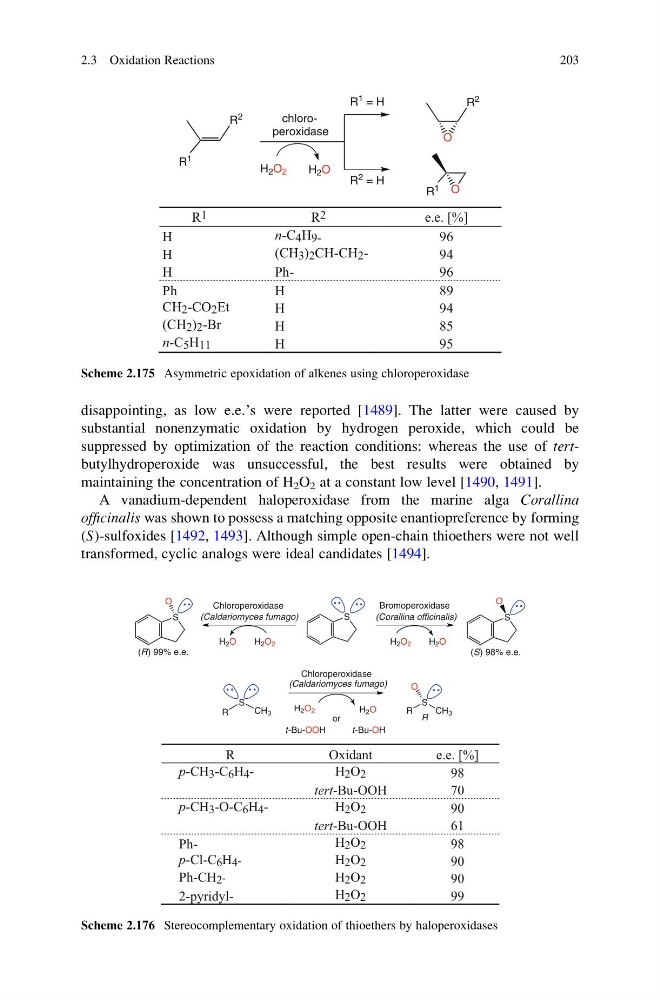
disappointing, as low e.e.’s were reported [1489]. The latter were caused by
substantial nonenzymatic oxidation by hydrogen peroxide, which could be
suppressed by optimization of the reaction conditions: whereas the use of tertbutylhydroperoxide was unsuccessful, the best results were obtained by
maintaining the concentration of H 2 O 2 at a constant low level [1490, 1491].
A vanadium-dependent haloperoxidase from the marine alga Corallina
officinalis was shown to possess a matching opposite enantiopreference by forming
(S)-sulfoxides [1492, 1493]. Although simple open-chain thioethers were not well
transformed, cyclic analogs were ideal candidates [1494].
O
R
1
O
R
2
R 1
R
2
chloroperoxidase
R 1 = H
R
2 = H
H 2 O
H 2 O 2
R 1
R 2
e.e. [%]
n-C 4 H 996
(CH 3 ) 2 CH-CH 2 -
94
Ph96
H
8 9
H
9 4
H
8 5
H
H
H
Ph
CH 2 -CO 2 Et
(CH 2 ) 2 -Br
n-C 5 H 11
H
9 5
Scheme 2.175 Asymmetric epoxidation of alkenes using chloroperoxidase
O
S
O
S
CH 3
R
S
S
CH 3
R
S
(S) 98% e.e.
(R) 99% e.e.
or
Chloroperoxidase
(Caldariomyces fumago)
Bromoperoxidase
(Corallina officinalis)
H 2 O 2
H 2 O
R
H 2 O
H 2 O 2
H 2 O
H 2 O 2
t-Bu-OH
t-Bu-OOH
Chloroperoxidase
(Caldariomyces fumago)
O
R
Oxidant
e.e. [%]
p-CH 3 -C 6 H 4 -
H 2 O 2
98
tert-Bu-OOH
70
p-CH 3 -O-C 6 H 4 -
H 2 O 2
90
tert-Bu-OOH
61
PhH 2 O 2
98
p-Cl-C 6 H 4 -
H 2 O 2
90
Ph-CH 2 -
H 2 O 2
90
2-pyridylH 2 O 2
99
Scheme 2.176 Stereocomplementary oxidation of thioethers by haloperoxidases
2.3 Oxidation Reactions
203
substantial nonenzymatic oxidation by hydrogen peroxide, which could be
suppressed by optimization of the reaction conditions: whereas the use of tertbutylhydroperoxide was unsuccessful, the best results were obtained by
maintaining the concentration of H 2 O 2 at a constant low level [1490, 1491].
A vanadium-dependent haloperoxidase from the marine alga Corallina
officinalis was shown to possess a matching opposite enantiopreference by forming
(S)-sulfoxides [1492, 1493]. Although simple open-chain thioethers were not well
transformed, cyclic analogs were ideal candidates [1494].
O
R
1
O
R
2
R 1
R
2
chloroperoxidase
R 1 = H
R
2 = H
H 2 O
H 2 O 2
R 1
R 2
e.e. [%]
n-C 4 H 996
(CH 3 ) 2 CH-CH 2 -
94
Ph96
H
8 9
H
9 4
H
8 5
H
H
H
Ph
CH 2 -CO 2 Et
(CH 2 ) 2 -Br
n-C 5 H 11
H
9 5
Scheme 2.175 Asymmetric epoxidation of alkenes using chloroperoxidase
O
S
O
S
CH 3
R
S
S
CH 3
R
S
(S) 98% e.e.
(R) 99% e.e.
or
Chloroperoxidase
(Caldariomyces fumago)
Bromoperoxidase
(Corallina officinalis)
H 2 O 2
H 2 O
R
H 2 O
H 2 O 2
H 2 O
H 2 O 2
t-Bu-OH
t-Bu-OOH
Chloroperoxidase
(Caldariomyces fumago)
O
R
Oxidant
e.e. [%]
p-CH 3 -C 6 H 4 -
H 2 O 2
98
tert-Bu-OOH
70
p-CH 3 -O-C 6 H 4 -
H 2 O 2
90
tert-Bu-OOH
61
PhH 2 O 2
98
p-Cl-C 6 H 4 -
H 2 O 2
90
Ph-CH 2 -
H 2 O 2
90
2-pyridylH 2 O 2
99
Scheme 2.176 Stereocomplementary oxidation of thioethers by haloperoxidases
2.3 Oxidation Reactions
203