

The substrate tolerance encompasses also nonaromatic C¼C bonds, provided
they are conjugated to aromatic systems (such as styrenes) or an additional alkene
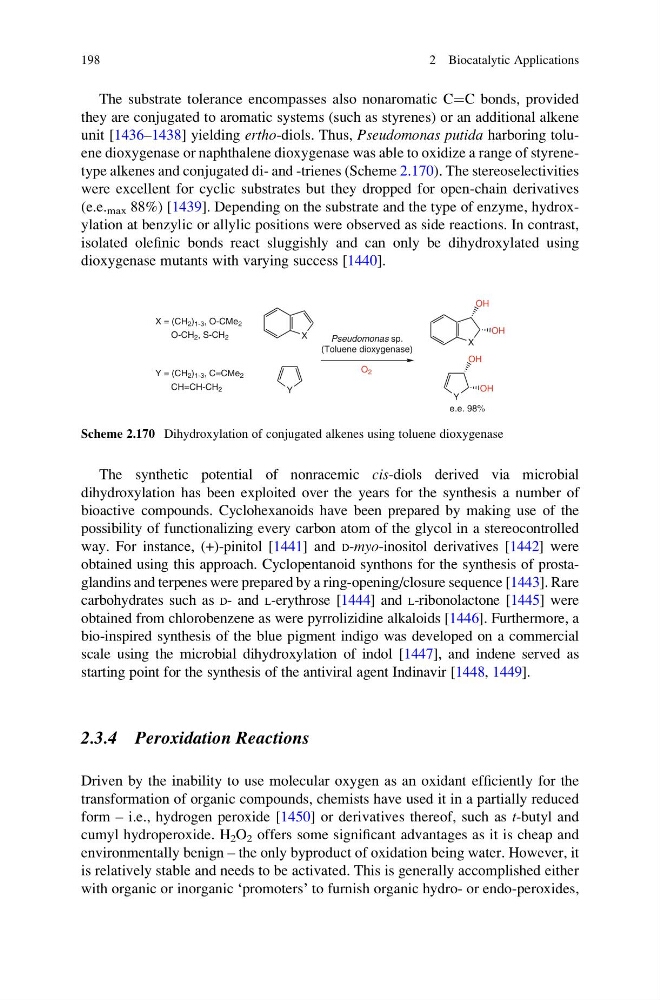
unit [1436–1438] yielding ertho-diols. Thus, Pseudomonas putida harboring toluene dioxygenase or naphthalene dioxygenase was able to oxidize a range of styrenetype alkenes and conjugated di- and -trienes (Scheme 2.170). The stereoselectivities
were excellent for cyclic substrates but they dropped for open-chain derivatives
(e.e. max 88%) [1439]. Depending on the substrate and the type of enzyme, hydroxylation at benzylic or allylic positions were observed as side reactions. In contrast,
isolated olefinic bonds react sluggishly and can only be dihydroxylated using
dioxygenase mutants with varying success [1440].
The synthetic potential of nonracemic cis-diols derived via microbial
dihydroxylation has been exploited over the years for the synthesis a number of
bioactive compounds. Cyclohexanoids have been prepared by making use of the
possibility of functionalizing every carbon atom of the glycol in a stereocontrolled
way. For instance, (+)-pinitol [1441] and D-myo-inositol derivatives [1442] were
obtained using this approach. Cyclopentanoid synthons for the synthesis of prostaglandins and terpenes were prepared by a ring-opening/closure sequence [1443]. Rare
carbohydrates such as D- and L-erythrose [1444] and L-ribonolactone [1445] were
obtained from chlorobenzene as were pyrrolizidine alkaloids [1446]. Furthermore, a
bio-inspired synthesis of the blue pigment indigo was developed on a commercial
scale using the microbial dihydroxylation of indol [1447], and indene served as
starting point for the synthesis of the antiviral agent Indinavir [1448, 1449].
2.3.4 Peroxidation Reactions
Driven by the inability to use molecular oxygen as an oxidant efficiently for the
transformation of organic compounds, chemists have used it in a partially reduced
form – i.e., hydrogen peroxide [1450] or derivatives thereof, such as t-butyl and
cumyl hydroperoxide. H 2 O 2 offers some significant advantages as it is cheap and
environmentally benign – the only byproduct of oxidation being water. However, it
is relatively stable and needs to be activated. This is generally accomplished either
with organic or inorganic ‘promoters’ to furnish organic hydro- or endo-peroxides,
X
OH
OH
X
Y
OH
OH
Y
(Toluene dioxygenase)
Pseudomonas sp.
X = (CH 2 ) 1-3 , O-CMe 2
O-CH 2 , S-CH 2
Y = (CH 2 ) 1-3 , C=CMe 2
e.e. 98%
O 2
CH=CH-CH 2
Scheme 2.170 Dihydroxylation of conjugated alkenes using toluene dioxygenase
198
2 Biocatalytic Applications
they are conjugated to aromatic systems (such as styrenes) or an additional alkene
unit [1436–1438] yielding ertho-diols. Thus, Pseudomonas putida harboring toluene dioxygenase or naphthalene dioxygenase was able to oxidize a range of styrenetype alkenes and conjugated di- and -trienes (Scheme 2.170). The stereoselectivities
were excellent for cyclic substrates but they dropped for open-chain derivatives
(e.e. max 88%) [1439]. Depending on the substrate and the type of enzyme, hydroxylation at benzylic or allylic positions were observed as side reactions. In contrast,
isolated olefinic bonds react sluggishly and can only be dihydroxylated using
dioxygenase mutants with varying success [1440].
The synthetic potential of nonracemic cis-diols derived via microbial
dihydroxylation has been exploited over the years for the synthesis a number of
bioactive compounds. Cyclohexanoids have been prepared by making use of the
possibility of functionalizing every carbon atom of the glycol in a stereocontrolled
way. For instance, (+)-pinitol [1441] and D-myo-inositol derivatives [1442] were
obtained using this approach. Cyclopentanoid synthons for the synthesis of prostaglandins and terpenes were prepared by a ring-opening/closure sequence [1443]. Rare
carbohydrates such as D- and L-erythrose [1444] and L-ribonolactone [1445] were
obtained from chlorobenzene as were pyrrolizidine alkaloids [1446]. Furthermore, a
bio-inspired synthesis of the blue pigment indigo was developed on a commercial
scale using the microbial dihydroxylation of indol [1447], and indene served as
starting point for the synthesis of the antiviral agent Indinavir [1448, 1449].
2.3.4 Peroxidation Reactions
Driven by the inability to use molecular oxygen as an oxidant efficiently for the
transformation of organic compounds, chemists have used it in a partially reduced
form – i.e., hydrogen peroxide [1450] or derivatives thereof, such as t-butyl and
cumyl hydroperoxide. H 2 O 2 offers some significant advantages as it is cheap and
environmentally benign – the only byproduct of oxidation being water. However, it
is relatively stable and needs to be activated. This is generally accomplished either
with organic or inorganic ‘promoters’ to furnish organic hydro- or endo-peroxides,
X
OH
OH
X
Y
OH
OH
Y
(Toluene dioxygenase)
Pseudomonas sp.
X = (CH 2 ) 1-3 , O-CMe 2
O-CH 2 , S-CH 2
Y = (CH 2 ) 1-3 , C=CMe 2
e.e. 98%
O 2
CH=CH-CH 2
Scheme 2.170 Dihydroxylation of conjugated alkenes using toluene dioxygenase
198
2 Biocatalytic Applications