

2.3.3.7 Dihydroxylation of Aromatic and Conjugated C¼C Bonds
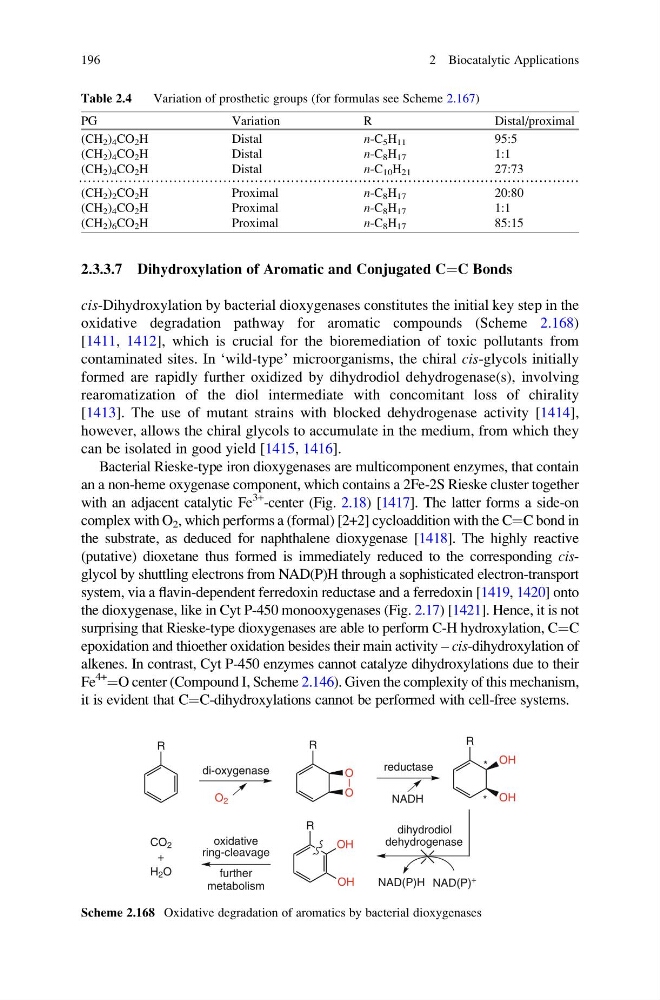
cis-Dihydroxylation by bacterial dioxygenases constitutes the initial key step in the
oxidative degradation pathway for aromatic compounds (Scheme 2.168)
[1411, 1412], which is crucial for the bioremediation of toxic pollutants from
contaminated sites. In ‘wild-type’ microorganisms, the chiral cis-glycols initially
formed are rapidly further oxidized by dihydrodiol dehydrogenase(s), involving
rearomatization of the diol intermediate with concomitant loss of chirality
[1413]. The use of mutant strains with blocked dehydrogenase activity [1414],
however, allows the chiral glycols to accumulate in the medium, from which they
can be isolated in good yield [1415, 1416].
Bacterial Rieske-type iron dioxygenases are multicomponent enzymes, that contain
an a non-heme oxygenase component, which contains a 2Fe-2S Rieske cluster together
with an adjacent catalytic Fe
3+
-center (Fig. 2.18) [1417]. The latter forms a side-on
complex with O 2 , which performs a (formal) [2+2] cycloaddition with the C¼C bond in
the substrate, as deduced for naphthalene dioxygenase [1418]. The highly reactive
(putative) dioxetane thus formed is immediately reduced to the corresponding cisglycol by shuttling electrons from NAD(P)H through a sophisticated electron-transport
system, via a flavin-dependent ferredoxin reductase and a ferredoxin [1419, 1420] onto
the dioxygenase, like in Cyt P-450 monooxygenases (Fig. 2.17) [1421]. Hence, it is not
surprising that Rieske-type dioxygenases are able to perform C-H hydroxylation, C¼C
epoxidation and thioether oxidation besides their main activity – cis-dihydroxylation of
alkenes. In contrast, Cyt P-450 enzymes cannot catalyze dihydroxylations due to their
Fe
4+
¼O center (Compound I, Scheme 2.146). Given the complexity of this mechanism,
it is evident that C¼C-dihydroxylations cannot be performed with cell-free systems.
. . . . . . . . . . . . . . . . . . . . . . . . . . . . . . . . . . . . . . . . . . . . . . . . . . . . . . . . . . . . . . . . . . . . . . . . . . . . . . . . . . . . . . . . . . . . . . . . . . . . . . . . . . . . . . .
. . . . . . . . . . . . . . . . . . . . . . . . . . . . . . . . . . . . . . . . . . . . . . . . . . . . . . . . . . . . . . . . . . . . . . . . . . . . .
. . . . . . . . . . . . . . . . . . . . . . . . . . . . . . . . . . . . . . . . . . . . . . . .
Table 2.4
Variation of prosthetic groups (for formulas see Scheme 2.167)
PG
Variation
R
Distal/proximal
(CH 2 ) 4 CO 2 H
Distal
n-C 5 H 11
95:5
(CH 2 ) 4 CO 2 H
Distal
n-C 8 H 17
1:1
(CH 2 ) 4 CO 2 H
Distal
n-C 10 H 21
27:73
(CH 2 ) 2 CO 2 H
Proximal
n-C 8 H 17
20:80
(CH 2 ) 4 CO 2 H
Proximal
n-C 8 H 17
1:1
(CH 2 ) 6 CO 2 H
Proximal
n-C 8 H 17
85:15
R
OH
OH
R
O
O
R
OH
OH
R
reductase
*
*
NAD(P)
+
NAD(P)H
dehydrogenase
dihydrodiol
ring-cleavage
oxidative
further
metabolism
di-oxygenase
O 2
NADH
CO 2
+
H 2 O
Scheme 2.168 Oxidative degradation of aromatics by bacterial dioxygenases
196
2 Biocatalytic Applications
cis-Dihydroxylation by bacterial dioxygenases constitutes the initial key step in the
oxidative degradation pathway for aromatic compounds (Scheme 2.168)
[1411, 1412], which is crucial for the bioremediation of toxic pollutants from
contaminated sites. In ‘wild-type’ microorganisms, the chiral cis-glycols initially
formed are rapidly further oxidized by dihydrodiol dehydrogenase(s), involving
rearomatization of the diol intermediate with concomitant loss of chirality
[1413]. The use of mutant strains with blocked dehydrogenase activity [1414],
however, allows the chiral glycols to accumulate in the medium, from which they
can be isolated in good yield [1415, 1416].
Bacterial Rieske-type iron dioxygenases are multicomponent enzymes, that contain
an a non-heme oxygenase component, which contains a 2Fe-2S Rieske cluster together
with an adjacent catalytic Fe
3+
-center (Fig. 2.18) [1417]. The latter forms a side-on
complex with O 2 , which performs a (formal) [2+2] cycloaddition with the C¼C bond in
the substrate, as deduced for naphthalene dioxygenase [1418]. The highly reactive
(putative) dioxetane thus formed is immediately reduced to the corresponding cisglycol by shuttling electrons from NAD(P)H through a sophisticated electron-transport
system, via a flavin-dependent ferredoxin reductase and a ferredoxin [1419, 1420] onto
the dioxygenase, like in Cyt P-450 monooxygenases (Fig. 2.17) [1421]. Hence, it is not
surprising that Rieske-type dioxygenases are able to perform C-H hydroxylation, C¼C
epoxidation and thioether oxidation besides their main activity – cis-dihydroxylation of
alkenes. In contrast, Cyt P-450 enzymes cannot catalyze dihydroxylations due to their
Fe
4+
¼O center (Compound I, Scheme 2.146). Given the complexity of this mechanism,
it is evident that C¼C-dihydroxylations cannot be performed with cell-free systems.
. . . . . . . . . . . . . . . . . . . . . . . . . . . . . . . . . . . . . . . . . . . . . . . . . . . . . . . . . . . . . . . . . . . . . . . . . . . . . . . . . . . . . . . . . . . . . . . . . . . . . . . . . . . . . . .
. . . . . . . . . . . . . . . . . . . . . . . . . . . . . . . . . . . . . . . . . . . . . . . . . . . . . . . . . . . . . . . . . . . . . . . . . . . . .
. . . . . . . . . . . . . . . . . . . . . . . . . . . . . . . . . . . . . . . . . . . . . . . .
Table 2.4
Variation of prosthetic groups (for formulas see Scheme 2.167)
PG
Variation
R
Distal/proximal
(CH 2 ) 4 CO 2 H
Distal
n-C 5 H 11
95:5
(CH 2 ) 4 CO 2 H
Distal
n-C 8 H 17
1:1
(CH 2 ) 4 CO 2 H
Distal
n-C 10 H 21
27:73
(CH 2 ) 2 CO 2 H
Proximal
n-C 8 H 17
20:80
(CH 2 ) 4 CO 2 H
Proximal
n-C 8 H 17
1:1
(CH 2 ) 6 CO 2 H
Proximal
n-C 8 H 17
85:15
R
OH
OH
R
O
O
R
OH
OH
R
reductase
*
*
NAD(P)
+
NAD(P)H
dehydrogenase
dihydrodiol
ring-cleavage
oxidative
further
metabolism
di-oxygenase
O 2
NADH
CO 2
+
H 2 O
Scheme 2.168 Oxidative degradation of aromatics by bacterial dioxygenases
196
2 Biocatalytic Applications