

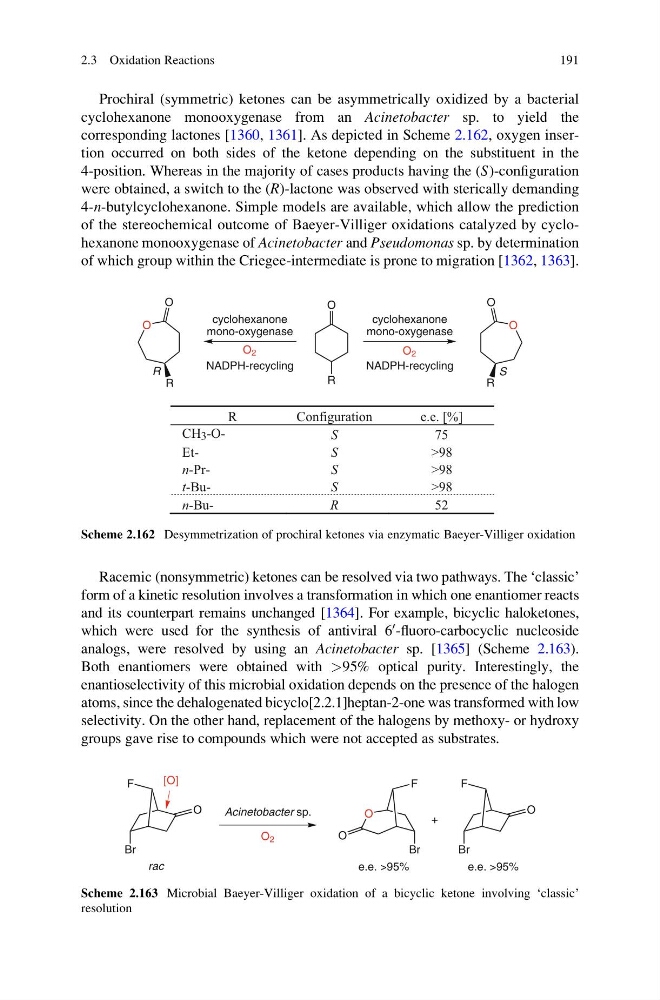
Prochiral (symmetric) ketones can be asymmetrically oxidized by a bacterial
cyclohexanone monooxygenase from an Acinetobacter sp. to yield the
corresponding lactones [1360, 1361]. As depicted in Scheme 2.162, oxygen insertion occurred on both sides of the ketone depending on the substituent in the
4-position. Whereas in the majority of cases products having the (S)-configuration
were obtained, a switch to the (R)-lactone was observed with sterically demanding
4-n-butylcyclohexanone. Simple models are available, which allow the prediction
of the stereochemical outcome of Baeyer-Villiger oxidations catalyzed by cyclohexanone monooxygenase of Acinetobacter and Pseudomonas sp. by determination
of which group within the Criegee-intermediate is prone to migration [1362, 1363].
Racemic (nonsymmetric) ketones can be resolved via two pathways. The ‘classic’
form of a kinetic resolution involves a transformation in which one enantiomer reacts
and its counterpart remains unchanged [1364]. For example, bicyclic haloketones,
which were used for the synthesis of antiviral 6
0 -fluoro-carbocyclic nucleoside
analogs, were resolved by using an Acinetobacter sp. [1365] (Scheme 2.163).
Both enantiomers were obtained with >95% optical purity. Interestingly, the
enantioselectivity of this microbial oxidation depends on the presence of the halogen
atoms, since the dehalogenated bicyclo[2.2.1]heptan-2-one was transformed with low
selectivity. On the other hand, replacement of the halogens by methoxy- or hydroxy
groups gave rise to compounds which were not accepted as substrates.
R
O
O
R
O
O
R
O
NADPH-recycling
mono-oxygenase
cyclohexanone
NADPH-recycling
mono-oxygenase
cyclohexanone
O 2
S
R
O 2
R
Configuration
e.e. [%]
CH 3 -OS
75
EtS
>98
n-PrS
>98
t-BuS
>98
n-BuR
52
Scheme 2.162 Desymmetrization of prochiral ketones via enzymatic Baeyer-Villiger oxidation
O
O
F
Br
O
F
Br
O
F
Br
rac
e.e. >95%
e.e. >95%
+
Acinetobacter sp.
O 2
[O]
Scheme 2.163 Microbial Baeyer-Villiger oxidation of a bicyclic ketone involving ‘classic’
resolution
2.3 Oxidation Reactions
191
cyclohexanone monooxygenase from an Acinetobacter sp. to yield the
corresponding lactones [1360, 1361]. As depicted in Scheme 2.162, oxygen insertion occurred on both sides of the ketone depending on the substituent in the
4-position. Whereas in the majority of cases products having the (S)-configuration
were obtained, a switch to the (R)-lactone was observed with sterically demanding
4-n-butylcyclohexanone. Simple models are available, which allow the prediction
of the stereochemical outcome of Baeyer-Villiger oxidations catalyzed by cyclohexanone monooxygenase of Acinetobacter and Pseudomonas sp. by determination
of which group within the Criegee-intermediate is prone to migration [1362, 1363].
Racemic (nonsymmetric) ketones can be resolved via two pathways. The ‘classic’
form of a kinetic resolution involves a transformation in which one enantiomer reacts
and its counterpart remains unchanged [1364]. For example, bicyclic haloketones,
which were used for the synthesis of antiviral 6
0 -fluoro-carbocyclic nucleoside
analogs, were resolved by using an Acinetobacter sp. [1365] (Scheme 2.163).
Both enantiomers were obtained with >95% optical purity. Interestingly, the
enantioselectivity of this microbial oxidation depends on the presence of the halogen
atoms, since the dehalogenated bicyclo[2.2.1]heptan-2-one was transformed with low
selectivity. On the other hand, replacement of the halogens by methoxy- or hydroxy
groups gave rise to compounds which were not accepted as substrates.
R
O
O
R
O
O
R
O
NADPH-recycling
mono-oxygenase
cyclohexanone
NADPH-recycling
mono-oxygenase
cyclohexanone
O 2
S
R
O 2
R
Configuration
e.e. [%]
CH 3 -OS
75
EtS
>98
n-PrS
>98
t-BuS
>98
n-BuR
52
Scheme 2.162 Desymmetrization of prochiral ketones via enzymatic Baeyer-Villiger oxidation
O
O
F
Br
O
F
Br
O
F
Br
rac
e.e. >95%
e.e. >95%
+
Acinetobacter sp.
O 2
[O]
Scheme 2.163 Microbial Baeyer-Villiger oxidation of a bicyclic ketone involving ‘classic’
resolution
2.3 Oxidation Reactions
191