

• Only few reports are available regarding α,β-unsaturated lactones, their degree
of activation parallels that of esters.
• α,β-Unsaturated nitriles may be used as substrates [1124].
• Sometimes the absolute (R/S)-configuration of the product can be controlled by
starting with (E)- or (Z)-alkenes (Scheme 2.136) [1125].
• Steric hindrance at Cβ (where the hydride has to be delivered) seems to play an
important role for OYEs. Consequently, sterically demanding substituents at the
C¼C-bond are more easily tolerated in the α-position.
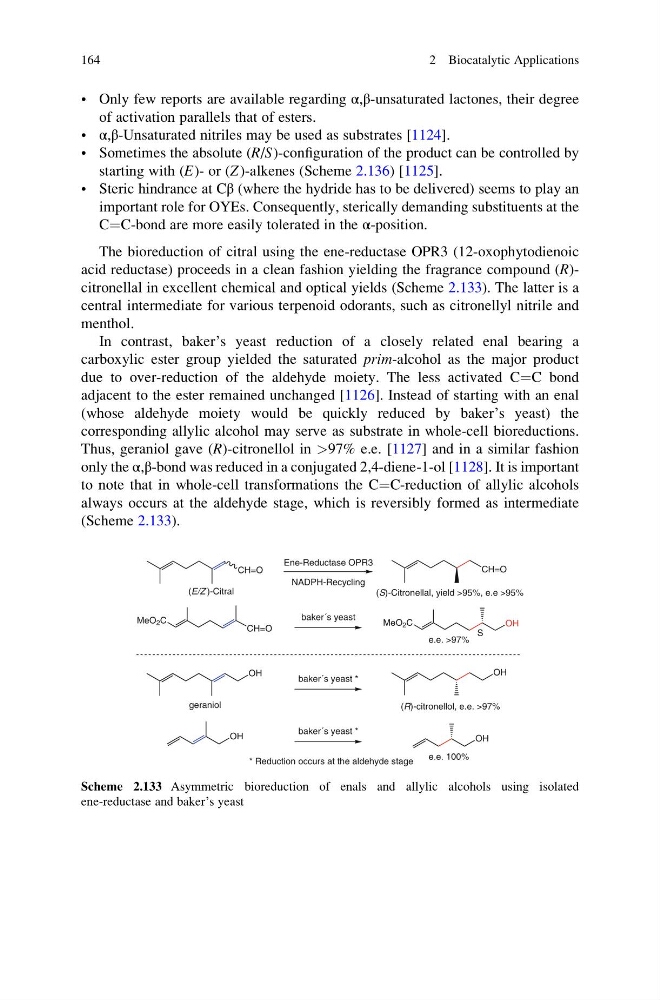
The bioreduction of citral using the ene-reductase OPR3 (12-oxophytodienoic
acid reductase) proceeds in a clean fashion yielding the fragrance compound (R)citronellal in excellent chemical and optical yields (Scheme 2.133). The latter is a
central intermediate for various terpenoid odorants, such as citronellyl nitrile and
menthol.
In contrast, baker’s yeast reduction of a closely related enal bearing a
carboxylic ester group yielded the saturated prim-alcohol as the major product
due to over-reduction of the aldehyde moiety. The less activated C¼C bond
adjacent to the ester remained unchanged [1126]. Instead of starting with an enal
(whose aldehyde moiety would be quickly reduced by baker’s yeast) the
corresponding allylic alcohol may serve as substrate in whole-cell bioreductions.
Thus, geraniol gave (R)-citronellol in >97% e.e. [1127] and in a similar fashion
only the α,β-bond was reduced in a conjugated 2,4-diene-1-ol [1128]. It is important
to note that in whole-cell transformations the C¼C-reduction of allylic alcohols
always occurs at the aldehyde stage, which is reversibly formed as intermediate
(Scheme 2.133).
OH
MeO 2 C
CH=O
CH=O
CH=O
MeO 2 C
OH
OH
OH
OH
* Reduction occurs at the aldehyde stage
(E/Z )-Citral
(S)-Citronellal, yield >95%, e.e >95%
NADPH-Recycling
Ene-Reductase OPR3
baker´s yeast
baker´s yeast *
baker´s yeast *
e.e. >97%
geraniol
(R)-citronellol, e.e. >97%
e.e. 100%
S
Scheme 2.133 Asymmetric bioreduction of enals and allylic alcohols using isolated
ene-reductase and baker’s yeast
164
2 Biocatalytic Applications
of activation parallels that of esters.
• α,β-Unsaturated nitriles may be used as substrates [1124].
• Sometimes the absolute (R/S)-configuration of the product can be controlled by
starting with (E)- or (Z)-alkenes (Scheme 2.136) [1125].
• Steric hindrance at Cβ (where the hydride has to be delivered) seems to play an
important role for OYEs. Consequently, sterically demanding substituents at the
C¼C-bond are more easily tolerated in the α-position.
The bioreduction of citral using the ene-reductase OPR3 (12-oxophytodienoic
acid reductase) proceeds in a clean fashion yielding the fragrance compound (R)citronellal in excellent chemical and optical yields (Scheme 2.133). The latter is a
central intermediate for various terpenoid odorants, such as citronellyl nitrile and
menthol.
In contrast, baker’s yeast reduction of a closely related enal bearing a
carboxylic ester group yielded the saturated prim-alcohol as the major product
due to over-reduction of the aldehyde moiety. The less activated C¼C bond
adjacent to the ester remained unchanged [1126]. Instead of starting with an enal
(whose aldehyde moiety would be quickly reduced by baker’s yeast) the
corresponding allylic alcohol may serve as substrate in whole-cell bioreductions.
Thus, geraniol gave (R)-citronellol in >97% e.e. [1127] and in a similar fashion
only the α,β-bond was reduced in a conjugated 2,4-diene-1-ol [1128]. It is important
to note that in whole-cell transformations the C¼C-reduction of allylic alcohols
always occurs at the aldehyde stage, which is reversibly formed as intermediate
(Scheme 2.133).
OH
MeO 2 C
CH=O
CH=O
CH=O
MeO 2 C
OH
OH
OH
OH
* Reduction occurs at the aldehyde stage
(E/Z )-Citral
(S)-Citronellal, yield >95%, e.e >95%
NADPH-Recycling
Ene-Reductase OPR3
baker´s yeast
baker´s yeast *
baker´s yeast *
e.e. >97%
geraniol
(R)-citronellol, e.e. >97%
e.e. 100%
S
Scheme 2.133 Asymmetric bioreduction of enals and allylic alcohols using isolated
ene-reductase and baker’s yeast
164
2 Biocatalytic Applications