

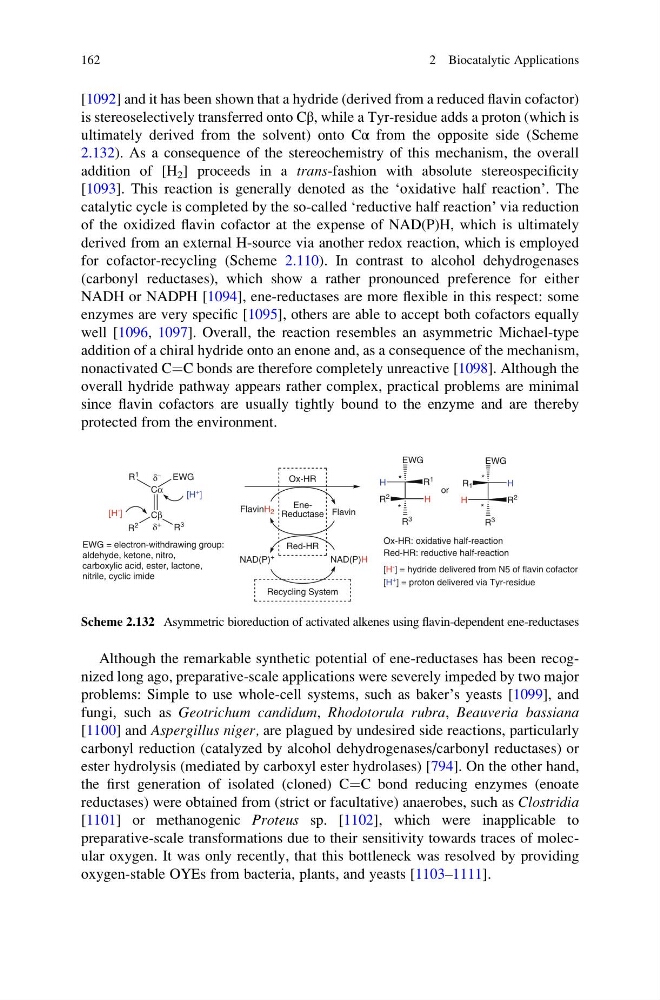
[1092] and it has been shown that a hydride (derived from a reduced flavin cofactor)
is stereoselectively transferred onto Cβ, while a Tyr-residue adds a proton (which is
ultimately derived from the solvent) onto Cα from the opposite side (Scheme
2.132). As a consequence of the stereochemistry of this mechanism, the overall
addition of [H 2 ] proceeds in a trans-fashion with absolute stereospecificity
[1093]. This reaction is generally denoted as the ‘oxidative half reaction’. The
catalytic cycle is completed by the so-called ‘reductive half reaction’ via reduction
of the oxidized flavin cofactor at the expense of NAD(P)H, which is ultimately
derived from an external H-source via another redox reaction, which is employed
for cofactor-recycling (Scheme 2.110). In contrast to alcohol dehydrogenases
(carbonyl reductases), which show a rather pronounced preference for either
NADH or NADPH [1094], ene-reductases are more flexible in this respect: some
enzymes are very specific [1095], others are able to accept both cofactors equally
well [1096, 1097]. Overall, the reaction resembles an asymmetric Michael-type
addition of a chiral hydride onto an enone and, as a consequence of the mechanism,
nonactivated C¼C bonds are therefore completely unreactive [1098]. Although the
overall hydride pathway appears rather complex, practical problems are minimal
since flavin cofactors are usually tightly bound to the enzyme and are thereby
protected from the environment.
Although the remarkable synthetic potential of ene-reductases has been recognized long ago, preparative-scale applications were severely impeded by two major
problems: Simple to use whole-cell systems, such as baker’s yeasts [1099], and
fungi, such as Geotrichum candidum, Rhodotorula rubra, Beauveria bassiana
[1100] and Aspergillus niger, are plagued by undesired side reactions, particularly
carbonyl reduction (catalyzed by alcohol dehydrogenases/carbonyl reductases) or
ester hydrolysis (mediated by carboxyl ester hydrolases) [794]. On the other hand,
the first generation of isolated (cloned) C¼C bond reducing enzymes (enoate
reductases) were obtained from (strict or facultative) anaerobes, such as Clostridia
[1101] or methanogenic Proteus sp. [1102], which were inapplicable to
preparative-scale transformations due to their sensitivity towards traces of molecular oxygen. It was only recently, that this bottleneck was resolved by providing
oxygen-stable OYEs from bacteria, plants, and yeasts [1103–1111].
H
H
EWG
R
1
R
2
R 3
R 2
R 1
EWG
H
H
R
3
R
3
R
2
R
1
EWG
Cβ
Cα
[H
-
] = hydride delivered from N5 of flavin cofactor
[H
+ ] = proton delivered via Tyr-residue
*
*
*
*
NAD(P)H
NAD(P) +
Recycling System
or
EneFlavinH 2
Flavin
Reductase
EWG = electron-withdrawing group:
aldehyde, ketone, nitro,
carboxylic acid, ester, lactone,
nitrile, cyclic imide
Ox-HR
Red-HR
Ox-HR: oxidative half-reaction
Red-HR: reductive half-reaction
δ
+
δ
−
[H - ]
[H + ]
Scheme 2.132 Asymmetric bioreduction of activated alkenes using flavin-dependent ene-reductases
162
2 Biocatalytic Applications
is stereoselectively transferred onto Cβ, while a Tyr-residue adds a proton (which is
ultimately derived from the solvent) onto Cα from the opposite side (Scheme
2.132). As a consequence of the stereochemistry of this mechanism, the overall
addition of [H 2 ] proceeds in a trans-fashion with absolute stereospecificity
[1093]. This reaction is generally denoted as the ‘oxidative half reaction’. The
catalytic cycle is completed by the so-called ‘reductive half reaction’ via reduction
of the oxidized flavin cofactor at the expense of NAD(P)H, which is ultimately
derived from an external H-source via another redox reaction, which is employed
for cofactor-recycling (Scheme 2.110). In contrast to alcohol dehydrogenases
(carbonyl reductases), which show a rather pronounced preference for either
NADH or NADPH [1094], ene-reductases are more flexible in this respect: some
enzymes are very specific [1095], others are able to accept both cofactors equally
well [1096, 1097]. Overall, the reaction resembles an asymmetric Michael-type
addition of a chiral hydride onto an enone and, as a consequence of the mechanism,
nonactivated C¼C bonds are therefore completely unreactive [1098]. Although the
overall hydride pathway appears rather complex, practical problems are minimal
since flavin cofactors are usually tightly bound to the enzyme and are thereby
protected from the environment.
Although the remarkable synthetic potential of ene-reductases has been recognized long ago, preparative-scale applications were severely impeded by two major
problems: Simple to use whole-cell systems, such as baker’s yeasts [1099], and
fungi, such as Geotrichum candidum, Rhodotorula rubra, Beauveria bassiana
[1100] and Aspergillus niger, are plagued by undesired side reactions, particularly
carbonyl reduction (catalyzed by alcohol dehydrogenases/carbonyl reductases) or
ester hydrolysis (mediated by carboxyl ester hydrolases) [794]. On the other hand,
the first generation of isolated (cloned) C¼C bond reducing enzymes (enoate
reductases) were obtained from (strict or facultative) anaerobes, such as Clostridia
[1101] or methanogenic Proteus sp. [1102], which were inapplicable to
preparative-scale transformations due to their sensitivity towards traces of molecular oxygen. It was only recently, that this bottleneck was resolved by providing
oxygen-stable OYEs from bacteria, plants, and yeasts [1103–1111].
H
H
EWG
R
1
R
2
R 3
R 2
R 1
EWG
H
H
R
3
R
3
R
2
R
1
EWG
Cβ
Cα
[H
-
] = hydride delivered from N5 of flavin cofactor
[H
+ ] = proton delivered via Tyr-residue
*
*
*
*
NAD(P)H
NAD(P) +
Recycling System
or
EneFlavinH 2
Flavin
Reductase
EWG = electron-withdrawing group:
aldehyde, ketone, nitro,
carboxylic acid, ester, lactone,
nitrile, cyclic imide
Ox-HR
Red-HR
Ox-HR: oxidative half-reaction
Red-HR: reductive half-reaction
δ
+
δ
−
[H - ]
[H + ]
Scheme 2.132 Asymmetric bioreduction of activated alkenes using flavin-dependent ene-reductases
162
2 Biocatalytic Applications