

byproduct. For organic chemists, however, this method is of limited use because
hydrogenase is usually isolated from strict anaerobic organisms. Thus, the enzyme
is sensitive to oxidation, is not commercially available and requires sophisticated
fermentation procedures for its production.
27 Furthermore, some of the organic
dyes, which serve as mediators for the transport of redox equivalents from the donor
onto the cofactor are relatively toxic.
Recycling of Oxidized Nicotinamide Cofactors
For oxidation, reduction reactions can be run in reverse, although the equilibrium is
strongly disfavoured. The best and most widely applied method for the regeneration
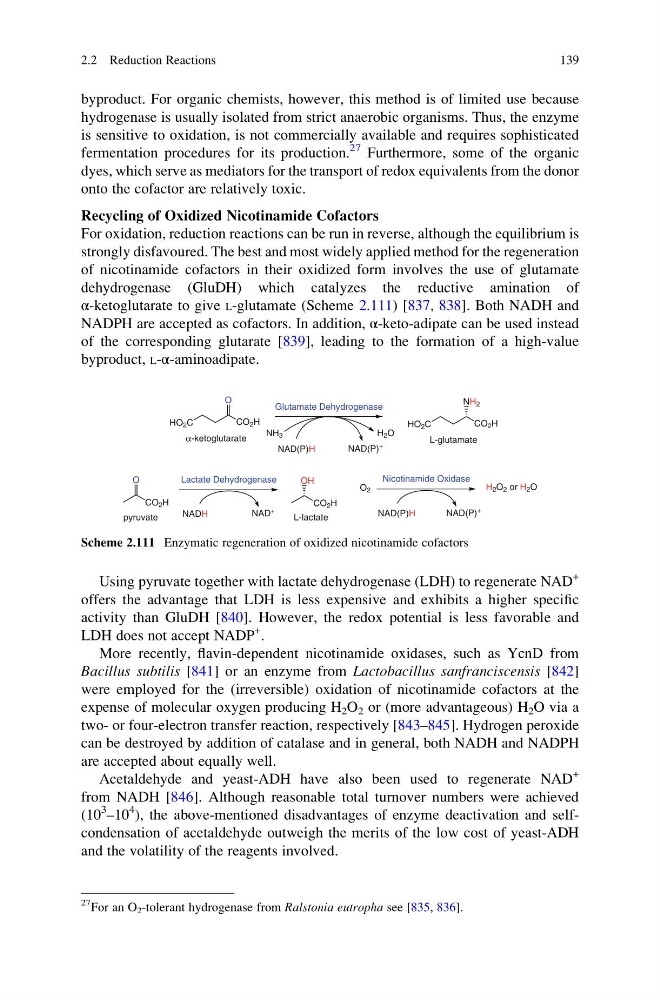
of nicotinamide cofactors in their oxidized form involves the use of glutamate
dehydrogenase (GluDH) which catalyzes the reductive amination of
α-ketoglutarate to give L-glutamate (Scheme 2.111) [837, 838]. Both NADH and
NADPH are accepted as cofactors. In addition, α-keto-adipate can be used instead
of the corresponding glutarate [839], leading to the formation of a high-value
byproduct, L-α-aminoadipate.
Using pyruvate together with lactate dehydrogenase (LDH) to regenerate NAD
+
offers the advantage that LDH is less expensive and exhibits a higher specific
activity than GluDH [840]. However, the redox potential is less favorable and
LDH does not accept NADP
+ .
More recently, flavin-dependent nicotinamide oxidases, such as YcnD from
Bacillus subtilis [841] or an enzyme from Lactobacillus sanfranciscensis [842]
were employed for the (irreversible) oxidation of nicotinamide cofactors at the
expense of molecular oxygen producing H 2 O 2 or (more advantageous) H 2 O via a
two- or four-electron transfer reaction, respectively [843–845]. Hydrogen peroxide
can be destroyed by addition of catalase and in general, both NADH and NADPH
are accepted about equally well.
Acetaldehyde and yeast-ADH have also been used to regenerate NAD
+
from NADH [846]. Although reasonable total turnover numbers were achieved
(10
3 –10
4 ), the above-mentioned disadvantages of enzyme deactivation and selfcondensation of acetaldehyde outweigh the merits of the low cost of yeast-ADH
and the volatility of the reagents involved.
O
CO 2 H
HO 2 C
NH 2
CO 2 H
HO 2 C
O
CO 2 H
OH
CO 2 H
H 2 O 2 or H 2 O
Nicotinamide Oxidase
NAD(P)H
NAD(P)
+
Lactate Dehydrogenase
α-ketoglutarate
L-glutamate
pyruvate
L-lactate
NAD(P)H
NAD(P)
+
Glutamate Dehydrogenase
O 2
NH 3
H 2 O
NADH
NAD +
Scheme 2.111 Enzymatic regeneration of oxidized nicotinamide cofactors
27 For an O 2 -tolerant hydrogenase from Ralstonia eutropha see [835, 836].
2.2 Reduction Reactions
139
hydrogenase is usually isolated from strict anaerobic organisms. Thus, the enzyme
is sensitive to oxidation, is not commercially available and requires sophisticated
fermentation procedures for its production.
27 Furthermore, some of the organic
dyes, which serve as mediators for the transport of redox equivalents from the donor
onto the cofactor are relatively toxic.
Recycling of Oxidized Nicotinamide Cofactors
For oxidation, reduction reactions can be run in reverse, although the equilibrium is
strongly disfavoured. The best and most widely applied method for the regeneration
of nicotinamide cofactors in their oxidized form involves the use of glutamate
dehydrogenase (GluDH) which catalyzes the reductive amination of
α-ketoglutarate to give L-glutamate (Scheme 2.111) [837, 838]. Both NADH and
NADPH are accepted as cofactors. In addition, α-keto-adipate can be used instead
of the corresponding glutarate [839], leading to the formation of a high-value
byproduct, L-α-aminoadipate.
Using pyruvate together with lactate dehydrogenase (LDH) to regenerate NAD
+
offers the advantage that LDH is less expensive and exhibits a higher specific
activity than GluDH [840]. However, the redox potential is less favorable and
LDH does not accept NADP
+ .
More recently, flavin-dependent nicotinamide oxidases, such as YcnD from
Bacillus subtilis [841] or an enzyme from Lactobacillus sanfranciscensis [842]
were employed for the (irreversible) oxidation of nicotinamide cofactors at the
expense of molecular oxygen producing H 2 O 2 or (more advantageous) H 2 O via a
two- or four-electron transfer reaction, respectively [843–845]. Hydrogen peroxide
can be destroyed by addition of catalase and in general, both NADH and NADPH
are accepted about equally well.
Acetaldehyde and yeast-ADH have also been used to regenerate NAD
+
from NADH [846]. Although reasonable total turnover numbers were achieved
(10
3 –10
4 ), the above-mentioned disadvantages of enzyme deactivation and selfcondensation of acetaldehyde outweigh the merits of the low cost of yeast-ADH
and the volatility of the reagents involved.
O
CO 2 H
HO 2 C
NH 2
CO 2 H
HO 2 C
O
CO 2 H
OH
CO 2 H
H 2 O 2 or H 2 O
Nicotinamide Oxidase
NAD(P)H
NAD(P)
+
Lactate Dehydrogenase
α-ketoglutarate
L-glutamate
pyruvate
L-lactate
NAD(P)H
NAD(P)
+
Glutamate Dehydrogenase
O 2
NH 3
H 2 O
NADH
NAD +
Scheme 2.111 Enzymatic regeneration of oxidized nicotinamide cofactors
27 For an O 2 -tolerant hydrogenase from Ralstonia eutropha see [835, 836].
2.2 Reduction Reactions
139