

is much wider than previously believed and that numerous biocatalysts are
capable of accepting nonnatural substrates of an unrelated structural type by
often exhibiting the same high specificities as for the natural counterparts. It
seems to be a general trend, that, the more complex the enzyme’s mechanism,
the narrower the limit for the acceptability of ‘foreign’ substrates. After all, there
are many enzymes whose natural substrates – if there are any – are unknown.
• ‘Enzymes work only in their natural environment’.
It is generally true that an enzyme displays its highest catalytic power in
water, which in turn represents something of a nightmare for the organic chemist
if it is the solvent of choice. However, biocatalysts can function in nonaqueous
media, such as organic solvents, ionic liquids, and supercritical fluids, as long as
certain guidelines are followed. Although the catalytic activity is usually lower
in nonaqueous environments, many other advantages can be accrued by enabling
reactions which are impossible in water (Sect. 3.1) [13–17].
1.3 Advantages and Disadvantages of Biocatalysts
1.3.1 Advantages of Biocatalysts
• Enzymes are very efficient catalysts.
Typically the rates of enzyme-mediated processes are 10
8 –10
10 times faster
than those of the corresponding noncatalyzed reactions,
5 and are thus far above
the values that chemical catalysts are capable of achieving [18–21]. As a
consequence, chemical catalysts are generally employed at 0.1–1 mol% of
catalyst loading, whereas most enzymatic reactions can be performed with a
mole percentage of 0.01–0.001, which clearly makes them more effective by
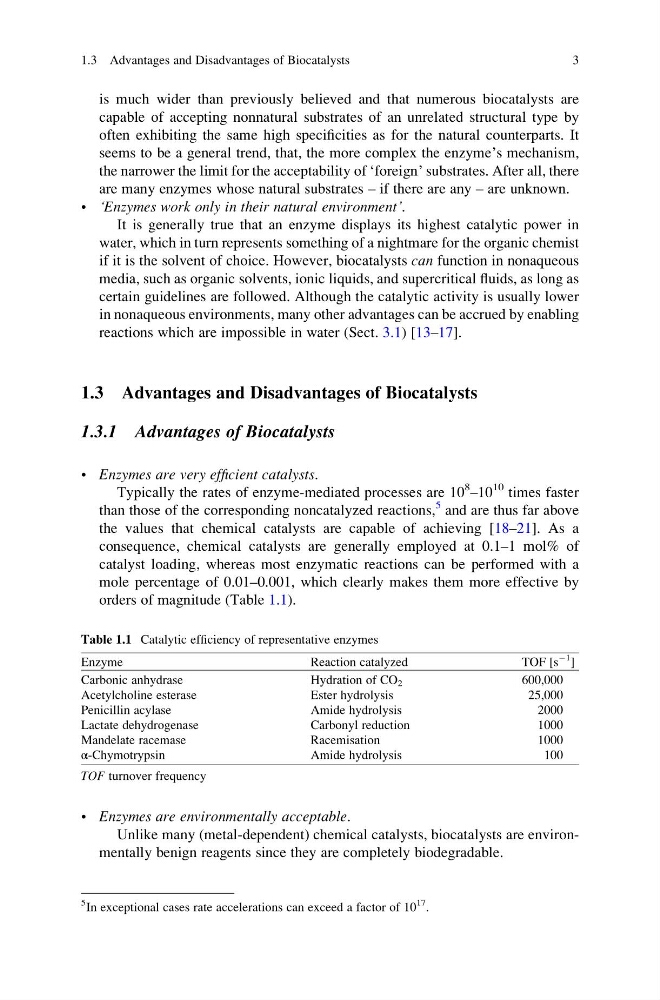
orders of magnitude (Table 1.1).
• Enzymes are environmentally acceptable.
Unlike many (metal-dependent) chemical catalysts, biocatalysts are environmentally benign reagents since they are completely biodegradable.
Table 1.1 Catalytic efficiency of representative enzymes
Enzyme
Reaction catalyzed
TOF [s
À1
]
Carbonic anhydrase
Hydration of CO 2
600,000
Acetylcholine esterase
Ester hydrolysis
25,000
Penicillin acylase
Amide hydrolysis
2000
Lactate dehydrogenase
Carbonyl reduction
1000
Mandelate racemase
Racemisation
1000
α-Chymotrypsin
Amide hydrolysis
100
TOF turnover frequency
5 In exceptional cases rate accelerations can exceed a factor of 10
17
.
1.3 Advantages and Disadvantages of Biocatalysts
3
capable of accepting nonnatural substrates of an unrelated structural type by
often exhibiting the same high specificities as for the natural counterparts. It
seems to be a general trend, that, the more complex the enzyme’s mechanism,
the narrower the limit for the acceptability of ‘foreign’ substrates. After all, there
are many enzymes whose natural substrates – if there are any – are unknown.
• ‘Enzymes work only in their natural environment’.
It is generally true that an enzyme displays its highest catalytic power in
water, which in turn represents something of a nightmare for the organic chemist
if it is the solvent of choice. However, biocatalysts can function in nonaqueous
media, such as organic solvents, ionic liquids, and supercritical fluids, as long as
certain guidelines are followed. Although the catalytic activity is usually lower
in nonaqueous environments, many other advantages can be accrued by enabling
reactions which are impossible in water (Sect. 3.1) [13–17].
1.3 Advantages and Disadvantages of Biocatalysts
1.3.1 Advantages of Biocatalysts
• Enzymes are very efficient catalysts.
Typically the rates of enzyme-mediated processes are 10
8 –10
10 times faster
than those of the corresponding noncatalyzed reactions,
5 and are thus far above
the values that chemical catalysts are capable of achieving [18–21]. As a
consequence, chemical catalysts are generally employed at 0.1–1 mol% of
catalyst loading, whereas most enzymatic reactions can be performed with a
mole percentage of 0.01–0.001, which clearly makes them more effective by
orders of magnitude (Table 1.1).
• Enzymes are environmentally acceptable.
Unlike many (metal-dependent) chemical catalysts, biocatalysts are environmentally benign reagents since they are completely biodegradable.
Table 1.1 Catalytic efficiency of representative enzymes
Enzyme
Reaction catalyzed
TOF [s
À1
]
Carbonic anhydrase
Hydration of CO 2
600,000
Acetylcholine esterase
Ester hydrolysis
25,000
Penicillin acylase
Amide hydrolysis
2000
Lactate dehydrogenase
Carbonyl reduction
1000
Mandelate racemase
Racemisation
1000
α-Chymotrypsin
Amide hydrolysis
100
TOF turnover frequency
5 In exceptional cases rate accelerations can exceed a factor of 10
17
.
1.3 Advantages and Disadvantages of Biocatalysts
3