

Two further ATP-recycling systems use carbamoyl phosphate (NH 2 -CO-O-P)
and methoxycarbonyl phosphate (MeO-CO-O-P) as nonnatural phosphate donors
together with carbamate kinase and acetate kinase, respectively [574, 575]. Both
systems lead to the formation of carbamic acid and methyl carbonate as unstable
by-products, which readily decompose forming NH 3 + CO 2 or MeOH + CO 2 ,
thereby driving the equilibrium towards completion. Unfortunately, both phosphate
donors undergo spontaneous hydrolysis in aqueous media, which severely limits
their applicability, hence these systems have not been widely employed.
A number of reactions which consume ATP generate AMP rather than ADP as a
product, only few produce adenosine [576]. ATP may be recycled from AMP using
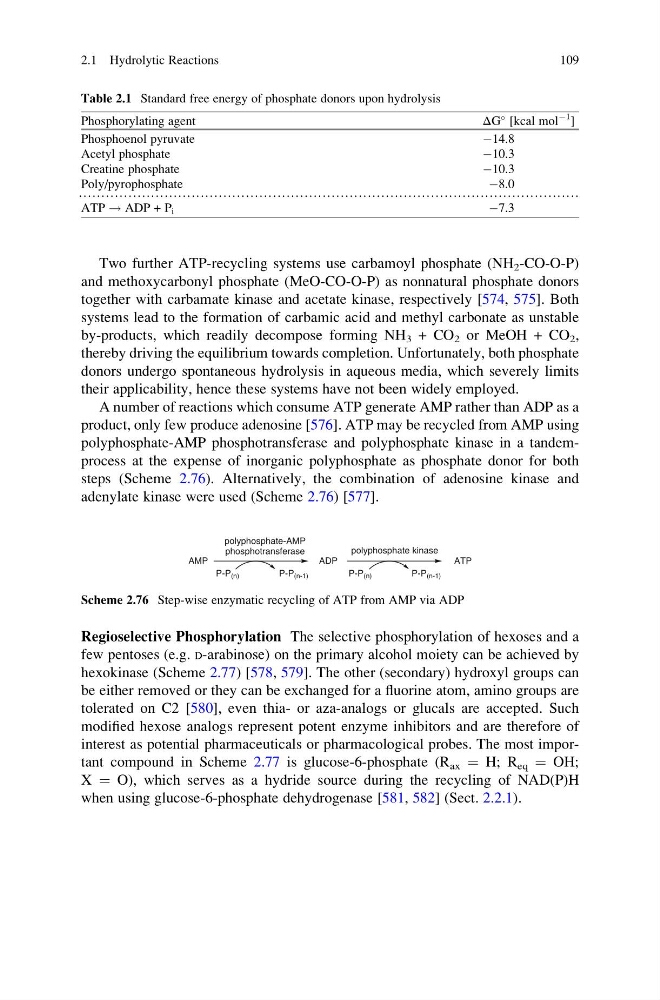
polyphosphate-AMP phosphotransferase and polyphosphate kinase in a tandemprocess at the expense of inorganic polyphosphate as phosphate donor for both
steps (Scheme 2.76). Alternatively, the combination of adenosine kinase and
adenylate kinase were used (Scheme 2.76) [577].
Regioselective Phosphorylation The selective phosphorylation of hexoses and a
few pentoses (e.g. D-arabinose) on the primary alcohol moiety can be achieved by
hexokinase (Scheme 2.77) [578, 579]. The other (secondary) hydroxyl groups can
be either removed or they can be exchanged for a fluorine atom, amino groups are
tolerated on C2 [580], even thia- or aza-analogs or glucals are accepted. Such
modified hexose analogs represent potent enzyme inhibitors and are therefore of
interest as potential pharmaceuticals or pharmacological probes. The most important compound in Scheme 2.77 is glucose-6-phosphate (R ax ¼ H; R eq ¼ OH;
X ¼ O), which serves as a hydride source during the recycling of NAD(P)H
when using glucose-6-phosphate dehydrogenase [581, 582] (Sect. 2.2.1).
. . . . . . . . . . . . . . . . . . . . . . . . . . . . . . . . . . . . . . . . . . . . . . . . . . . . . . . . . . . . . . . . . . . . . . . . . . . . . . . . . . . . . . . . . . . . . . . . . . . . . . . . . . . . . . .
Table 2.1 Standard free energy of phosphate donors upon hydrolysis
Phosphorylating agent
ΔG
[kcal mol
À1
]
Phosphoenol pyruvate
À14.8
Acetyl phosphate
À10.3
Creatine phosphate
À10.3
Poly/pyrophosphate
À8.0
ATP ! ADP + P i
À7.3
AMP
ADP
ATP
polyphosphate kinase
polyphosphate-AMP
phosphotransferase
P-P (n)
P-P (n-1)
P-P (n)
P-P (n-1)
Scheme 2.76 Step-wise enzymatic recycling of ATP from AMP via ADP
2.1 Hydrolytic Reactions
109
and methoxycarbonyl phosphate (MeO-CO-O-P) as nonnatural phosphate donors
together with carbamate kinase and acetate kinase, respectively [574, 575]. Both
systems lead to the formation of carbamic acid and methyl carbonate as unstable
by-products, which readily decompose forming NH 3 + CO 2 or MeOH + CO 2 ,
thereby driving the equilibrium towards completion. Unfortunately, both phosphate
donors undergo spontaneous hydrolysis in aqueous media, which severely limits
their applicability, hence these systems have not been widely employed.
A number of reactions which consume ATP generate AMP rather than ADP as a
product, only few produce adenosine [576]. ATP may be recycled from AMP using
polyphosphate-AMP phosphotransferase and polyphosphate kinase in a tandemprocess at the expense of inorganic polyphosphate as phosphate donor for both
steps (Scheme 2.76). Alternatively, the combination of adenosine kinase and
adenylate kinase were used (Scheme 2.76) [577].
Regioselective Phosphorylation The selective phosphorylation of hexoses and a
few pentoses (e.g. D-arabinose) on the primary alcohol moiety can be achieved by
hexokinase (Scheme 2.77) [578, 579]. The other (secondary) hydroxyl groups can
be either removed or they can be exchanged for a fluorine atom, amino groups are
tolerated on C2 [580], even thia- or aza-analogs or glucals are accepted. Such
modified hexose analogs represent potent enzyme inhibitors and are therefore of
interest as potential pharmaceuticals or pharmacological probes. The most important compound in Scheme 2.77 is glucose-6-phosphate (R ax ¼ H; R eq ¼ OH;
X ¼ O), which serves as a hydride source during the recycling of NAD(P)H
when using glucose-6-phosphate dehydrogenase [581, 582] (Sect. 2.2.1).
. . . . . . . . . . . . . . . . . . . . . . . . . . . . . . . . . . . . . . . . . . . . . . . . . . . . . . . . . . . . . . . . . . . . . . . . . . . . . . . . . . . . . . . . . . . . . . . . . . . . . . . . . . . . . . .
Table 2.1 Standard free energy of phosphate donors upon hydrolysis
Phosphorylating agent
ΔG
[kcal mol
À1
]
Phosphoenol pyruvate
À14.8
Acetyl phosphate
À10.3
Creatine phosphate
À10.3
Poly/pyrophosphate
À8.0
ATP ! ADP + P i
À7.3
AMP
ADP
ATP
polyphosphate kinase
polyphosphate-AMP
phosphotransferase
P-P (n)
P-P (n-1)
P-P (n)
P-P (n-1)
Scheme 2.76 Step-wise enzymatic recycling of ATP from AMP via ADP
2.1 Hydrolytic Reactions
109