

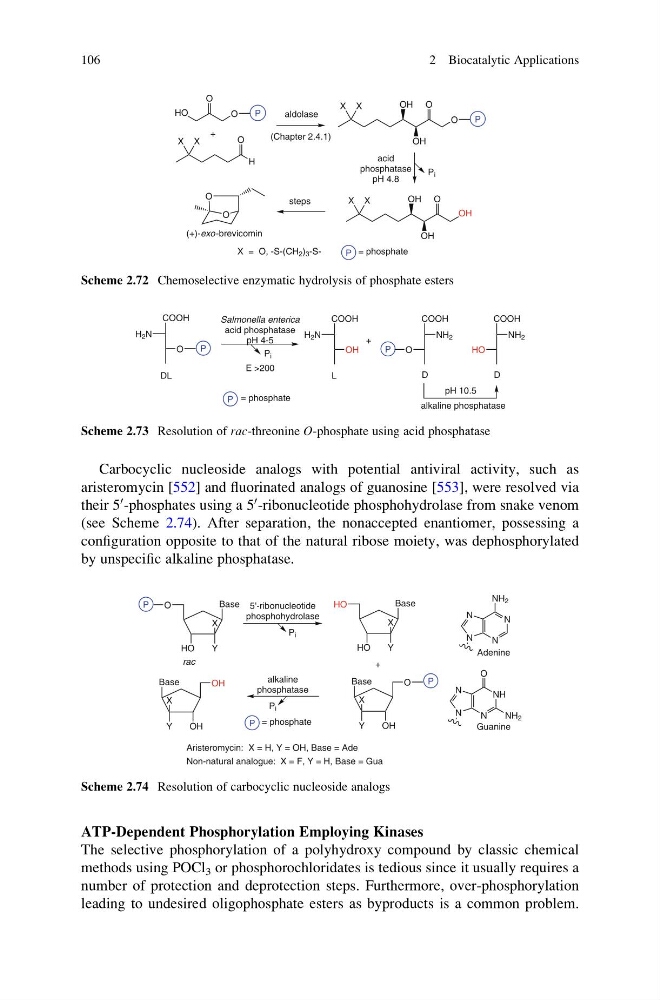
Carbocyclic nucleoside analogs with potential antiviral activity, such as
aristeromycin [552] and fluorinated analogs of guanosine [553], were resolved via
their 5
0 -phosphates using a 5
0 -ribonucleotide phosphohydrolase from snake venom
(see Scheme 2.74). After separation, the nonaccepted enantiomer, possessing a
configuration opposite to that of the natural ribose moiety, was dephosphorylated
by unspecific alkaline phosphatase.
ATP-Dependent Phosphorylation Employing Kinases
The selective phosphorylation of a polyhydroxy compound by classic chemical
methods using POCl 3 or phosphorochloridates is tedious since it usually requires a
number of protection and deprotection steps. Furthermore, over-phosphorylation
leading to undesired oligophosphate esters as byproducts is a common problem.
O
O
O
O
HO
OH
OH
O
X X
OH
O
X X
H
OH
OH
O
X X
O
= phosphate
X = O, -S-(CH 2 ) 3 -S(+)-exo-brevicomin
steps
acid
phosphatase
pH 4.8
aldolase
+
(Chapter 2.4.1)
P
P
P
P i
Scheme 2.72 Chemoselective enzymatic hydrolysis of phosphate esters
NH 2
O
COOH
H 2 N
O
COOH
NH 2
HO
COOH
H 2 N
OH
COOH
alkaline phosphatase
pH 10.5
= phosphate
L
DL
+
Salmonella enterica
acid phosphatase
pH 4-5
E >200
P
D
D
P
P
P i
Scheme 2.73 Resolution of rac-threonine O-phosphate using acid phosphatase
Base
OH
Y
X
OH
Base
OH
Y
X
O
Base
HO
Y
X
HO
Base
HO
Y
X
O
= phosphate
Non-natural analogue: X = F, Y = H, Base = Gua
Aristeromycin: X = H, Y = OH, Base = Ade
rac
alkaline
phosphatase
+
5'-ribonucleotide
phosphohydrolase
P
P
P
P i
P i
N
N
N
NH
O
NH 2
Guanine
N
N
N
N
NH 2
Adenine
Scheme 2.74 Resolution of carbocyclic nucleoside analogs
106
2 Biocatalytic Applications
aristeromycin [552] and fluorinated analogs of guanosine [553], were resolved via
their 5
0 -phosphates using a 5
0 -ribonucleotide phosphohydrolase from snake venom
(see Scheme 2.74). After separation, the nonaccepted enantiomer, possessing a
configuration opposite to that of the natural ribose moiety, was dephosphorylated
by unspecific alkaline phosphatase.
ATP-Dependent Phosphorylation Employing Kinases
The selective phosphorylation of a polyhydroxy compound by classic chemical
methods using POCl 3 or phosphorochloridates is tedious since it usually requires a
number of protection and deprotection steps. Furthermore, over-phosphorylation
leading to undesired oligophosphate esters as byproducts is a common problem.
O
O
O
O
HO
OH
OH
O
X X
OH
O
X X
H
OH
OH
O
X X
O
= phosphate
X = O, -S-(CH 2 ) 3 -S(+)-exo-brevicomin
steps
acid
phosphatase
pH 4.8
aldolase
+
(Chapter 2.4.1)
P
P
P
P i
Scheme 2.72 Chemoselective enzymatic hydrolysis of phosphate esters
NH 2
O
COOH
H 2 N
O
COOH
NH 2
HO
COOH
H 2 N
OH
COOH
alkaline phosphatase
pH 10.5
= phosphate
L
DL
+
Salmonella enterica
acid phosphatase
pH 4-5
E >200
P
D
D
P
P
P i
Scheme 2.73 Resolution of rac-threonine O-phosphate using acid phosphatase
Base
OH
Y
X
OH
Base
OH
Y
X
O
Base
HO
Y
X
HO
Base
HO
Y
X
O
= phosphate
Non-natural analogue: X = F, Y = H, Base = Gua
Aristeromycin: X = H, Y = OH, Base = Ade
rac
alkaline
phosphatase
+
5'-ribonucleotide
phosphohydrolase
P
P
P
P i
P i
N
N
N
NH
O
NH 2
Guanine
N
N
N
N
NH 2
Adenine
Scheme 2.74 Resolution of carbocyclic nucleoside analogs
106
2 Biocatalytic Applications