

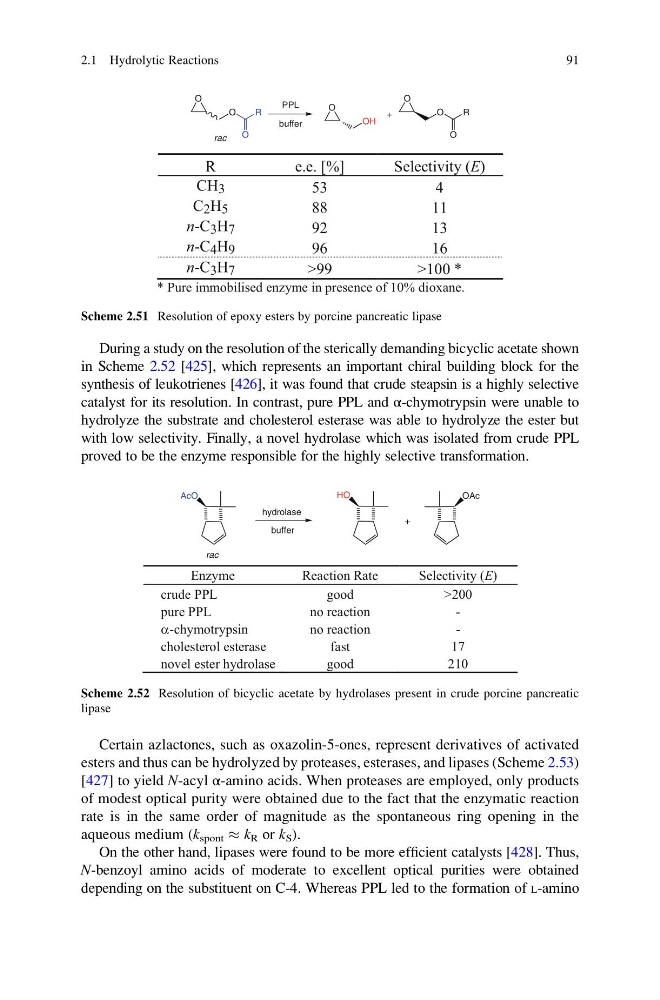
During a study on the resolution of the sterically demanding bicyclic acetate shown
in Scheme 2.52 [425], which represents an important chiral building block for the
synthesis of leukotrienes [426], it was found that crude steapsin is a highly selective
catalyst for its resolution. In contrast, pure PPL and α-chymotrypsin were unable to
hydrolyze the substrate and cholesterol esterase was able to hydrolyze the ester but
with low selectivity. Finally, a novel hydrolase which was isolated from crude PPL
proved to be the enzyme responsible for the highly selective transformation.
Certain azlactones, such as oxazolin-5-ones, represent derivatives of activated
esters and thus can be hydrolyzed by proteases, esterases, and lipases (Scheme 2.53)
[427] to yield N-acyl α-amino acids. When proteases are employed, only products
of modest optical purity were obtained due to the fact that the enzymatic reaction
rate is in the same order of magnitude as the spontaneous ring opening in the
aqueous medium (k spont % k R or k S ).
On the other hand, lipases were found to be more efficient catalysts [428]. Thus,
N-benzoyl amino acids of moderate to excellent optical purities were obtained
depending on the substituent on C-4. Whereas PPL led to the formation of L-amino
O
R
O
O
O
O
O
R
O
OH
buffer
PPL
rac
+
R
e.e. [%]
Selectivity (E)
CH 3
53
4
C 2 H 5
88
11
n-C 3 H 7
92
13
n-C 4 H 9
96
16
n-C 3 H 7
>99
>100 *
* Pure immobilised enzyme in presence of 10% dioxane.
Scheme 2.51 Resolution of epoxy esters by porcine pancreatic lipase
OAc
HO
AcO
rac
+
hydrolase
buffer
Enzyme
Reaction Rate
Selectivity (E)
crude PPL
good
>200
pure PPL
no reaction
-
α-chymotrypsin
no reaction
-
cholesterol esterase
fast
17
novel ester hydrolase
good
210
Scheme 2.52 Resolution of bicyclic acetate by hydrolases present in crude porcine pancreatic
lipase
2.1 Hydrolytic Reactions
91
in Scheme 2.52 [425], which represents an important chiral building block for the
synthesis of leukotrienes [426], it was found that crude steapsin is a highly selective
catalyst for its resolution. In contrast, pure PPL and α-chymotrypsin were unable to
hydrolyze the substrate and cholesterol esterase was able to hydrolyze the ester but
with low selectivity. Finally, a novel hydrolase which was isolated from crude PPL
proved to be the enzyme responsible for the highly selective transformation.
Certain azlactones, such as oxazolin-5-ones, represent derivatives of activated
esters and thus can be hydrolyzed by proteases, esterases, and lipases (Scheme 2.53)
[427] to yield N-acyl α-amino acids. When proteases are employed, only products
of modest optical purity were obtained due to the fact that the enzymatic reaction
rate is in the same order of magnitude as the spontaneous ring opening in the
aqueous medium (k spont % k R or k S ).
On the other hand, lipases were found to be more efficient catalysts [428]. Thus,
N-benzoyl amino acids of moderate to excellent optical purities were obtained
depending on the substituent on C-4. Whereas PPL led to the formation of L-amino
O
R
O
O
O
O
O
R
O
OH
buffer
PPL
rac
+
R
e.e. [%]
Selectivity (E)
CH 3
53
4
C 2 H 5
88
11
n-C 3 H 7
92
13
n-C 4 H 9
96
16
n-C 3 H 7
>99
>100 *
* Pure immobilised enzyme in presence of 10% dioxane.
Scheme 2.51 Resolution of epoxy esters by porcine pancreatic lipase
OAc
HO
AcO
rac
+
hydrolase
buffer
Enzyme
Reaction Rate
Selectivity (E)
crude PPL
good
>200
pure PPL
no reaction
-
α-chymotrypsin
no reaction
-
cholesterol esterase
fast
17
novel ester hydrolase
good
210
Scheme 2.52 Resolution of bicyclic acetate by hydrolases present in crude porcine pancreatic
lipase
2.1 Hydrolytic Reactions
91