

238
TAKEHIKO KOJI
Transcription regulatory factors
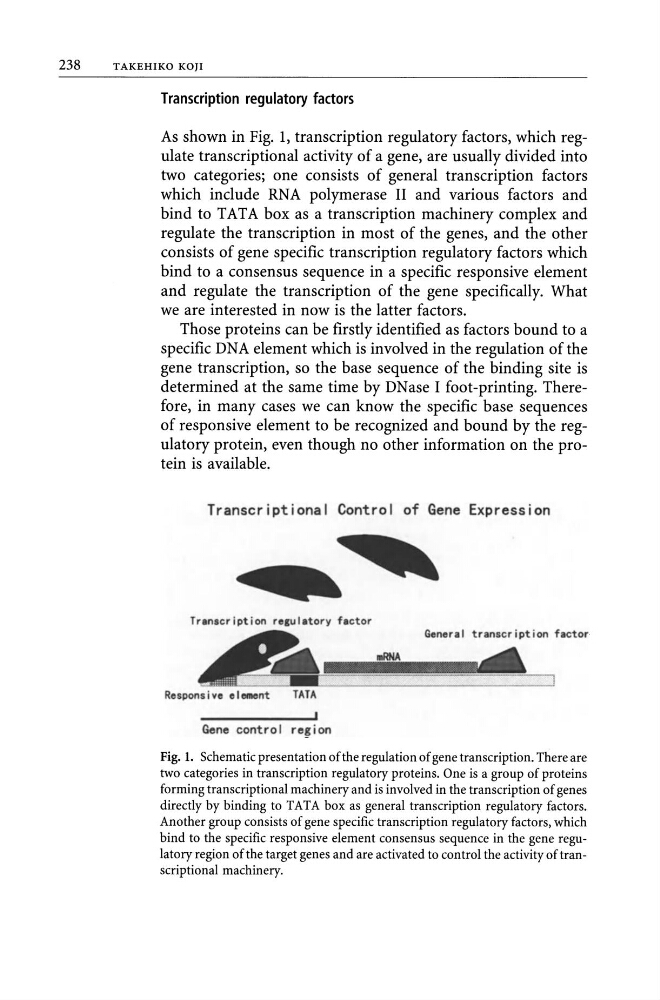
As shown in Fig. 1, transcription regulatory factors, which regulate transcriptional activity of a gene, are usually divided into
two categories; one consists of general transcription factors
which include RNA polymerase II and various factors and
bind to TAT A box as a transcription machinery complex and
regulate the transcription in most of the genes, and the other
consists of gene specific transcription regulatory factors which
bind to a consensus sequence in a specific responsive element
and regulate the transcription of the gene specifically. What
we are interested in now is the latter factors.
Those proteins can be firstly identified as factors bound to a
specific DNA element which is involved in the regulation of the
gene transcription, so the base sequence of the binding site is
determined at the same time by DNase I foot-printing. Therefore, in many cases we can know the specific base sequences
of responsive element to be recognized and bound by the regulatory protein, even though no other information on the protein is available.
Transcriptional Control of Gene Expression
Transcription relul'tory factor
General transcription factor
,Responsive element
TATA
Gene control re~ion
Fig. 1. Schematic presentation of the regulation of gene transcription. There are
two categories in transcription regulatory proteins. One is a group of proteins
forming transcriptional machinery and is involved in the transcription of genes
directly by binding to TAT A box as general transcription regulatory factors.
Another group consists of gene specific transcription regulatory factors, which
bind to the specific responsive element consensus sequence in the gene regulatory region of the target genes and are activated to control the activity of transcriptional machinery.
TAKEHIKO KOJI
Transcription regulatory factors
As shown in Fig. 1, transcription regulatory factors, which regulate transcriptional activity of a gene, are usually divided into
two categories; one consists of general transcription factors
which include RNA polymerase II and various factors and
bind to TAT A box as a transcription machinery complex and
regulate the transcription in most of the genes, and the other
consists of gene specific transcription regulatory factors which
bind to a consensus sequence in a specific responsive element
and regulate the transcription of the gene specifically. What
we are interested in now is the latter factors.
Those proteins can be firstly identified as factors bound to a
specific DNA element which is involved in the regulation of the
gene transcription, so the base sequence of the binding site is
determined at the same time by DNase I foot-printing. Therefore, in many cases we can know the specific base sequences
of responsive element to be recognized and bound by the regulatory protein, even though no other information on the protein is available.
Transcriptional Control of Gene Expression
Transcription relul'tory factor
General transcription factor
,Responsive element
TATA
Gene control re~ion
Fig. 1. Schematic presentation of the regulation of gene transcription. There are
two categories in transcription regulatory proteins. One is a group of proteins
forming transcriptional machinery and is involved in the transcription of genes
directly by binding to TAT A box as general transcription regulatory factors.
Another group consists of gene specific transcription regulatory factors, which
bind to the specific responsive element consensus sequence in the gene regulatory region of the target genes and are activated to control the activity of transcriptional machinery.