

158
YOSHITAKA HISHIKAWA ET AL.
for dot blot
hybridization
with T-T dimerized DNA
probes
for in situ
hybridization
with T-T
dimerized
probes
- Gel stain Rotator
- Dryoven: Dry oven (DS-44 / yamato, Japan)
- Constant temperature oven (DN-43H, KAYAGAK1 1R1KA
KOGYO,LTD., Japan)
- Water bath: constant temperature water bath (BK-43, yamato, Japan)
- Boiling bath: hot plate (type 1000, TECMO, Japan)
- Blocking solution
- 500 /Jg/ml normal goat 19G : Goat 19G, purified immunoglobulin (1-5256, Sigma)
- 5% BSA (98-99% pure) : albumins, bovine (98-99% alb)
(A-7030, Sigma)
- 100 /Jg/ml yeast tRNA : RNA transfer,type X from Bakers
yeast (R-9001, Sigma)
- 100 /Jg/ml salmon sperm DNA: salmon testes DNA for hybridization (D-7656, Sigma)
- 0.05% NaN3
- PBS
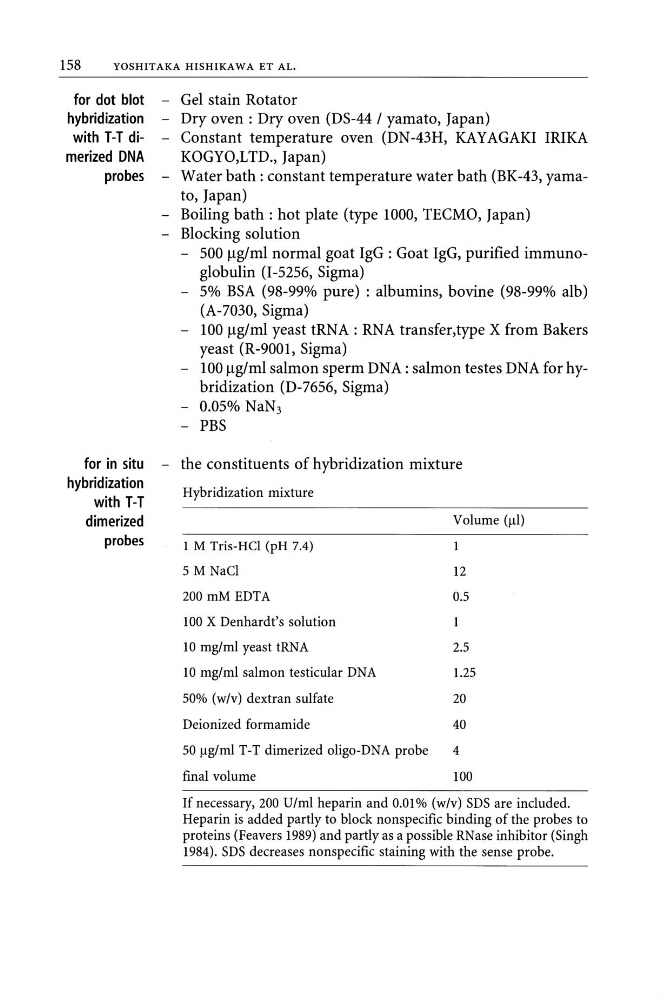
- the constituents of hybridization mixture
Hybridization mixture
1 M Tris-HCl (pH 7.4)
5 M NaCI
200 mM EDTA
100 X Denhardt's solution
Volume (Ill)
12
0.5
10 mg/ml yeast tRNA
2.5
10 mg/ml salmon testicular DNA
1.25
50% (w/v) dextran sulfate
20
Deionized formamide
40
50 Ilglml T-T dimerized oligo-DNA probe
4
final volume
100
If necessary, 200 Vlml heparin and 0.01 % (w/v) SDS are included.
Heparin is added partly to block nonspecific binding of the probes to
proteins (Feavers 1989) and partly as a possible RNase inhibitor (Singh
1984). SDS decreases nonspecific staining with the sense probe.
YOSHITAKA HISHIKAWA ET AL.
for dot blot
hybridization
with T-T dimerized DNA
probes
for in situ
hybridization
with T-T
dimerized
probes
- Gel stain Rotator
- Dryoven: Dry oven (DS-44 / yamato, Japan)
- Constant temperature oven (DN-43H, KAYAGAK1 1R1KA
KOGYO,LTD., Japan)
- Water bath: constant temperature water bath (BK-43, yamato, Japan)
- Boiling bath: hot plate (type 1000, TECMO, Japan)
- Blocking solution
- 500 /Jg/ml normal goat 19G : Goat 19G, purified immunoglobulin (1-5256, Sigma)
- 5% BSA (98-99% pure) : albumins, bovine (98-99% alb)
(A-7030, Sigma)
- 100 /Jg/ml yeast tRNA : RNA transfer,type X from Bakers
yeast (R-9001, Sigma)
- 100 /Jg/ml salmon sperm DNA: salmon testes DNA for hybridization (D-7656, Sigma)
- 0.05% NaN3
- PBS
- the constituents of hybridization mixture
Hybridization mixture
1 M Tris-HCl (pH 7.4)
5 M NaCI
200 mM EDTA
100 X Denhardt's solution
Volume (Ill)
12
0.5
10 mg/ml yeast tRNA
2.5
10 mg/ml salmon testicular DNA
1.25
50% (w/v) dextran sulfate
20
Deionized formamide
40
50 Ilglml T-T dimerized oligo-DNA probe
4
final volume
100
If necessary, 200 Vlml heparin and 0.01 % (w/v) SDS are included.
Heparin is added partly to block nonspecific binding of the probes to
proteins (Feavers 1989) and partly as a possible RNase inhibitor (Singh
1984). SDS decreases nonspecific staining with the sense probe.