

6
TAKEHlKO KOJl
SSB
5'
,.
3'
3'
5'
I,
~
v
C Bi~tin DNA pol~erase I
5'
0 t , 3'
3'
5'
~
Snapback reaction
0
5'
3'
3'
5'
~
S' _ _ _ q;:==::::O::::'- _ _ 3'
3' _ _ _ _ _ _ _ _ _ _ 5'
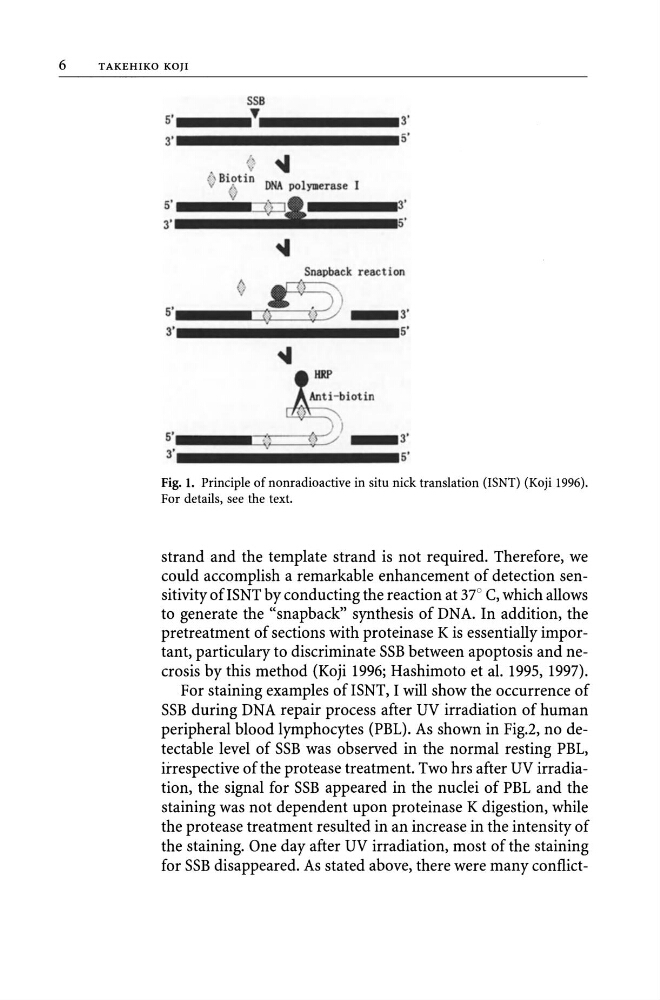
Fig.!. Principle of nonradioactive in situ nick translation (ISNT) (Koji 1996).
For details, see the text.
strand and the template strand is not required. Therefore, we
could accomplish a remarkable enhancement of detection sensitivity ofISNT by conducting the reaction at 37° C, which allows
to generate the "snapback" synthesis of DNA. In addition, the
pretreatment of sections with proteinase K is essentially important, particulary to discriminate SSB between apoptosis and necrosis by this method (Koji 1996; Hashimoto et al. 1995, 1997).
For staining examples ofISNT, I will show the occurrence of
SSB during DNA repair process after UV irradiation of human
peripheral blood lymphocytes (PBL). As shown in Fig.2, no detectable level of SSB was observed in the normal resting PBL,
irrespective of the protease treatment. Two hrs after UV irradiation, the signal for SSB appeared in the nuclei of PBL and the
staining was not dependent upon proteinase K digestion, while
the protease treatment resulted in an increase in the intensity of
the staining. One day after UV irradiation, most of the staining
for SSB disappeared. As stated above, there were many conflict-
TAKEHlKO KOJl
SSB
5'
,.
3'
3'
5'
I,
~
v
C Bi~tin DNA pol~erase I
5'
0 t , 3'
3'
5'
~
Snapback reaction
0
5'
3'
3'
5'
~
S' _ _ _ q;:==::::O::::'- _ _ 3'
3' _ _ _ _ _ _ _ _ _ _ 5'
Fig.!. Principle of nonradioactive in situ nick translation (ISNT) (Koji 1996).
For details, see the text.
strand and the template strand is not required. Therefore, we
could accomplish a remarkable enhancement of detection sensitivity ofISNT by conducting the reaction at 37° C, which allows
to generate the "snapback" synthesis of DNA. In addition, the
pretreatment of sections with proteinase K is essentially important, particulary to discriminate SSB between apoptosis and necrosis by this method (Koji 1996; Hashimoto et al. 1995, 1997).
For staining examples ofISNT, I will show the occurrence of
SSB during DNA repair process after UV irradiation of human
peripheral blood lymphocytes (PBL). As shown in Fig.2, no detectable level of SSB was observed in the normal resting PBL,
irrespective of the protease treatment. Two hrs after UV irradiation, the signal for SSB appeared in the nuclei of PBL and the
staining was not dependent upon proteinase K digestion, while
the protease treatment resulted in an increase in the intensity of
the staining. One day after UV irradiation, most of the staining
for SSB disappeared. As stated above, there were many conflict-