

102
TAKASHI SAWAI AND MIWA UZUKI
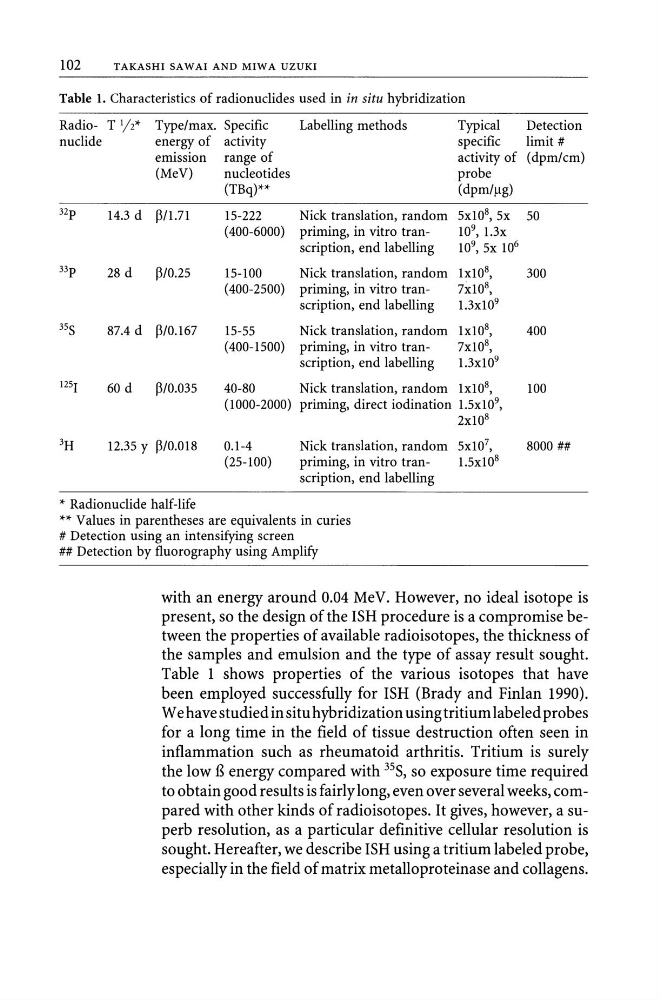
Table 1. Characteristics of radio nuclides used in in situ hybridization
Radio- T l/Z* Type/max. Specific
Labelling methods
Typical
Detection
nuclide
energy of activity
specific
limit #
emission range of
activity of (dpm/cm)
(MeV)
nucleotides
probe
(TBq)**
(dpm/i-1g)
3Zp
14.3 d ~/1.71
15-222
Nick translation, random 5x10 8 ,5x 50
(400-6000) priming, in vitro tran10 9 , 1.3x
scription, end labelling
10 9 , 5x 10 6
33p
28 d
~/0.25
15-100
Nick translation, random 1x10 8 ,
300
(400-2500) priming, in vitro tran7x10 8 ,
scription, end labelling
1.3 x 10 9
35S
87.4 d ~/0.167
15-55
Nick translation, random lx10 8 ,
400
(400-1500) priming, in vitro tran7x10 8 ,
scription, end labelling
1.3 x 10 9
125 1
60 d
~/0.035
40-80
Nick translation, random lx10 8 ,
100
(1000-2000) priming, direct iodination 1.5xl0 9 ,
2x10 8
3H
12.35 Y ~/0.Dl8
0.1-4
Nick translation, random 5x10 7 ,
8000 ##
(25-100)
priming, in vitro tran1.5x10 8
scription, end labelling
* Radionuclide half-life
** Values in parentheses are equivalents in curies
# Detection using an intensifying screen
## Detection by fluorography using Amplify
with an energy around 0.04 MeV. However, no ideal isotope is
present, so the design of the ISH procedure is a compromise between the properties of available radioisotopes, the thickness of
the samples and emulsion and the type of assay result sought.
Table 1 shows properties of the various isotopes that have
been employed successfully for ISH (Brady and Finlan 1990).
We have studied in situ hybridization using tritium labeled probes
for a long time in the field of tissue destruction often seen in
inflammation such as rheumatoid arthritis. Tritium is surely
the low g energy compared with 35S, so exposure time required
to obtain good results is fairly long, even over several weeks, compared with other kinds of radioisotopes. It gives, however, a superb resolution, as a particular definitive cellular resolution is
sought. Hereafter, we describe ISH using a tritium labeled probe,
especially in the field of matrix metalloproteinase and collagens.
TAKASHI SAWAI AND MIWA UZUKI
Table 1. Characteristics of radio nuclides used in in situ hybridization
Radio- T l/Z* Type/max. Specific
Labelling methods
Typical
Detection
nuclide
energy of activity
specific
limit #
emission range of
activity of (dpm/cm)
(MeV)
nucleotides
probe
(TBq)**
(dpm/i-1g)
3Zp
14.3 d ~/1.71
15-222
Nick translation, random 5x10 8 ,5x 50
(400-6000) priming, in vitro tran10 9 , 1.3x
scription, end labelling
10 9 , 5x 10 6
33p
28 d
~/0.25
15-100
Nick translation, random 1x10 8 ,
300
(400-2500) priming, in vitro tran7x10 8 ,
scription, end labelling
1.3 x 10 9
35S
87.4 d ~/0.167
15-55
Nick translation, random lx10 8 ,
400
(400-1500) priming, in vitro tran7x10 8 ,
scription, end labelling
1.3 x 10 9
125 1
60 d
~/0.035
40-80
Nick translation, random lx10 8 ,
100
(1000-2000) priming, direct iodination 1.5xl0 9 ,
2x10 8
3H
12.35 Y ~/0.Dl8
0.1-4
Nick translation, random 5x10 7 ,
8000 ##
(25-100)
priming, in vitro tran1.5x10 8
scription, end labelling
* Radionuclide half-life
** Values in parentheses are equivalents in curies
# Detection using an intensifying screen
## Detection by fluorography using Amplify
with an energy around 0.04 MeV. However, no ideal isotope is
present, so the design of the ISH procedure is a compromise between the properties of available radioisotopes, the thickness of
the samples and emulsion and the type of assay result sought.
Table 1 shows properties of the various isotopes that have
been employed successfully for ISH (Brady and Finlan 1990).
We have studied in situ hybridization using tritium labeled probes
for a long time in the field of tissue destruction often seen in
inflammation such as rheumatoid arthritis. Tritium is surely
the low g energy compared with 35S, so exposure time required
to obtain good results is fairly long, even over several weeks, compared with other kinds of radioisotopes. It gives, however, a superb resolution, as a particular definitive cellular resolution is
sought. Hereafter, we describe ISH using a tritium labeled probe,
especially in the field of matrix metalloproteinase and collagens.