

54
A. F. BARTHOLOMAY
In recogmtlon of the enlargement of the original biosystem by the
addition of an experimental environmental system or component, one must
enlarge the deterministic model or representation accordingly. In a sense
this amounts to obtaining from it a very simple kind of stochastic model.
But it might be more appropriate to refer to the result as a "statisticallyadjusted-deterministic model". These points may be demonstrated by the
following simple example, following which this section will be concluded
with a general mathematical formulation of the concept of a statisticallyadjusted-deterministic model.
Example: A Deterministic Model ~f the Kinetics of the Unimolecular Reaction
Process.
Perhaps a "lower bound" to biological systems particularly amenable
to this kind of mathematical treatment is a simple biological or chemical
transformation, T: A -+ B, in which a set of objects a E A of some biologicalor chemical species A are transformed directly into objects bE B. Here
the system {5 consists of C-components, A and B, and the function T E F.
If this is a chemical transformation, then the rest of the description of {5
would consist of noting that the transformation may be considered as a
homogeneous one, spacewise, and carried out in vitro in an environment E
consisting of a pressure and temperature controlled reaction vessel with
associated measuring devices to follow the progress of the reaction, etc.
If it is a biological transformation of some kind such as, say, the destruction
of a group A of organisms, then a complete {5-like description would
include the pertinent structures of the organisms, the nature of the destructive process T, temperature conditions of the environment E and a description of other systems in the environment of significance to this {5.
Suppose further, that it is simply the kinetics of this process in which
we are interested, and simply at an empirical level, say. Then, in the chemical case, for the simplest possible formulation, the Law of Mass Action is
invoked as a fundamental principle. In the biological case an equivalent
principle of the Law of Malthus states that the rate at which population A
diminishes in a process of simple destruction, again, is proportional to the
number of organisms present. And so, by identifying an algebraic variable x,
in the first case with the cardinality of the set A divided by volume V (i.e.,
in terms of concentration units) and in the second case with the number of
organisms in the experimental medium-and by making the convenient
mathematical assumption in both cases that x is a continuous, in fact,
differentiable function of time, we bring the problem into the domains of
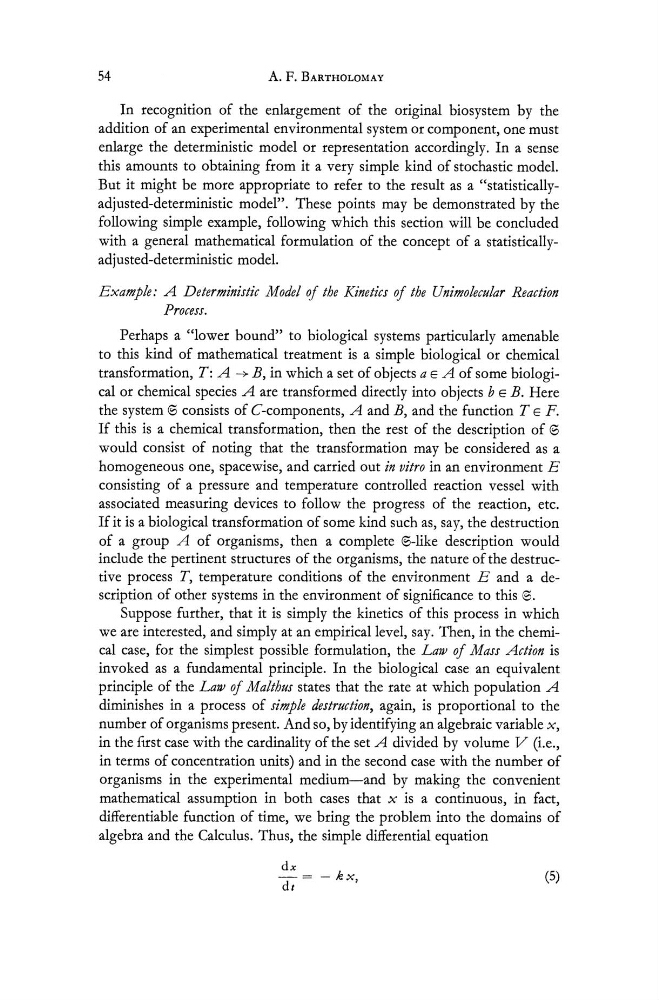
algebra and the Calculus. Thus, the simple differential equation
dx
- = -kx
dt
'
(5)
A. F. BARTHOLOMAY
In recogmtlon of the enlargement of the original biosystem by the
addition of an experimental environmental system or component, one must
enlarge the deterministic model or representation accordingly. In a sense
this amounts to obtaining from it a very simple kind of stochastic model.
But it might be more appropriate to refer to the result as a "statisticallyadjusted-deterministic model". These points may be demonstrated by the
following simple example, following which this section will be concluded
with a general mathematical formulation of the concept of a statisticallyadjusted-deterministic model.
Example: A Deterministic Model ~f the Kinetics of the Unimolecular Reaction
Process.
Perhaps a "lower bound" to biological systems particularly amenable
to this kind of mathematical treatment is a simple biological or chemical
transformation, T: A -+ B, in which a set of objects a E A of some biologicalor chemical species A are transformed directly into objects bE B. Here
the system {5 consists of C-components, A and B, and the function T E F.
If this is a chemical transformation, then the rest of the description of {5
would consist of noting that the transformation may be considered as a
homogeneous one, spacewise, and carried out in vitro in an environment E
consisting of a pressure and temperature controlled reaction vessel with
associated measuring devices to follow the progress of the reaction, etc.
If it is a biological transformation of some kind such as, say, the destruction
of a group A of organisms, then a complete {5-like description would
include the pertinent structures of the organisms, the nature of the destructive process T, temperature conditions of the environment E and a description of other systems in the environment of significance to this {5.
Suppose further, that it is simply the kinetics of this process in which
we are interested, and simply at an empirical level, say. Then, in the chemical case, for the simplest possible formulation, the Law of Mass Action is
invoked as a fundamental principle. In the biological case an equivalent
principle of the Law of Malthus states that the rate at which population A
diminishes in a process of simple destruction, again, is proportional to the
number of organisms present. And so, by identifying an algebraic variable x,
in the first case with the cardinality of the set A divided by volume V (i.e.,
in terms of concentration units) and in the second case with the number of
organisms in the experimental medium-and by making the convenient
mathematical assumption in both cases that x is a continuous, in fact,
differentiable function of time, we bring the problem into the domains of
algebra and the Calculus. Thus, the simple differential equation
dx
- = -kx
dt
'
(5)