

48
A. F. BARTHOLOMAY
b. Structure 5, or Form of a Biological System. The term "structure" of a
biological system may refer to a straightforward qualitative or quantitative
description of the directly or indirectly visible parts or whole of the system.
Or indeed, it may be simply a relational or topological-like statement of the
interrelationship and organization of the component parts and units of
composition C, or even of the "black boxes" (when the system is not geometrically or biologically resolvable into definite units of composition). In
any case, some indication of the relation of the parts to the whole is required,
since the "structure", or "form", or "organization" of a system we assume
has to do with the way in which the compositional units are related each
with the other, and with the media by which communication of all kinds
between them and with other systems in the environment (v.i.) is accomplished and maintained. Moreover, the basic compositional decomposition
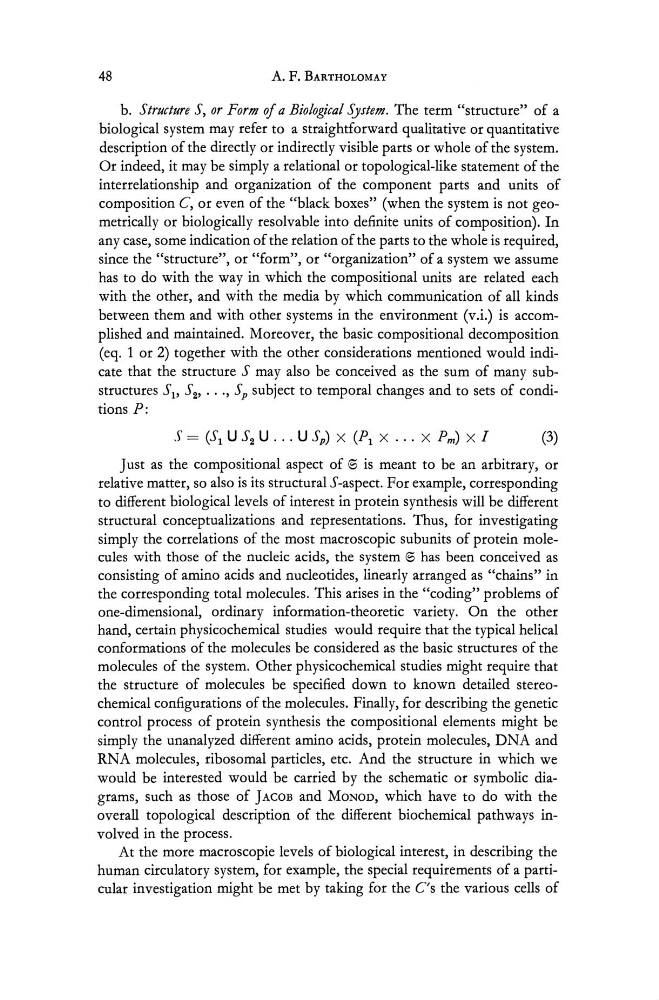
(eq. 1 or 2) together with the other considerations mentioned would indicate that the structure 5 may also be conceived as the sum of many substructures 51' 52' ... , 5p subject to temporal changes and to sets of conditions P:
Just as the compositional aspect of @) is meant to be an arbitrary, or
relative matter, so also is its structural 5-aspect. For example, corresponding
to different biological levels of interest in protein synthesis will be different
structural conceptualizations and representations. Thus, for investigating
simply the correlations of the most macroscopic subunits of protein molecules with those of the nucleic acids, the system @) has been conceived as
consisting of amino acids and nucleotides, linearly arranged as "chains" in
the corresponding total molecules. This arises in the "coding" problems of
one-dimensional, ordinary information-theoretic variety. On the other
hand, certain physicochemical studies would require that the typical helical
conformations of the molecules be considered as the basic structures of the
molecules of the system. Other physicochemical studies might require that
the structure of molecules be specified down to known detailed stereochemical configurations of the molecules. Finally, for describing the genetic
control process of protein synthesis the compositional elements might be
simply the unanalyzed different amino acids, protein molecules, DNA and
RNA molecules, ribosomal particles, etc. And the structure in which we
would be interested would be carried by the schematic or symbolic diagrams, such as those of JACOB and MONOD, which have to do with the
overall topological description of the different biochemical pathways involved in the process.
At the more macroscopie levels of biological interest, in describing the
human circulatory system, for example, the special requirements of a particular investigation might be met by taking for the C's the various cells of
A. F. BARTHOLOMAY
b. Structure 5, or Form of a Biological System. The term "structure" of a
biological system may refer to a straightforward qualitative or quantitative
description of the directly or indirectly visible parts or whole of the system.
Or indeed, it may be simply a relational or topological-like statement of the
interrelationship and organization of the component parts and units of
composition C, or even of the "black boxes" (when the system is not geometrically or biologically resolvable into definite units of composition). In
any case, some indication of the relation of the parts to the whole is required,
since the "structure", or "form", or "organization" of a system we assume
has to do with the way in which the compositional units are related each
with the other, and with the media by which communication of all kinds
between them and with other systems in the environment (v.i.) is accomplished and maintained. Moreover, the basic compositional decomposition
(eq. 1 or 2) together with the other considerations mentioned would indicate that the structure 5 may also be conceived as the sum of many substructures 51' 52' ... , 5p subject to temporal changes and to sets of conditions P:
Just as the compositional aspect of @) is meant to be an arbitrary, or
relative matter, so also is its structural 5-aspect. For example, corresponding
to different biological levels of interest in protein synthesis will be different
structural conceptualizations and representations. Thus, for investigating
simply the correlations of the most macroscopic subunits of protein molecules with those of the nucleic acids, the system @) has been conceived as
consisting of amino acids and nucleotides, linearly arranged as "chains" in
the corresponding total molecules. This arises in the "coding" problems of
one-dimensional, ordinary information-theoretic variety. On the other
hand, certain physicochemical studies would require that the typical helical
conformations of the molecules be considered as the basic structures of the
molecules of the system. Other physicochemical studies might require that
the structure of molecules be specified down to known detailed stereochemical configurations of the molecules. Finally, for describing the genetic
control process of protein synthesis the compositional elements might be
simply the unanalyzed different amino acids, protein molecules, DNA and
RNA molecules, ribosomal particles, etc. And the structure in which we
would be interested would be carried by the schematic or symbolic diagrams, such as those of JACOB and MONOD, which have to do with the
overall topological description of the different biochemical pathways involved in the process.
At the more macroscopie levels of biological interest, in describing the
human circulatory system, for example, the special requirements of a particular investigation might be met by taking for the C's the various cells of