

44
CH. WALTER
GRIFFITH:
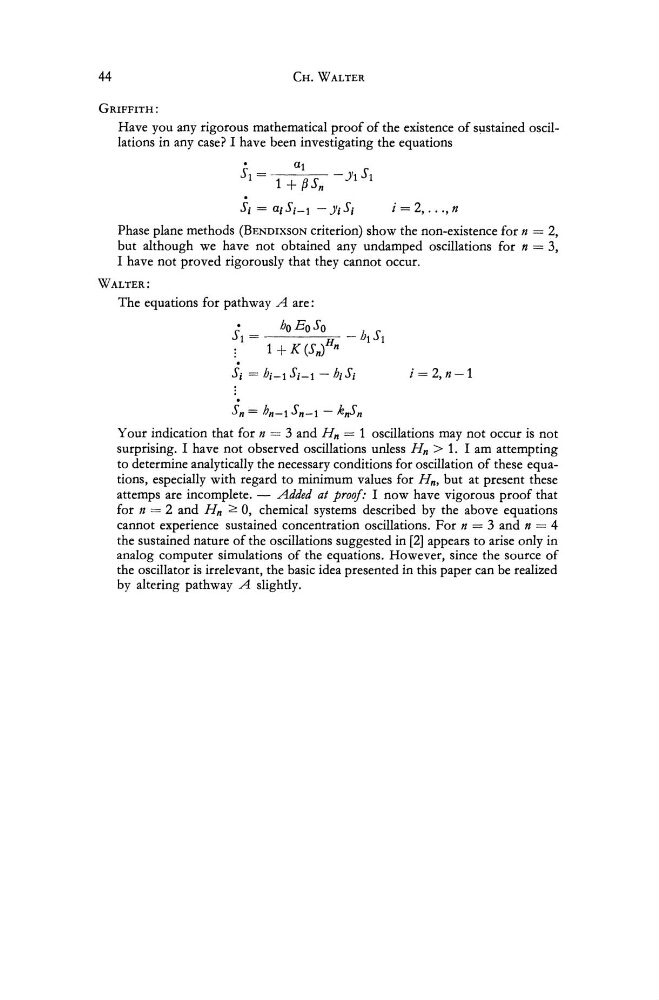
Have you any rigorous mathematical proof of the existence of sustained oscillations in any case? I have been investigating the equations
•
al
51 -
J 5
- 1 + f3S n - 1 I
5j = ai 5i-1 - Ji 5i
i = 2, ... , n
Phase plane methods (BENDIXSON criterion) show the non-existence for n = 2,
but although we have not obtained any undamped oscillations for n = 3,
I have not proved rigorously that they cannot occur.
WALTER:
The equations for pathway A are:
•
hoE o50
51 =
- hi 51
:
1+K(5 n )Hn
·
5i = hi-I 5i - 1 - hi 5i
i = 2, n-l
·
5n = hn - I 5n - 1 - kn5n
Your indication that for n = 3 and Hn = 1 oscillations may not occur is not
surprising. I have not observed oscillations unless Hn > 1. I am attempting
to determine analytically the necessary conditions for oscillation of these equations, especially with regard to minimum values for Hn, but at present these
attemps are incomplete. - Added at proof: I now have vigorous proof that
for n = 2 and Hn :2:: 0, chemical systems described by the above equations
cannot experience sustained concentration oscillations. For n = 3 and n = 4
the sustained nature of the oscillations suggested in [2] appears to arise only in
analog computer simulations of the equations. However, since the source of
the oscillator is irrelevant, the basic idea presented in this paper can be realized
by altering pathway A slightly.
CH. WALTER
GRIFFITH:
Have you any rigorous mathematical proof of the existence of sustained oscillations in any case? I have been investigating the equations
•
al
51 -
J 5
- 1 + f3S n - 1 I
5j = ai 5i-1 - Ji 5i
i = 2, ... , n
Phase plane methods (BENDIXSON criterion) show the non-existence for n = 2,
but although we have not obtained any undamped oscillations for n = 3,
I have not proved rigorously that they cannot occur.
WALTER:
The equations for pathway A are:
•
hoE o50
51 =
- hi 51
:
1+K(5 n )Hn
·
5i = hi-I 5i - 1 - hi 5i
i = 2, n-l
·
5n = hn - I 5n - 1 - kn5n
Your indication that for n = 3 and Hn = 1 oscillations may not occur is not
surprising. I have not observed oscillations unless Hn > 1. I am attempting
to determine analytically the necessary conditions for oscillation of these equations, especially with regard to minimum values for Hn, but at present these
attemps are incomplete. - Added at proof: I now have vigorous proof that
for n = 2 and Hn :2:: 0, chemical systems described by the above equations
cannot experience sustained concentration oscillations. For n = 3 and n = 4
the sustained nature of the oscillations suggested in [2] appears to arise only in
analog computer simulations of the equations. However, since the source of
the oscillator is irrelevant, the basic idea presented in this paper can be realized
by altering pathway A slightly.