

42
CH. WALTER
That pathway B is capable of exhibiting binary character can be seen in
Fig. 1. Although the functions in Fig. 1 are continuous, it is not difficult
to see that the relationships at larger m could be accurately represented as
a binary variable. A more complete discussion of the binary character of
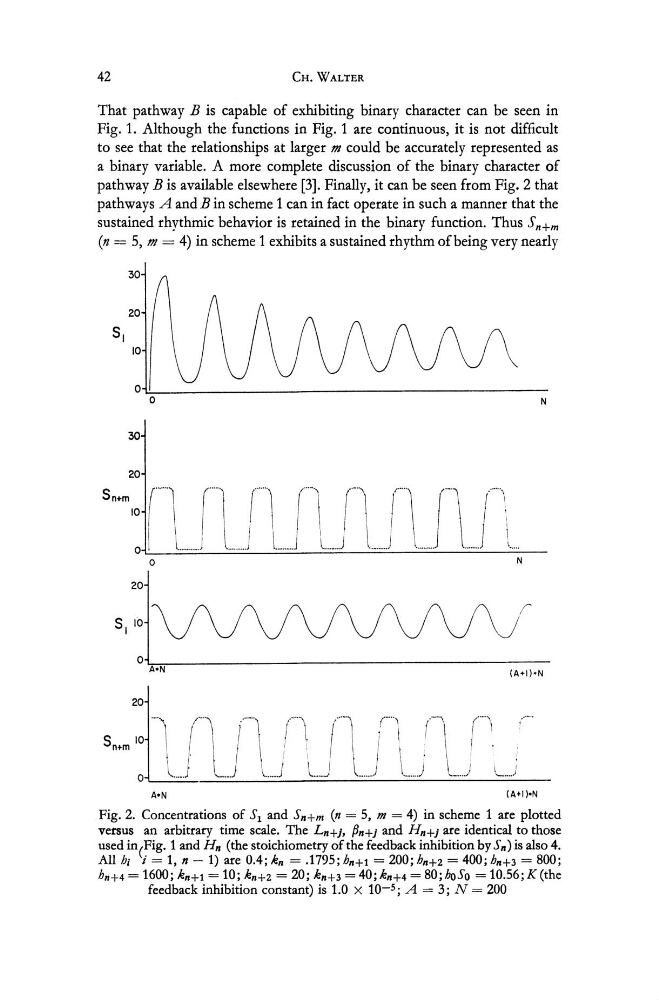
pathway B is available elsewhere [3]. Finally, it can be seen from Fig. 2 that
pathways A and B in scheme 1 can in fact operate in such a manner that the
sustained rhythmic behavior is retained in the binary function. Thus Sn+m
(n = 5, m = 4) in scheme 1 exhibits a sustained rhythm of being very nearly
30
20
10
o~ __________________________________________ _
o
N
30
20
o
N
20
O;A~'N~-----------------------------------------(A-+-I)*-N20
· · . . 1 ('1
1
( ..... \
, ...... \
("' 1 ("'\ I('!
Sn+m 10
' I )
( 1 1 / 1 I
I
: (l \. : I I \ l i
OL-l= . . . . . . ~J.~.= ..... __ ~~ . . = . . . . . J ___ l . . . _ . . . J __ l_ . . . . . _...J _ _ l_ ...... _) ___ ...... _) __ l._ .... ,J_' _ _
A'N
(A+I)'N
Fig. 2. Concentrations of S1 and Sn+m (n = 5, m = 4) in scheme 1 are plotted
versus an arbitrary time scale. The Ln+i> {3n+i and Hn+i are identical to those
used in(~ig. 1 and Hn (the stoichiometry of the feedback inhibition by Sn) is also 4.
All hi 1 = 1, n - 1) are 0.4; k n = .1795; hn+t = 200; hn+2 = 400; hn+3 = 800;
hnH = 1600; kn+l = 10; kn+2 = 20; knH = 4O;knH = 80;hoSo = 10.56; K (the
feedback inhibition constant) is 1.0 X 10- 5 ; A = 3; N = 200
CH. WALTER
That pathway B is capable of exhibiting binary character can be seen in
Fig. 1. Although the functions in Fig. 1 are continuous, it is not difficult
to see that the relationships at larger m could be accurately represented as
a binary variable. A more complete discussion of the binary character of
pathway B is available elsewhere [3]. Finally, it can be seen from Fig. 2 that
pathways A and B in scheme 1 can in fact operate in such a manner that the
sustained rhythmic behavior is retained in the binary function. Thus Sn+m
(n = 5, m = 4) in scheme 1 exhibits a sustained rhythm of being very nearly
30
20
10
o~ __________________________________________ _
o
N
30
20
o
N
20
O;A~'N~-----------------------------------------(A-+-I)*-N20
· · . . 1 ('1
1
( ..... \
, ...... \
("' 1 ("'\ I('!
Sn+m 10
' I )
( 1 1 / 1 I
I
: (l \. : I I \ l i
OL-l= . . . . . . ~J.~.= ..... __ ~~ . . = . . . . . J ___ l . . . _ . . . J __ l_ . . . . . _...J _ _ l_ ...... _) ___ ...... _) __ l._ .... ,J_' _ _
A'N
(A+I)'N
Fig. 2. Concentrations of S1 and Sn+m (n = 5, m = 4) in scheme 1 are plotted
versus an arbitrary time scale. The Ln+i> {3n+i and Hn+i are identical to those
used in(~ig. 1 and Hn (the stoichiometry of the feedback inhibition by Sn) is also 4.
All hi 1 = 1, n - 1) are 0.4; k n = .1795; hn+t = 200; hn+2 = 400; hn+3 = 800;
hnH = 1600; kn+l = 10; kn+2 = 20; knH = 4O;knH = 80;hoSo = 10.56; K (the
feedback inhibition constant) is 1.0 X 10- 5 ; A = 3; N = 200