

40
CH. WALTER
S1 is formed from So by the catalytic action of a "branch point" enzyme, Eo.
In pathway A S1 is metabolized via a series of consecutive reactions wherein
the formation of substance Sj from Sj_1 is catalyzed by enzyme Ej_1> and
conversion to Si+ 1 is catalyzed by enzyme E j • The final substance in pathway
A, Sm exits from the system with rate constant k n • So is maintained constant from the external source and Eo is inhibited cooperatively by S n'
Pathway A is a typical negative feedback scheme of the YATES-PARDEE [4]
type.
In pathway B S1 is metabolized via a series of different consecutive
reactions wherein formation of substance Sn+1 is catalyzed by enzyme E n + b
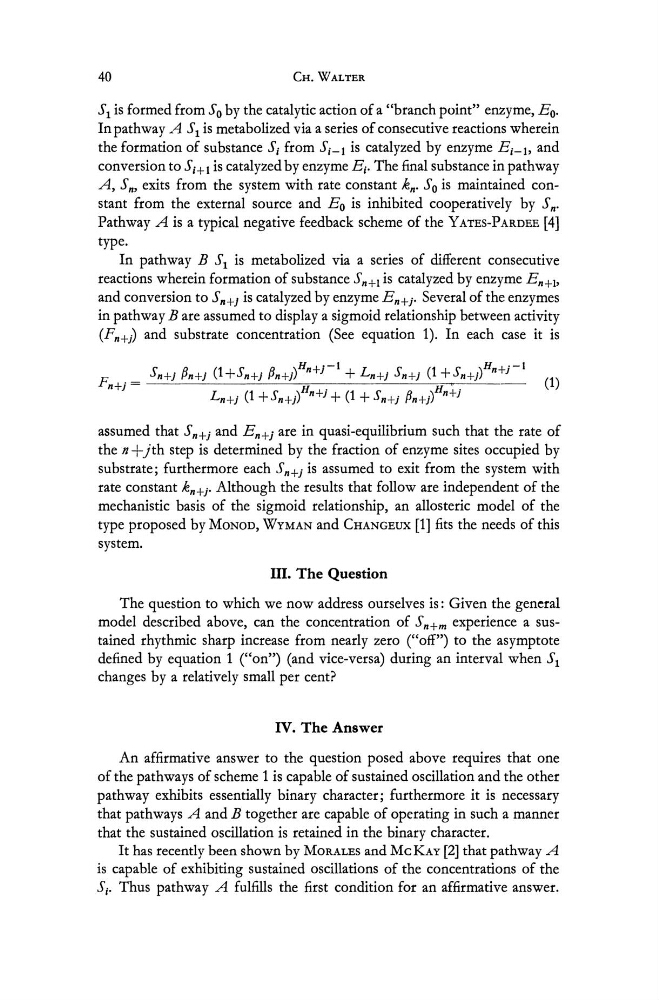
and conversion to Sn+j is catalyzed by enzyme E n+j. Several of the enzymes
in pathway B are assumed to display a sigmoid relationship between activity
(Fn+j ) and substrate concentration (See equation 1). In each case it is
assumed that Sn+j and En+j are in quasi-equilibrium such that the rate of
the n + jth step is determined by the fraction of enzyme sites occupied by
substrate; furthermore each Sn+j is assumed to exit from the system with
rate constant kn+j. Although the results that follow are independent of the
mechanistic basis of the sigmoid relationship, an allosteric model of the
type proposed by MONOD, WYMAN and CHANGEUX [1] fits the needs of this
system.
III. The Question
The question to which we now address ourselves is: Given the general
model described above, can the concentration of Sn+m experience a sustained rhythmic sharp increase from nearly zero ("off") to the asymptote
defined by equation 1 ("on") (and vice-versa) during an interval when S1
changes by a relatively small per cent?
IV. The Answer
An affirmative answer to the question posed above requires that one
of the pathways of scheme 1 is capable of sustained oscillation and the other
pathway exhibits essentially binary character; furthermore it is necessary
that pathways A and B together are capable of operating in such a manner
that the sustained oscillation is retained in the binary character.
It has recently been shown by MORALES and McKAY [2] that pathway A
is capable of exhibiting sustained oscillations of the concentrations of the
Sj. Thus pathway A fulfills the first condition for an affirmative answer.
CH. WALTER
S1 is formed from So by the catalytic action of a "branch point" enzyme, Eo.
In pathway A S1 is metabolized via a series of consecutive reactions wherein
the formation of substance Sj from Sj_1 is catalyzed by enzyme Ej_1> and
conversion to Si+ 1 is catalyzed by enzyme E j • The final substance in pathway
A, Sm exits from the system with rate constant k n • So is maintained constant from the external source and Eo is inhibited cooperatively by S n'
Pathway A is a typical negative feedback scheme of the YATES-PARDEE [4]
type.
In pathway B S1 is metabolized via a series of different consecutive
reactions wherein formation of substance Sn+1 is catalyzed by enzyme E n + b
and conversion to Sn+j is catalyzed by enzyme E n+j. Several of the enzymes
in pathway B are assumed to display a sigmoid relationship between activity
(Fn+j ) and substrate concentration (See equation 1). In each case it is
assumed that Sn+j and En+j are in quasi-equilibrium such that the rate of
the n + jth step is determined by the fraction of enzyme sites occupied by
substrate; furthermore each Sn+j is assumed to exit from the system with
rate constant kn+j. Although the results that follow are independent of the
mechanistic basis of the sigmoid relationship, an allosteric model of the
type proposed by MONOD, WYMAN and CHANGEUX [1] fits the needs of this
system.
III. The Question
The question to which we now address ourselves is: Given the general
model described above, can the concentration of Sn+m experience a sustained rhythmic sharp increase from nearly zero ("off") to the asymptote
defined by equation 1 ("on") (and vice-versa) during an interval when S1
changes by a relatively small per cent?
IV. The Answer
An affirmative answer to the question posed above requires that one
of the pathways of scheme 1 is capable of sustained oscillation and the other
pathway exhibits essentially binary character; furthermore it is necessary
that pathways A and B together are capable of operating in such a manner
that the sustained oscillation is retained in the binary character.
It has recently been shown by MORALES and McKAY [2] that pathway A
is capable of exhibiting sustained oscillations of the concentrations of the
Sj. Thus pathway A fulfills the first condition for an affirmative answer.