

28
R. ROSEN
contradicting our hypothesis that such a description has been given). Let
o E B j denote a c-state, lying in the i-th basin. Let F (x, t) denote the set of
all transients which can be applied to the system. We call two transients
G 1 , G 2 equivalent if, for all 0 E B j , both G 1 (0, t), G 2 (0, t) E B J for all sufficiently large t (i.e. if G 1 , G 2 cause the same d-state transitions). Denote by
Fj ex, t) the totality of all such equivalent transients; we shall in general
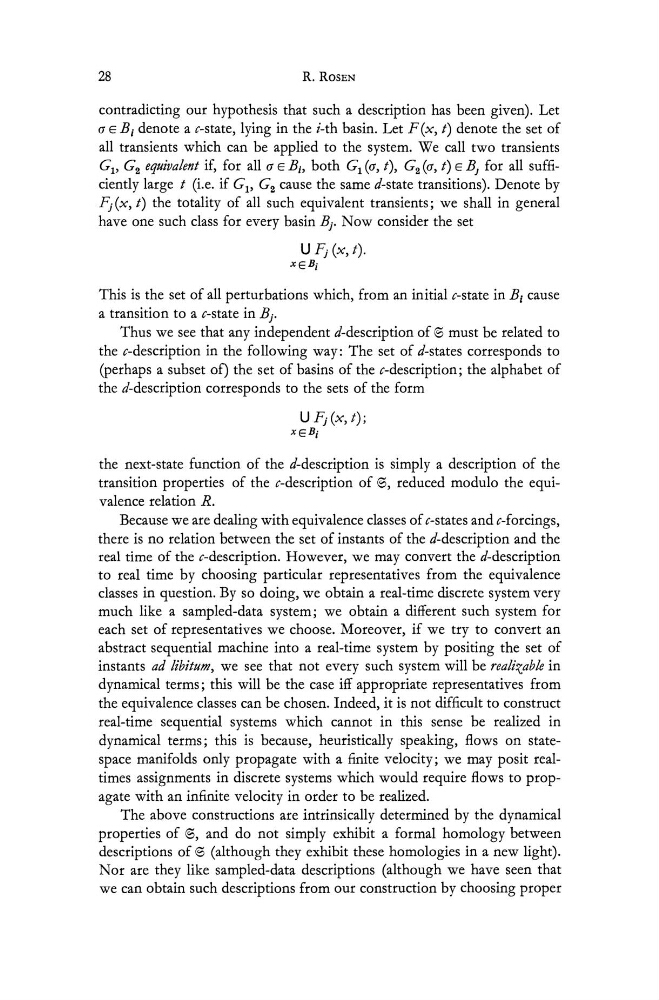
have one such class for every basin B j • Now consider the set
This is the set of all perturbations which, from an initial c-state in Bj cause
a transition to a c-state in B j .
Thus we see that any independent d-description of 6 must be related to
the c-description in the following way: The set of d-states corresponds to
(perhaps a subset of) the set of basins of the c-description; the alphabet of
the d-description corresponds to the sets of the form
U Fj ex, t);
XEBj
the next-state function of the d-description is simply a description of the
transition properties of the c-description of 6, reduced modulo the equivalence relation R.
Because we are dealing with equivalence classes of c-states and c-forcings,
there is no relation between the set of instants of the d-description and the
real time of the c-description. However, we may convert the d-description
to real time by choosing particular representatives from the equivalence
classes in question. By so doing, we obtain a real-time discrete system very
much like a sampled-data system; we obtain a different such system for
each set of representatives we choose. Moreover, if we try to convert an
abstract sequential machine into a real-time system by positing the set of
instants ad libitum, we see that not every such system will be realizable in
dynamical terms; this will be the case iff appropriate representatives from
the equivalence classes can be chosen. Indeed, it is not difficult to construct
real-time sequential systems which cannot in this sense be realized in
dynamical terms; this is because, heuristically speaking, flows on statespace manifolds only propagate with a finite velocity; we may posit realtimes assignments in discrete systems which would require flows to propagate with an infinite velocity in order to be realized.
The above constructions are intrinsically determined by the dynamical
properties of 6, and do not simply exhibit a formal homology between
descriptions of 6 (although they exhibit these homologies in a new light).
Nor are they like sampled-data descriptions (although we have seen that
we can obtain such descriptions from our construction by choosing proper
R. ROSEN
contradicting our hypothesis that such a description has been given). Let
o E B j denote a c-state, lying in the i-th basin. Let F (x, t) denote the set of
all transients which can be applied to the system. We call two transients
G 1 , G 2 equivalent if, for all 0 E B j , both G 1 (0, t), G 2 (0, t) E B J for all sufficiently large t (i.e. if G 1 , G 2 cause the same d-state transitions). Denote by
Fj ex, t) the totality of all such equivalent transients; we shall in general
have one such class for every basin B j • Now consider the set
This is the set of all perturbations which, from an initial c-state in Bj cause
a transition to a c-state in B j .
Thus we see that any independent d-description of 6 must be related to
the c-description in the following way: The set of d-states corresponds to
(perhaps a subset of) the set of basins of the c-description; the alphabet of
the d-description corresponds to the sets of the form
U Fj ex, t);
XEBj
the next-state function of the d-description is simply a description of the
transition properties of the c-description of 6, reduced modulo the equivalence relation R.
Because we are dealing with equivalence classes of c-states and c-forcings,
there is no relation between the set of instants of the d-description and the
real time of the c-description. However, we may convert the d-description
to real time by choosing particular representatives from the equivalence
classes in question. By so doing, we obtain a real-time discrete system very
much like a sampled-data system; we obtain a different such system for
each set of representatives we choose. Moreover, if we try to convert an
abstract sequential machine into a real-time system by positing the set of
instants ad libitum, we see that not every such system will be realizable in
dynamical terms; this will be the case iff appropriate representatives from
the equivalence classes can be chosen. Indeed, it is not difficult to construct
real-time sequential systems which cannot in this sense be realized in
dynamical terms; this is because, heuristically speaking, flows on statespace manifolds only propagate with a finite velocity; we may posit realtimes assignments in discrete systems which would require flows to propagate with an infinite velocity in order to be realized.
The above constructions are intrinsically determined by the dynamical
properties of 6, and do not simply exhibit a formal homology between
descriptions of 6 (although they exhibit these homologies in a new light).
Nor are they like sampled-data descriptions (although we have seen that
we can obtain such descriptions from our construction by choosing proper