

20
H. KAesER, and J. A. BURNS
@
•
F
E
•
of SE
~
E
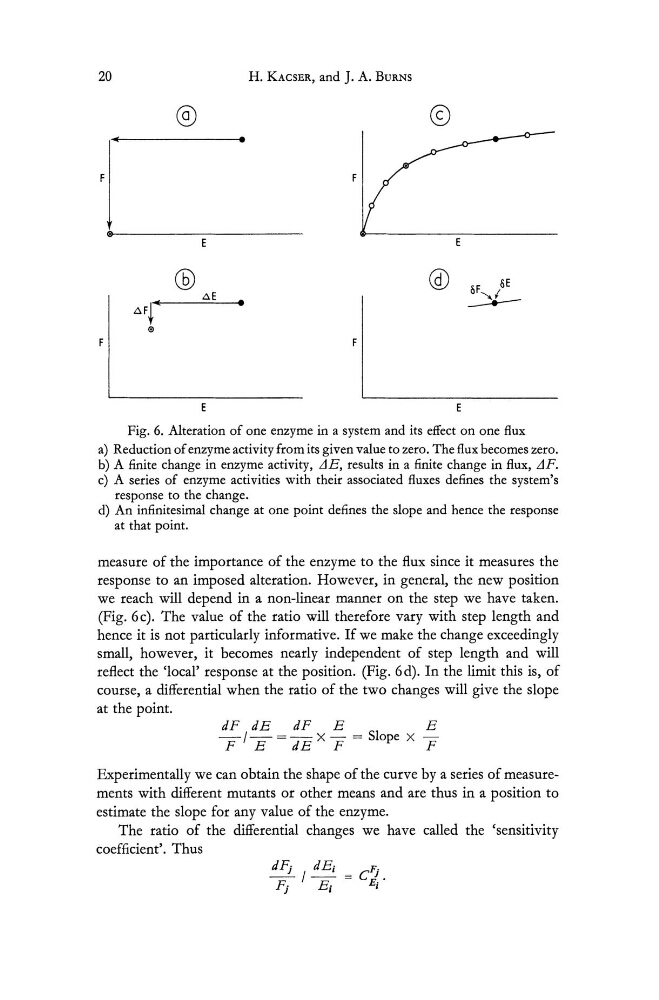
Fig. 6. Alteration of one enzyme in a system and its effect on one flux
a) Reduction of enzyme activity from its given value to zero. The flux becomes zero.
b) A finite change in enzyme activity, LIE, results in a finite change in flux, LlF.
c) A series of enzyme activities with their associated fluxes defines the system's
response to the change.
d) An infinitesimal change at one point defines the slope and hence the response
at that point.
measure of the importance of the enzyme to the flux since it measures the
response to an imposed alteration. However, in general, the new position
we reach will depend in a non-linear manner on the step we have taken.
(Fig. 6c). The value of the ratio will therefore vary with step length and
hence it is not particularly informative. If we make the change exceedingly
small, however, it becomes nearly independent of step length and will
reflect the 'local' response at the position. (Fig. 6 d). In the limit this is, of
course, a differential when the ratio of the two changes will give the slope
at the point.
dF dE
dF
E
E
F / I i = dE x F = Slope X F
Experimentally we can obtain the shape of the curve by a series of measurements with different mutants or other means and are thus in a position to
estimate the slope for any value of the enzyme.
The ratio of the differential changes we have called the 'sensitivity
coefficient'. Thus
dF
dE
--' /--' -
Fj
E j
CFJ E·' ,
H. KAesER, and J. A. BURNS
@
•
F
E
•
of SE
~
E
Fig. 6. Alteration of one enzyme in a system and its effect on one flux
a) Reduction of enzyme activity from its given value to zero. The flux becomes zero.
b) A finite change in enzyme activity, LIE, results in a finite change in flux, LlF.
c) A series of enzyme activities with their associated fluxes defines the system's
response to the change.
d) An infinitesimal change at one point defines the slope and hence the response
at that point.
measure of the importance of the enzyme to the flux since it measures the
response to an imposed alteration. However, in general, the new position
we reach will depend in a non-linear manner on the step we have taken.
(Fig. 6c). The value of the ratio will therefore vary with step length and
hence it is not particularly informative. If we make the change exceedingly
small, however, it becomes nearly independent of step length and will
reflect the 'local' response at the position. (Fig. 6 d). In the limit this is, of
course, a differential when the ratio of the two changes will give the slope
at the point.
dF dE
dF
E
E
F / I i = dE x F = Slope X F
Experimentally we can obtain the shape of the curve by a series of measurements with different mutants or other means and are thus in a position to
estimate the slope for any value of the enzyme.
The ratio of the differential changes we have called the 'sensitivity
coefficient'. Thus
dF
dE
--' /--' -
Fj
E j
CFJ E·' ,