

Memory and Cellular Control Processes
239
3. Control Processes and Differentitation
MONOD and JACOB [44] have pointed out that certain interactions between genetic regulatory elements could result in a cell having two or more
different stable sets of concentrations of mRNA, protein, etc. A particular
example which they give can best be described as a cellular flip-flop in
which there are two genes, Go and G 1 say, the product of either of which
catalyzes the synthesis of a metabolite which represses the synthesis of the
messenger from the other. Thus only one gene can be "on" at a time, the
other being held "off". They suggest that differentiation arises through the
operation of mechanisms of this or similar kinds, which seems highly
plausible (though see [52]), and I shall suppose here that it is correct. I have
discussed in a recent book [30] the relevance of this to the organization of
the nervous system, and the present discussion, although self-contained, is
largely complementary to my previous one and a development of it.
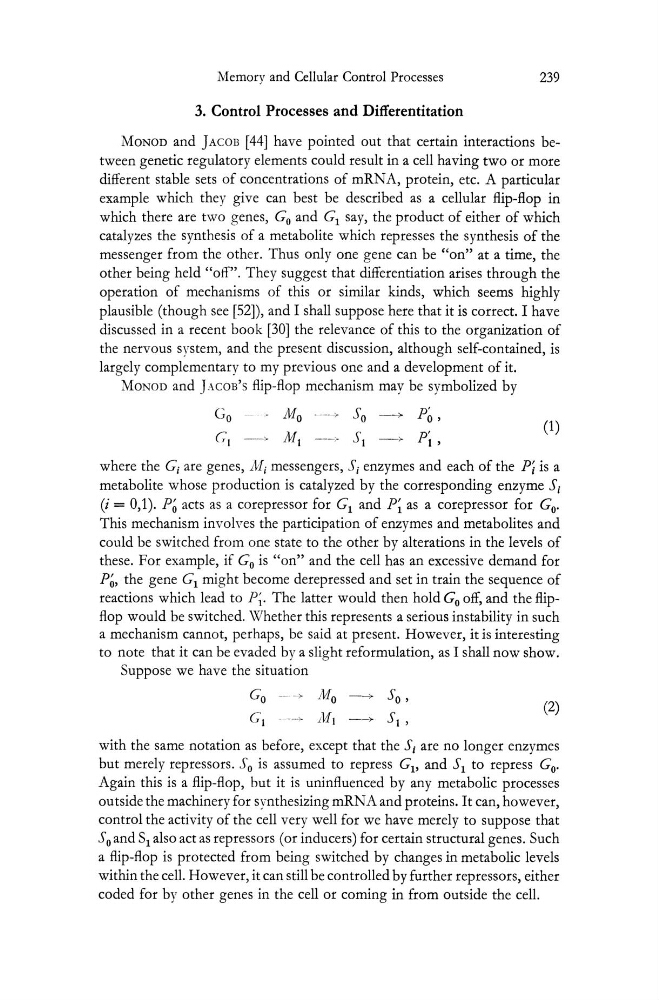
MONOD and JACOB'S flip-flop mechanism may be symbolized by
Mo ---* So ---* P~,
MI
SI --;.- P~,
(1)
where the Gi are genes, Mi messengers, Sj enzymes and each of the Pi is a
metabolite whose production is catalyzed by the corresponding enzyme Sj
(i = 0,1). P~ acts as a corepressor for G 1 and P~ as a corepressor for Go.
This mechanism involves the participation of enzymes and metabolites and
could be switched from one state to the other by alterations in the levels of
these. For example, if Go is "on" and the cell has an excessive demand for
P~, the gene G 1 might become derepressed and set in train the sequence of
reactions which lead to P~. The latter would then hold Go off, and the flipflop would be switched. Whether this represents a serious instability in such
a mechanism cannot, perhaps, be said at present. However, it is interesting
to note that it can be evaded by a slight reformulation, as I shall now show.
Suppose we have the situation
Go -_.> Mo
G I
--+
1111
(2)
with the same notation as before, except that the Sj are no longer enzymes
but merely repressors. So is assumed to repress G l , and Sl to repress GO'
Again this is a flip-flop, but it is uninfluenced by any metabolic processes
outside the machinery for synthesizing mRNA and proteins. It can, however,
control the activity of the cell very well for we have merely to suppose that
So and Sl also act as repressors (or inducers) for certain structural genes. Such
a flip-flop is protected from being switched by changes in metabolic levels
within the cell. However, it can still be controlled by further repressors, either
coded for by other genes in the cell or coming in from outside the cell.
239
3. Control Processes and Differentitation
MONOD and JACOB [44] have pointed out that certain interactions between genetic regulatory elements could result in a cell having two or more
different stable sets of concentrations of mRNA, protein, etc. A particular
example which they give can best be described as a cellular flip-flop in
which there are two genes, Go and G 1 say, the product of either of which
catalyzes the synthesis of a metabolite which represses the synthesis of the
messenger from the other. Thus only one gene can be "on" at a time, the
other being held "off". They suggest that differentiation arises through the
operation of mechanisms of this or similar kinds, which seems highly
plausible (though see [52]), and I shall suppose here that it is correct. I have
discussed in a recent book [30] the relevance of this to the organization of
the nervous system, and the present discussion, although self-contained, is
largely complementary to my previous one and a development of it.
MONOD and JACOB'S flip-flop mechanism may be symbolized by
Mo ---* So ---* P~,
MI
SI --;.- P~,
(1)
where the Gi are genes, Mi messengers, Sj enzymes and each of the Pi is a
metabolite whose production is catalyzed by the corresponding enzyme Sj
(i = 0,1). P~ acts as a corepressor for G 1 and P~ as a corepressor for Go.
This mechanism involves the participation of enzymes and metabolites and
could be switched from one state to the other by alterations in the levels of
these. For example, if Go is "on" and the cell has an excessive demand for
P~, the gene G 1 might become derepressed and set in train the sequence of
reactions which lead to P~. The latter would then hold Go off, and the flipflop would be switched. Whether this represents a serious instability in such
a mechanism cannot, perhaps, be said at present. However, it is interesting
to note that it can be evaded by a slight reformulation, as I shall now show.
Suppose we have the situation
Go -_.> Mo
G I
--+
1111
(2)
with the same notation as before, except that the Sj are no longer enzymes
but merely repressors. So is assumed to repress G l , and Sl to repress GO'
Again this is a flip-flop, but it is uninfluenced by any metabolic processes
outside the machinery for synthesizing mRNA and proteins. It can, however,
control the activity of the cell very well for we have merely to suppose that
So and Sl also act as repressors (or inducers) for certain structural genes. Such
a flip-flop is protected from being switched by changes in metabolic levels
within the cell. However, it can still be controlled by further repressors, either
coded for by other genes in the cell or coming in from outside the cell.