

Coactive Regulatory i\lechanisms Realizing Optimal Autoregulation 197
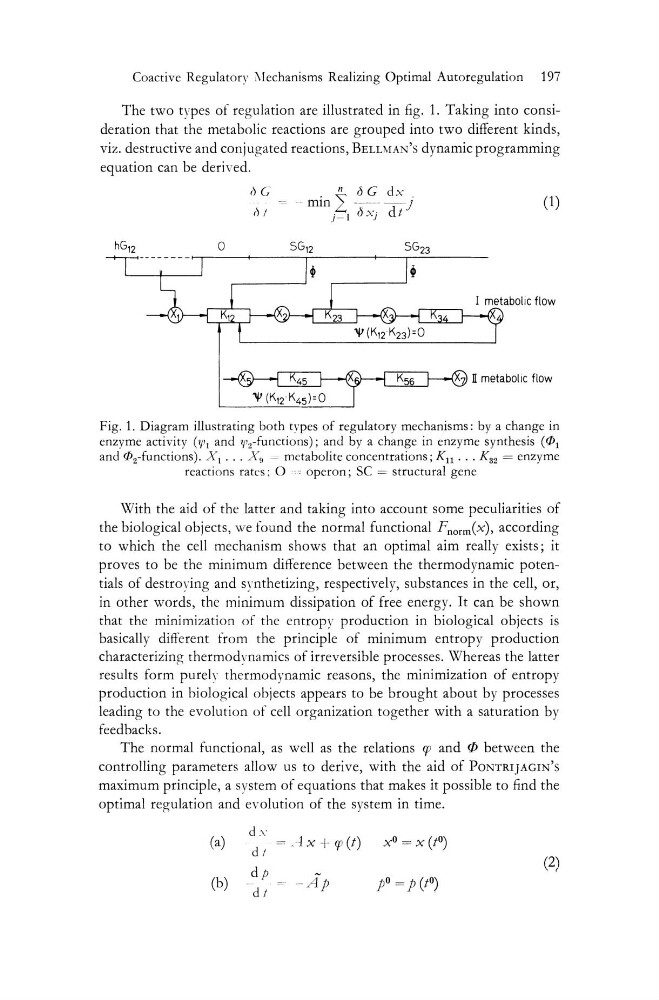
The two types of regulation are illustrated in fig. 1. Taking into consideration that the metabolic reactions are grouped into two different kinds,
viz. destructive and conjugated reactions, BELLMAN'S dynamic programming
equation can be derived.
rlG
,) t
n
rl G dx
min 2: ---J
i-I b Xj dt
(1)
I metabolic flow
"l n metabolic flow
Fig. 1. Diagram illustrating both types of regulatory mechanisms: by a change in
enzyme activity (V', and ljlz-functions); and by a change in enzyme synthesis Crt>,
and lliz-functions). X, ... X\I- metabolite concentrations; Kn ... K32 = enzyme
reactions rates: 0
operon; SC = structural gene
With the aid of the latter and taking into account some peculiarities of
the biological objects, we found the normal functional Fnorm(x), according
to which the cell mechanism shows that an optimal aim really exists; it
proves to be the minimum difference between the thermodynamic potentials of destrO\ing and synthetizing, respectively, substances in the cell, or,
in other words, the minimum dissipation of free energy. It can be shown
that the minimization of the entropy production in biological objects is
basically different from the principle of minimum entropy production
characterizing thermodymmics of irreversible processes. Whereas the latter
results form purelY thermodynamic reasons, the minimization of entropy
production in biological ohjects appears to be brought about by processes
leading to the evolution of cell organization together with a saturation by
feedbacks.
The normal functional, as well as the relations ffJ and c[J between the
controlling parameters allow us to derive, with the aid of PONTRIJAGIN'S
maximum principle, a system of equations that makes it possible to find the
optimal regulation and evolution of the system in time.
d.,"
(a)
dt
i x 1- ffJ (t)
XO = x (to)
dp
(2)
(b)
dt
-Ap
pO = p (to)
The two types of regulation are illustrated in fig. 1. Taking into consideration that the metabolic reactions are grouped into two different kinds,
viz. destructive and conjugated reactions, BELLMAN'S dynamic programming
equation can be derived.
rlG
,) t
n
rl G dx
min 2: ---J
i-I b Xj dt
(1)
I metabolic flow
"l n metabolic flow
Fig. 1. Diagram illustrating both types of regulatory mechanisms: by a change in
enzyme activity (V', and ljlz-functions); and by a change in enzyme synthesis Crt>,
and lliz-functions). X, ... X\I- metabolite concentrations; Kn ... K32 = enzyme
reactions rates: 0
operon; SC = structural gene
With the aid of the latter and taking into account some peculiarities of
the biological objects, we found the normal functional Fnorm(x), according
to which the cell mechanism shows that an optimal aim really exists; it
proves to be the minimum difference between the thermodynamic potentials of destrO\ing and synthetizing, respectively, substances in the cell, or,
in other words, the minimum dissipation of free energy. It can be shown
that the minimization of the entropy production in biological objects is
basically different from the principle of minimum entropy production
characterizing thermodymmics of irreversible processes. Whereas the latter
results form purelY thermodynamic reasons, the minimization of entropy
production in biological ohjects appears to be brought about by processes
leading to the evolution of cell organization together with a saturation by
feedbacks.
The normal functional, as well as the relations ffJ and c[J between the
controlling parameters allow us to derive, with the aid of PONTRIJAGIN'S
maximum principle, a system of equations that makes it possible to find the
optimal regulation and evolution of the system in time.
d.,"
(a)
dt
i x 1- ffJ (t)
XO = x (to)
dp
(2)
(b)
dt
-Ap
pO = p (to)