

6
A. LOCKER
two respective entities, viz. model and system, wherein the complexity of
the "abundant" properties of the latter exceeds that of the former. Subjectivization may finally be formalized as follows: If two homomorphic
sets are given, one of them is called model if at least one human exists for
whom during the time T with respect to certain perceptive and operative
functions Yj the system 51 may be replaced by 52 [12]. Formally, the definition may be written as follows:
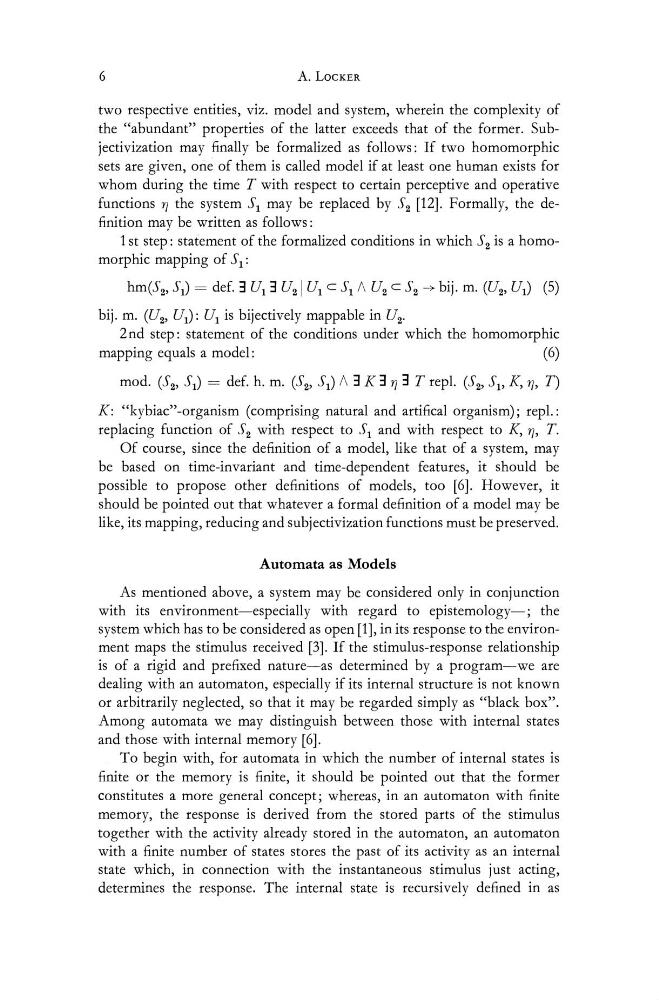
1 st step: statement of the formalized conditions in which 52 is a homomorphic mapping of 51:
hm(5 2 , 51) = def. 3 U 1 3 U 2 1 U l c 51 1\ U 2 C 52 -+ bij. m. (U 2 , U l ) (5)
bij. m. (U 2 , U l ): U l is bijectively mappable in U 2 •
2 nd step: statement of the conditions under which the homomorphic
mapping equals a model:
(6)
mod. (52' 51) = def. h. m. (52' 51) 1\ 3 K 3 Yj 3 T rep!. (5 2 ,5 1 , K, Yj, T)
K: "kybiac" -organism (comprising natural and artifical organism); repl.:
replacing function of 52 with respect to 51 and with respect to K, 1), T.
Of course, since the definition of a model, like that of a system, may
be based on time-invariant and time-dependent features, it should be
possible to propose other definitions of models, too [6]. However, it
should be pointed out that whatever a formal definition of a model may be
like, its mapping, reducing and subjectivization functions must be preserved.
Automata as Models
As mentioned above, a system may be considered only in conjunction
with its environment-especially with regard to epistemology-; the
system which has to be considered as open [1], in its response to the environment maps the stimulus received [3]. If the stimulus-response relationship
is of a rigid and prefixed nature-as determined by a program-we are
dealing with an automaton, especially if its internal structure is not known
or arbitrarily neglected, so that it may be regarded simply as "black box".
Among automata we may distinguish between those with internal states
and those with internal memory [6].
To begin with, for automata in which the number of internal states is
finite or the memory is finite, it should be pointed out that the former
constitutes a more general concept; whereas, in an automaton with finite
memory, the response is derived from the stored parts of the stimulus
together with the activity already stored in the automaton, an automaton
with a finite number of states stores the past of its activity as an internal
state which, in connection with the instantaneous stimulus just acting,
determines the response. The internal state is recursively defined in as
A. LOCKER
two respective entities, viz. model and system, wherein the complexity of
the "abundant" properties of the latter exceeds that of the former. Subjectivization may finally be formalized as follows: If two homomorphic
sets are given, one of them is called model if at least one human exists for
whom during the time T with respect to certain perceptive and operative
functions Yj the system 51 may be replaced by 52 [12]. Formally, the definition may be written as follows:
1 st step: statement of the formalized conditions in which 52 is a homomorphic mapping of 51:
hm(5 2 , 51) = def. 3 U 1 3 U 2 1 U l c 51 1\ U 2 C 52 -+ bij. m. (U 2 , U l ) (5)
bij. m. (U 2 , U l ): U l is bijectively mappable in U 2 •
2 nd step: statement of the conditions under which the homomorphic
mapping equals a model:
(6)
mod. (52' 51) = def. h. m. (52' 51) 1\ 3 K 3 Yj 3 T rep!. (5 2 ,5 1 , K, Yj, T)
K: "kybiac" -organism (comprising natural and artifical organism); repl.:
replacing function of 52 with respect to 51 and with respect to K, 1), T.
Of course, since the definition of a model, like that of a system, may
be based on time-invariant and time-dependent features, it should be
possible to propose other definitions of models, too [6]. However, it
should be pointed out that whatever a formal definition of a model may be
like, its mapping, reducing and subjectivization functions must be preserved.
Automata as Models
As mentioned above, a system may be considered only in conjunction
with its environment-especially with regard to epistemology-; the
system which has to be considered as open [1], in its response to the environment maps the stimulus received [3]. If the stimulus-response relationship
is of a rigid and prefixed nature-as determined by a program-we are
dealing with an automaton, especially if its internal structure is not known
or arbitrarily neglected, so that it may be regarded simply as "black box".
Among automata we may distinguish between those with internal states
and those with internal memory [6].
To begin with, for automata in which the number of internal states is
finite or the memory is finite, it should be pointed out that the former
constitutes a more general concept; whereas, in an automaton with finite
memory, the response is derived from the stored parts of the stimulus
together with the activity already stored in the automaton, an automaton
with a finite number of states stores the past of its activity as an internal
state which, in connection with the instantaneous stimulus just acting,
determines the response. The internal state is recursively defined in as