

Biomathematical Interpretation of Organismic Growth
135
the inflection varies according to different and possible values of the parameters, thus giving rise to three types of curves.
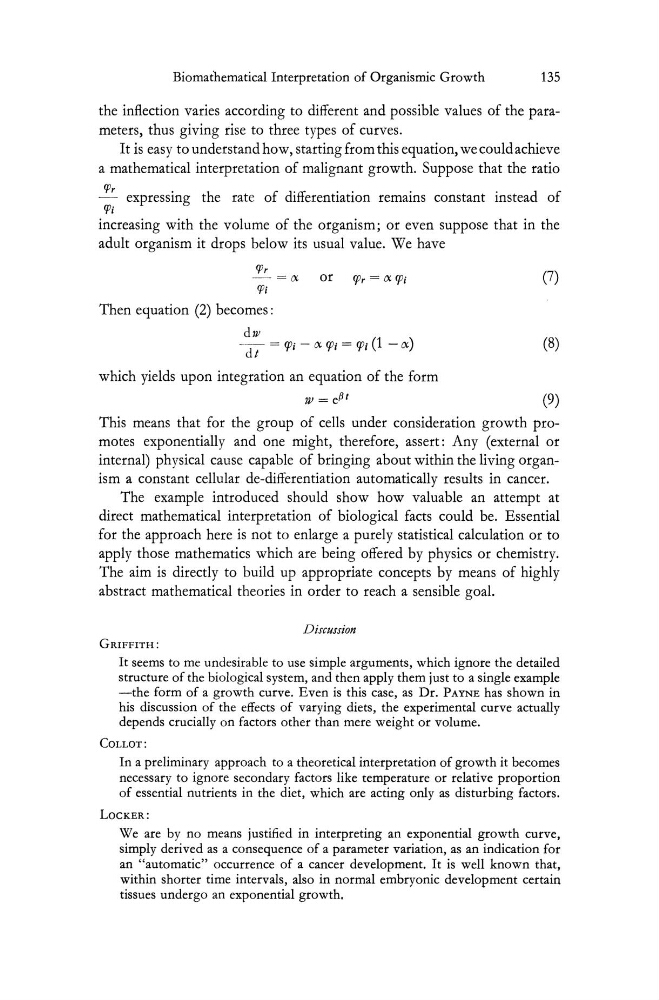
It is easy to understand how, starting from this equation, we could achieve
a mathematical interpretation of malignant growth. Suppose that the ratio
~ expressing the rate of differentiation remains constant instead of
lPi
increasing with the volume of the organism; or even suppose that in the
adult organism it drops below its usual value. We have
CPr
-- = (X or lPr = (X lPi
CPi
Then equation (2) becomes:
dw
- - = lPi - (X rpi = rpi (1 - (X)
dt
which yields upon integration an equation of the form
lV = ef3 t
(7)
(8)
(9)
This means that for the group of cells under consideration growth promotes exponentially and one might, therefore, assert: Any (external or
internal) physical cause capable of bringing about within the living organism a constant cellular de-differentiation automatically results in cancer.
The example introduced should show how valuable an attempt at
direct mathematical interpretation of biological facts could be. Essential
for the approach here is not to enlarge a purely statistical calculation or to
apply those mathematics which are being offered by physics or chemistry.
The aim is directly to build up appropriate concepts by means of highly
abstract mathematical theories in order to reach a sensible goal.
Discussion
GRIFFITH:
It seems to me undesirable to use simple arguments, which ignore the detailed
structure of the biological system, and then apply them just to a single example
-the form of a growth curve. Even is this case, as Dr. PAYNE has shown in
his discussion of the effects of varying diets, the experimental curve actually
depends crucially on factors other than mere weight or volume.
COLLOT:
In a preliminary approach to a theoretical interpretation of growth it becomes
necessary to ignore secondary factors like temperature or relative proportion
of essential nutrients in the diet, which are acting only as disturbing factors.
LOCKER:
We are by no means justified in interpreting an exponential growth curve,
simply derived as a consequence of a parameter variation, as an indication for
an "automatic" occurrence of a cancer development. It is well known that,
within shorter time intervals, also in normal embryonic development certain
tissues undergo an exponential growth.
135
the inflection varies according to different and possible values of the parameters, thus giving rise to three types of curves.
It is easy to understand how, starting from this equation, we could achieve
a mathematical interpretation of malignant growth. Suppose that the ratio
~ expressing the rate of differentiation remains constant instead of
lPi
increasing with the volume of the organism; or even suppose that in the
adult organism it drops below its usual value. We have
CPr
-- = (X or lPr = (X lPi
CPi
Then equation (2) becomes:
dw
- - = lPi - (X rpi = rpi (1 - (X)
dt
which yields upon integration an equation of the form
lV = ef3 t
(7)
(8)
(9)
This means that for the group of cells under consideration growth promotes exponentially and one might, therefore, assert: Any (external or
internal) physical cause capable of bringing about within the living organism a constant cellular de-differentiation automatically results in cancer.
The example introduced should show how valuable an attempt at
direct mathematical interpretation of biological facts could be. Essential
for the approach here is not to enlarge a purely statistical calculation or to
apply those mathematics which are being offered by physics or chemistry.
The aim is directly to build up appropriate concepts by means of highly
abstract mathematical theories in order to reach a sensible goal.
Discussion
GRIFFITH:
It seems to me undesirable to use simple arguments, which ignore the detailed
structure of the biological system, and then apply them just to a single example
-the form of a growth curve. Even is this case, as Dr. PAYNE has shown in
his discussion of the effects of varying diets, the experimental curve actually
depends crucially on factors other than mere weight or volume.
COLLOT:
In a preliminary approach to a theoretical interpretation of growth it becomes
necessary to ignore secondary factors like temperature or relative proportion
of essential nutrients in the diet, which are acting only as disturbing factors.
LOCKER:
We are by no means justified in interpreting an exponential growth curve,
simply derived as a consequence of a parameter variation, as an indication for
an "automatic" occurrence of a cancer development. It is well known that,
within shorter time intervals, also in normal embryonic development certain
tissues undergo an exponential growth.