

114
F. KRUGER
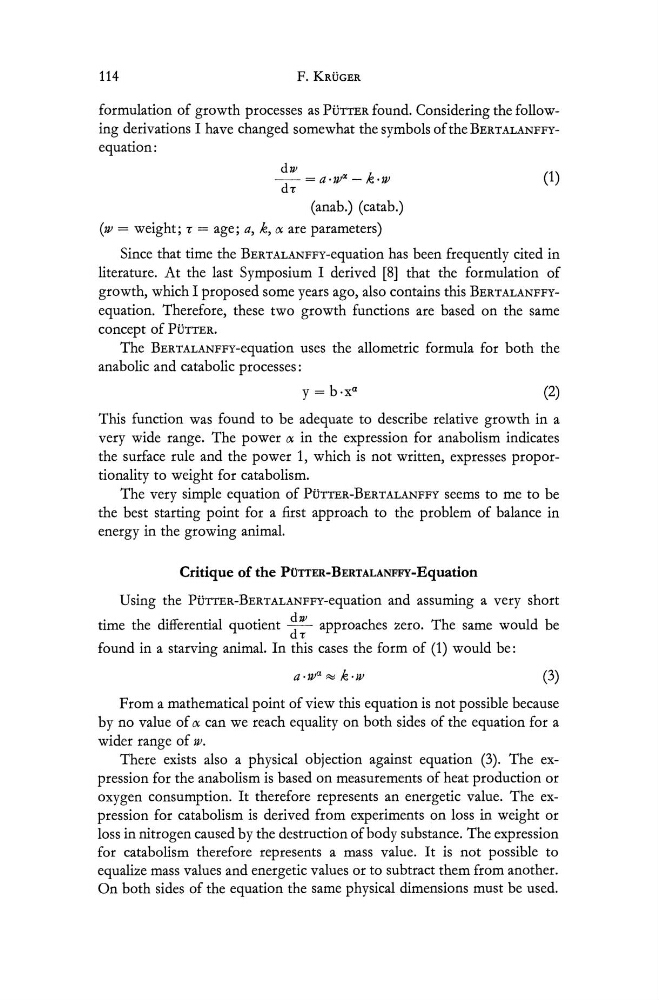
formulation of growth processes as PUTTER found. Considering the following derivations I have changed somewhat the symbols of the BERTALANFFYequation:
dw
- - = a·w'" - k·w
dT
(anab.) (catab.)
(w = weight; T = age; a, k, IX are parameters)
(1)
Since that time the BERTALANFFy-equation has been frequently cited in
literature. At the last Symposium I derived [8] that the formulation of
growth, which I proposed some years ago, also contains this BERTALANFFYequation. Therefore, these two growth functions are based on the same
concept of PUTTER.
The BERTALANFFy-equation uses the allometric formula for both the
anabolic and catabolic processes:
(2)
This function was found to be adequate to describe relative growth in a
very wide range. The power IX in the expression for anabolism indicates
the surface rule and the power 1, which is not written, expresses proportionality to weight for catabolism.
The very simple equation of PUTTER-BERTALANFFY seems to me to be
the best starting point for a first approach to the problem of balance in
energy in the growing animal.
Critique of the PUTTER-BERTALANFFY-Equation
Using the PUTTER-BERTALANFFy-equation and assuming a very short
time the differential quotient ~; approaches zero. The same would be
found in a starving animal. In this cases the form of (1) would be:
(3)
From a mathematical point of view this equation is not possible because
by no value of IX can we reach equality on both sides of the equation for a
wider range of w.
There exists also a physical objection against equation (3). The expression for the anabolism is based on measurements of heat production or
oxygen consumption. It therefore represents an energetic value. The expression for catabolism is derived from experiments on loss in weight or
loss in nitrogen caused by the destruction of body substance. The expression
for catabolism therefore represents a mass value. It is not possible to
equalize mass values and energetic values or to subtract them from another.
On both sides of the equation the same physical dimensions must be used.
F. KRUGER
formulation of growth processes as PUTTER found. Considering the following derivations I have changed somewhat the symbols of the BERTALANFFYequation:
dw
- - = a·w'" - k·w
dT
(anab.) (catab.)
(w = weight; T = age; a, k, IX are parameters)
(1)
Since that time the BERTALANFFy-equation has been frequently cited in
literature. At the last Symposium I derived [8] that the formulation of
growth, which I proposed some years ago, also contains this BERTALANFFYequation. Therefore, these two growth functions are based on the same
concept of PUTTER.
The BERTALANFFy-equation uses the allometric formula for both the
anabolic and catabolic processes:
(2)
This function was found to be adequate to describe relative growth in a
very wide range. The power IX in the expression for anabolism indicates
the surface rule and the power 1, which is not written, expresses proportionality to weight for catabolism.
The very simple equation of PUTTER-BERTALANFFY seems to me to be
the best starting point for a first approach to the problem of balance in
energy in the growing animal.
Critique of the PUTTER-BERTALANFFY-Equation
Using the PUTTER-BERTALANFFy-equation and assuming a very short
time the differential quotient ~; approaches zero. The same would be
found in a starving animal. In this cases the form of (1) would be:
(3)
From a mathematical point of view this equation is not possible because
by no value of IX can we reach equality on both sides of the equation for a
wider range of w.
There exists also a physical objection against equation (3). The expression for the anabolism is based on measurements of heat production or
oxygen consumption. It therefore represents an energetic value. The expression for catabolism is derived from experiments on loss in weight or
loss in nitrogen caused by the destruction of body substance. The expression
for catabolism therefore represents a mass value. It is not possible to
equalize mass values and energetic values or to subtract them from another.
On both sides of the equation the same physical dimensions must be used.