

96
E. ZERBST
The simplest flux equilibrium model of metabolism is the monomolecular reaction with concentrations A and B. In order to maintain the conditions for an open system, A must be replenished from a source Sand B
must be removed to some sink Z. One way to establish this is by considering diffusion; by adding in diffusion processes the system's scheme will be
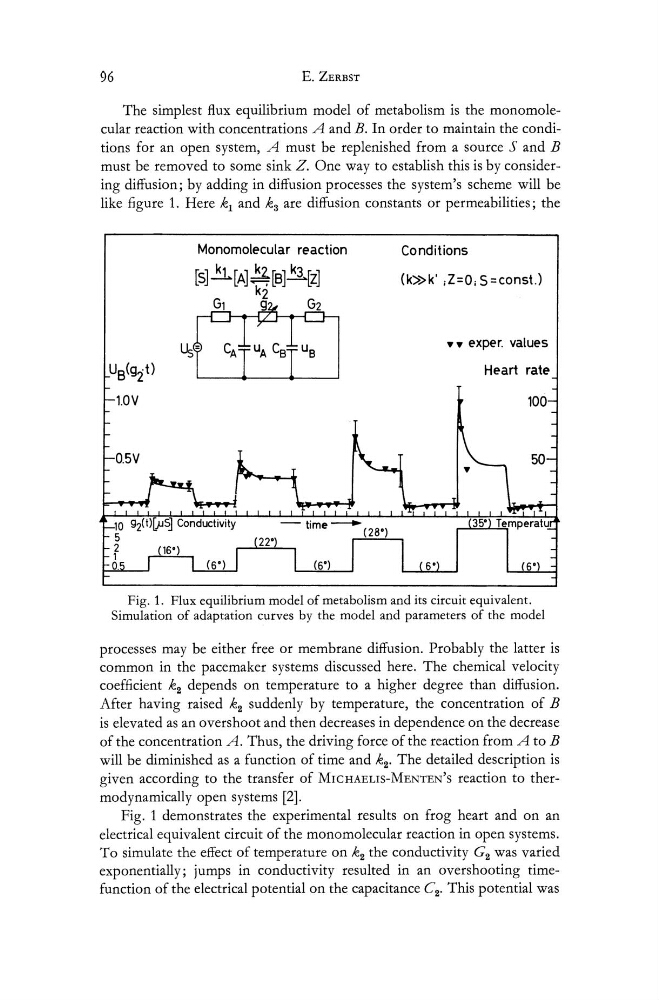
like figure 1. Here kl and k3 are diffusion constants or permeabilities; the
Monomolecular reaction
Conditions
[S]~[A]~[B]~[Z]
k2
G,
9
G2
(k»k' ,Z=O, S=const.)
us=
y y exper. values
Heart rate
100
Fig. 1. Flux equilibrium model of metabolism and its circuit equivalent.
Simulation of adaptation curves by the model and parameters of the model
processes may be either free or membrane diffusion. Probably the latter is
common in the pacemaker systems discussed here. The chemical velocity
coefficient k2 depends on temperature to a higher degree than diffusion.
After having raised k2 suddenly by temperature, the concentration of B
is elevated as an overshoot and then decreases in dependence on the decrease
of the concentration A. Thus, the driving force of the reaction from A to B
will be diminished as a function of time and k 2 • The detailed description is
given according to the transfer of MICHAELIS-MENTEN'S reaction to thermodynamically open systems [2].
Fig. 1 demonstrates the experimental results on frog heart and on an
electrical equivalent circuit of the monomolecular reaction in open systems.
To simulate the effect of temperature on k2 the conductivity G 2 was varied
exponentially; jumps in conductivity resulted in an overshooting timefunction of the electrical potential on the capacitance C 2 • This potential was
E. ZERBST
The simplest flux equilibrium model of metabolism is the monomolecular reaction with concentrations A and B. In order to maintain the conditions for an open system, A must be replenished from a source Sand B
must be removed to some sink Z. One way to establish this is by considering diffusion; by adding in diffusion processes the system's scheme will be
like figure 1. Here kl and k3 are diffusion constants or permeabilities; the
Monomolecular reaction
Conditions
[S]~[A]~[B]~[Z]
k2
G,
9
G2
(k»k' ,Z=O, S=const.)
us=
y y exper. values
Heart rate
100
Fig. 1. Flux equilibrium model of metabolism and its circuit equivalent.
Simulation of adaptation curves by the model and parameters of the model
processes may be either free or membrane diffusion. Probably the latter is
common in the pacemaker systems discussed here. The chemical velocity
coefficient k2 depends on temperature to a higher degree than diffusion.
After having raised k2 suddenly by temperature, the concentration of B
is elevated as an overshoot and then decreases in dependence on the decrease
of the concentration A. Thus, the driving force of the reaction from A to B
will be diminished as a function of time and k 2 • The detailed description is
given according to the transfer of MICHAELIS-MENTEN'S reaction to thermodynamically open systems [2].
Fig. 1 demonstrates the experimental results on frog heart and on an
electrical equivalent circuit of the monomolecular reaction in open systems.
To simulate the effect of temperature on k2 the conductivity G 2 was varied
exponentially; jumps in conductivity resulted in an overshooting timefunction of the electrical potential on the capacitance C 2 • This potential was