

Heat Production, Oxygen Consumption and Temperature in Poikilotherms 87
E
F
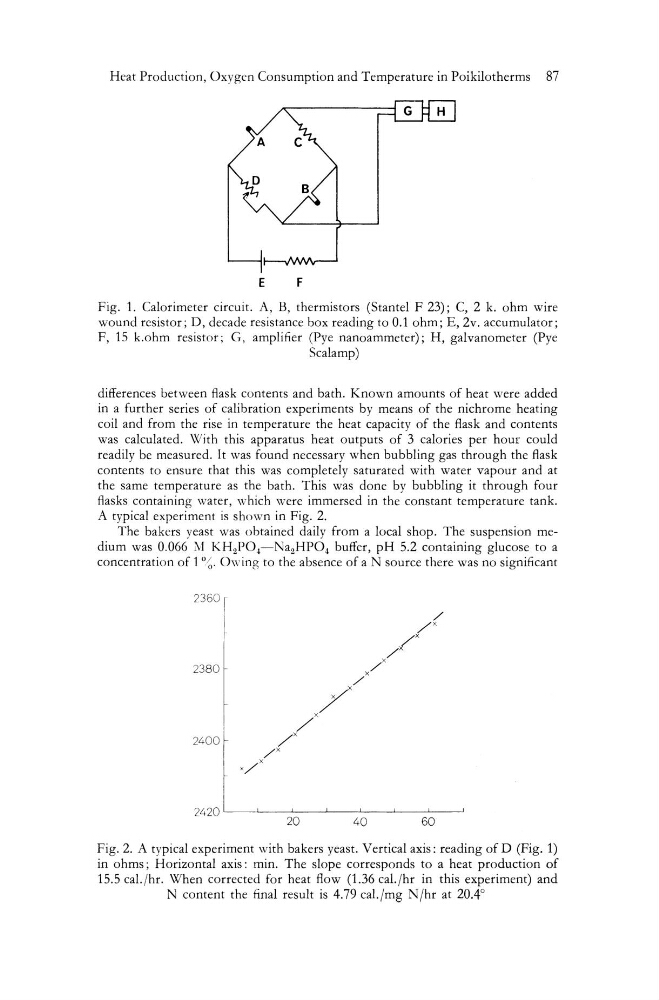
Fig. 1. Calorimeter circuit. A, 13, thermistors (Stantel F 23); C, 2 k. ohm wire
wound resistor; D, decade resistance box reading to 0.1 ohm; E, 2v. accumulator;
F, 15 k.ohm resistor; G, amplifier (Pye nanoammeter); H, galvanometer (Pye
Scalamp)
differences between flask contents and bath. Known amounts of heat were added
in a further series of calibration experiments by means of the nichrome heating
coil and from the rise in temperature the heat capacity of the flask and contents
was calculated. With this apparatus heat outputs of 3 calories per hour could
readily be measured. It was found necessary when bubbling gas through the flask
contents to ensure that this was completely saturated with water vapour and at
the same temperature as the bath. This was done by bubbling it through four
flasks containing water, which were immersed in the constant temperature tank.
A typical experiment is shown in Fig. 2.
The bakers yeast was obtained daily from a local shop. The suspension medium was 0.066 M KH2PO J -Na2HPOt buffer, pH 5.2 containing glucose to a
concentration of 1 o~. Owing to the absence of a N source there was no significant
7360 I
2380
2400
I
I
2420 I'----------L~____'_~---'--~--'---~"__------"~_"
20
40
60
Fig. 2. A typical experiment with bakers yeast. Vertical axis: reading of D (Fig. 1)
in ohms; Horizontal axis: min. The slope corresponds to a heat production of
15.5 cal./hr. When corrected for heat flow (1.36 cal./hr in this experiment) and
N content the final result is 4.79 cal./mg N/hr at 20,40
E
F
Fig. 1. Calorimeter circuit. A, 13, thermistors (Stantel F 23); C, 2 k. ohm wire
wound resistor; D, decade resistance box reading to 0.1 ohm; E, 2v. accumulator;
F, 15 k.ohm resistor; G, amplifier (Pye nanoammeter); H, galvanometer (Pye
Scalamp)
differences between flask contents and bath. Known amounts of heat were added
in a further series of calibration experiments by means of the nichrome heating
coil and from the rise in temperature the heat capacity of the flask and contents
was calculated. With this apparatus heat outputs of 3 calories per hour could
readily be measured. It was found necessary when bubbling gas through the flask
contents to ensure that this was completely saturated with water vapour and at
the same temperature as the bath. This was done by bubbling it through four
flasks containing water, which were immersed in the constant temperature tank.
A typical experiment is shown in Fig. 2.
The bakers yeast was obtained daily from a local shop. The suspension medium was 0.066 M KH2PO J -Na2HPOt buffer, pH 5.2 containing glucose to a
concentration of 1 o~. Owing to the absence of a N source there was no significant
7360 I
2380
2400
I
I
2420 I'----------L~____'_~---'--~--'---~"__------"~_"
20
40
60
Fig. 2. A typical experiment with bakers yeast. Vertical axis: reading of D (Fig. 1)
in ohms; Horizontal axis: min. The slope corresponds to a heat production of
15.5 cal./hr. When corrected for heat flow (1.36 cal./hr in this experiment) and
N content the final result is 4.79 cal./mg N/hr at 20,40