

3 Purification of Nucleic Acids From Eukaryotic Cells
51
pletely inhibit RNAse activity, and it is a solvent for RNA molecules that
contain long poly(A) tails (Sambrock et al. 1989; Brawerman et al. 1972).
Chloroform reduces the amount of aqueous solution retained in the organic
phase and its high density enhances phase separation. Isoamyl alcohol inhibits foam formation at the interphase. The phenol!chloroform extraction
is followed by one extraction with chloroform alone to remove any traces of
phenol from the nucleic acids, which might otherwise inhibit subsequent
r
1. Add organic solvent
(PCA or chloroform)
2. Mix and spin
Nucleic acids
in solution
5. Reextract
3. Transfer
aqueous phase
to new tube
6. Add salt
7. Add 100% ethanol
8.
Freeze
l
Aqueous phase
with nucleic acids
PCA
Pipet
Tilt to increase recovery
9.
Mix and spin
10. Decant liquid
0
11. Add70%ethanol y
12. Gentrifuge
13. Decant liquid
14. Dry pellt
_________..
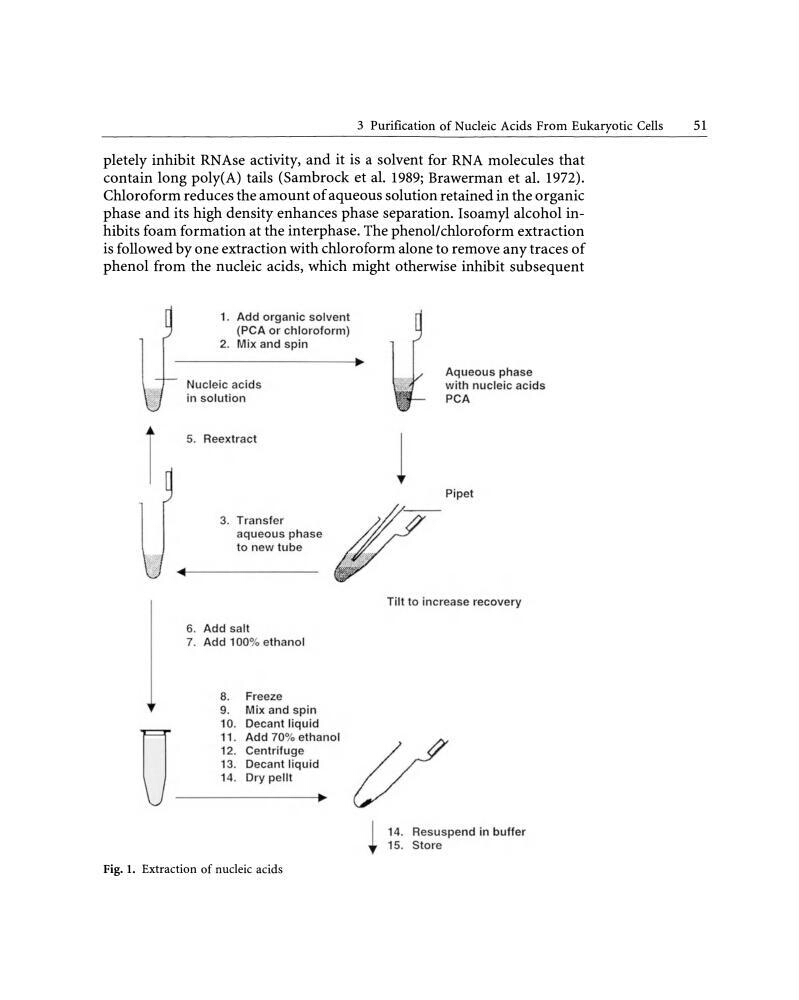
Fig. 1. Extraction of nucleic acids
I 14. Resuspend in buffer
.. 15. Store
51
pletely inhibit RNAse activity, and it is a solvent for RNA molecules that
contain long poly(A) tails (Sambrock et al. 1989; Brawerman et al. 1972).
Chloroform reduces the amount of aqueous solution retained in the organic
phase and its high density enhances phase separation. Isoamyl alcohol inhibits foam formation at the interphase. The phenol!chloroform extraction
is followed by one extraction with chloroform alone to remove any traces of
phenol from the nucleic acids, which might otherwise inhibit subsequent
r
1. Add organic solvent
(PCA or chloroform)
2. Mix and spin
Nucleic acids
in solution
5. Reextract
3. Transfer
aqueous phase
to new tube
6. Add salt
7. Add 100% ethanol
8.
Freeze
l
Aqueous phase
with nucleic acids
PCA
Pipet
Tilt to increase recovery
9.
Mix and spin
10. Decant liquid
0
11. Add70%ethanol y
12. Gentrifuge
13. Decant liquid
14. Dry pellt
_________..
Fig. 1. Extraction of nucleic acids
I 14. Resuspend in buffer
.. 15. Store