

2 Enzyrnatic Modification of DNA and RNA
37
Procedure
The following gives an example for the dephosphorylation of 1 J.Lg vector CIP reaction
DNA, i. e. approximately 1 pmol DNA. Use at least 1 U CIP per pmol DNA. If
more than 10 J.Lg DNA is tobe dephosphorylated, the reaction should be
scaled up to 100 Jll.
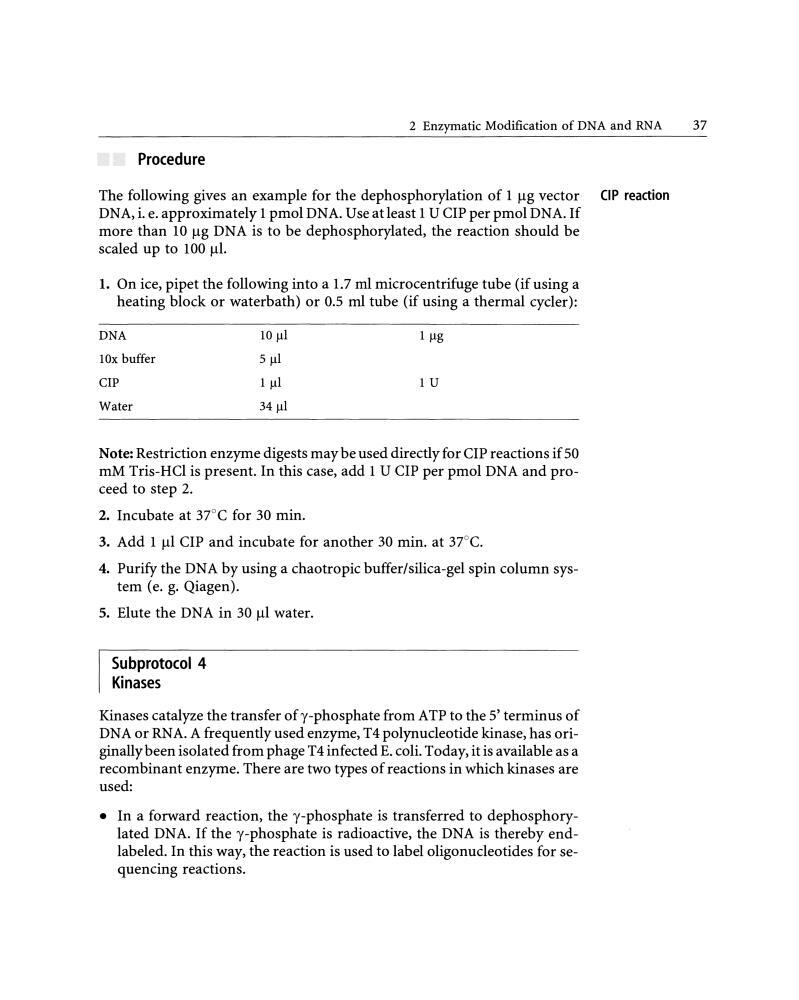
1. On ice, pipet the following into a 1.7 ml microcentrifuge tube (if using a
heating block or waterbath) or 0.5 ml tube (if using a thermal cycler):
DNA
lOx buffer
CIP
lU
Water
Note: Restrietion enzyme digests may be used directly for CIP reactions if 50
mM Tris-HCI is present. In this case, add 1 U CIP per pmol DNA and proceed to step 2.
2. Incubate at 37°C for 30 min.
3. Add 1 Jll CIP and incubate foranother 30 min. at 37°C.
4. Purify the DNA by using a chaotropic buffer/silica-gel spin column system (e. g. Qiagen).
5. Elute the DNA in 30 Jll water.
I Subprotocol 4
Kinases
Kinases catalyze the transfer of y-phosphate from ATP to the 5' terminus of
DNA or RNA. A frequently used enzyme, T4 polynucleotide kinase, has originally been isolated from phage T4 infected E. coli. Today, it is available as a
recombinant enzyme. There are two types of reactions in which kinases are
used:
• In a forward reaction, the y-phosphate is transferred to dephosphorylated DNA. If the y-phosphate is radioactive, the DNA is thereby endlabeled. In this way, the reaction is used to Iabel oligonucleotides for sequencing reactions.
37
Procedure
The following gives an example for the dephosphorylation of 1 J.Lg vector CIP reaction
DNA, i. e. approximately 1 pmol DNA. Use at least 1 U CIP per pmol DNA. If
more than 10 J.Lg DNA is tobe dephosphorylated, the reaction should be
scaled up to 100 Jll.
1. On ice, pipet the following into a 1.7 ml microcentrifuge tube (if using a
heating block or waterbath) or 0.5 ml tube (if using a thermal cycler):
DNA
lOx buffer
CIP
lU
Water
Note: Restrietion enzyme digests may be used directly for CIP reactions if 50
mM Tris-HCI is present. In this case, add 1 U CIP per pmol DNA and proceed to step 2.
2. Incubate at 37°C for 30 min.
3. Add 1 Jll CIP and incubate foranother 30 min. at 37°C.
4. Purify the DNA by using a chaotropic buffer/silica-gel spin column system (e. g. Qiagen).
5. Elute the DNA in 30 Jll water.
I Subprotocol 4
Kinases
Kinases catalyze the transfer of y-phosphate from ATP to the 5' terminus of
DNA or RNA. A frequently used enzyme, T4 polynucleotide kinase, has originally been isolated from phage T4 infected E. coli. Today, it is available as a
recombinant enzyme. There are two types of reactions in which kinases are
used:
• In a forward reaction, the y-phosphate is transferred to dephosphorylated DNA. If the y-phosphate is radioactive, the DNA is thereby endlabeled. In this way, the reaction is used to Iabel oligonucleotides for sequencing reactions.