

2 Enzymatic Modification of DNA and RNA
35
end ligation buffer: 0.66 M Tris-HCl pH7.6, 50 mM MgC12, 50 mM DTT,
10 mM hexaminecobalt chloride, 2 mM ATP, 5 mM spermidine-HCl, 250
J..Lg/ml bovine serum albumine
• T4 DNA ligase (1-5 Weiss units/J..Ll, available from various suppliers)
Procedure
The protocol gives an example for a standard ligation reaction of cohesive or T4 ligase reaction
blunt DNA ends, e. g. the ligation of a 1000 bp DNA insert into a 3000 bp
plasmid vector.
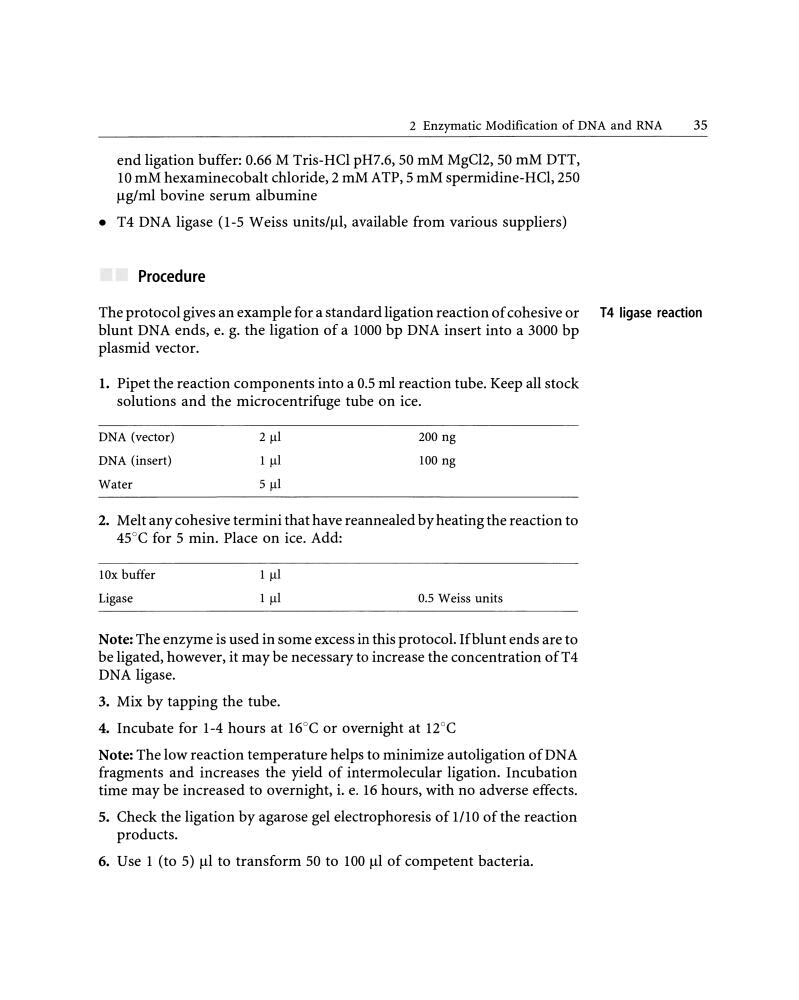
1. Pipet the reaction components into a 0.5 ml reaction tube. Keep all stock
solutions and the microcentrifuge tube on ice.
DNA (vector)
DNA (insert)
Water
200 ng
100 ng
2. Melt any cohesive termini that have reannealed by heating the reaction to
45°C for 5 min. Place on ice. Add:
lOx buffer
Ligase
0.5 W eiss units
Note: The enzyme is used in some excess in this protocol. Ifblunt ends are to
be ligated, however, it may be necessary to increase the concentration ofT4
DNA ligase.
3. Mix by tapping the tube.
4. Incubate for 1-4 hours at 16°C or overnight at 12°C
Note: The low reaction temperature helps to minimize autoligation ofDNA
fragments and increases the yield of intermolecular ligation. Incubation
time may be increased to overnight, i. e. 16 hours, with no adverse effects.
5. Check the ligation by agarose gel electrophoresis of 1/10 of the reaction
products.
6. Use 1 (to 5} J.!l to transform 50 to 100 J.!l of competent bacteria.
35
end ligation buffer: 0.66 M Tris-HCl pH7.6, 50 mM MgC12, 50 mM DTT,
10 mM hexaminecobalt chloride, 2 mM ATP, 5 mM spermidine-HCl, 250
J..Lg/ml bovine serum albumine
• T4 DNA ligase (1-5 Weiss units/J..Ll, available from various suppliers)
Procedure
The protocol gives an example for a standard ligation reaction of cohesive or T4 ligase reaction
blunt DNA ends, e. g. the ligation of a 1000 bp DNA insert into a 3000 bp
plasmid vector.
1. Pipet the reaction components into a 0.5 ml reaction tube. Keep all stock
solutions and the microcentrifuge tube on ice.
DNA (vector)
DNA (insert)
Water
200 ng
100 ng
2. Melt any cohesive termini that have reannealed by heating the reaction to
45°C for 5 min. Place on ice. Add:
lOx buffer
Ligase
0.5 W eiss units
Note: The enzyme is used in some excess in this protocol. Ifblunt ends are to
be ligated, however, it may be necessary to increase the concentration ofT4
DNA ligase.
3. Mix by tapping the tube.
4. Incubate for 1-4 hours at 16°C or overnight at 12°C
Note: The low reaction temperature helps to minimize autoligation ofDNA
fragments and increases the yield of intermolecular ligation. Incubation
time may be increased to overnight, i. e. 16 hours, with no adverse effects.
5. Check the ligation by agarose gel electrophoresis of 1/10 of the reaction
products.
6. Use 1 (to 5} J.!l to transform 50 to 100 J.!l of competent bacteria.