

2 Enzymatic Modification of DNA and RNA
29
Cleavage of a DN A fragment may result in blunt ends, 3' protruding ends,
or 3' recessed ends. Figure 3 shows examples for each group. Blunt ended
DNA fragments can be ligated to any other blunt ended fragment, regardless
ofthe enzymes theywere generated with. Blunt ends have no inherent tendency tostick together, since they are base paired out to their ends. In contrast, Pstl and EcoRI produce short single stranded tails. Complementary
single stranded tails tend to associate by base pairing. They are therefore
called cohesive, or sticky ends. Cohesive ends can be permanently joined
together by the action of DNA ligase (see below).
Uses
Restrietion enzymes are used to cut purified preparations of genomic, plasmid, phage, phagemid, or cosmid DNA. Digestion of genomic DNA results
in many fragments of different lengths which appear as a smear on agarose
gel electrophoresis, whereas digestion of cloned DNA results in distinct
bands. The lengths of these bands in base pairs (bp) are predictable
from the sequence. Digested DNA may be used for Southern blotting, in
which specific fragments are identified using a labeled DNA probe. Restrietion endonuclease-digested DNA is also used for molecular cloning. Since
all digested fragments have cohesive or blunt ends of predictable sequence,
DNA from different sources may be ligated together. For example, a Pstl
fragment of a human gene may be ligated into a bacterial plasmid vector
that has been digested with the same enzyme, thus creating a molecule of
"recombinant DNA".
Protocols for restriction endonuclease digestion
Most restriction enzymes are available as purified proteins from bacterial
cultures. However, some have been cloned and are available as in vitro expressed recombinant proteins. Most restriction enzymes are shipped and
stored in glycerol containing buffers at -20°C. Their activity is given in U/).11.
One unit is defined as the amount of enzyme that cuts 1 )lg oflambda phage
DNA to completion in one hour.
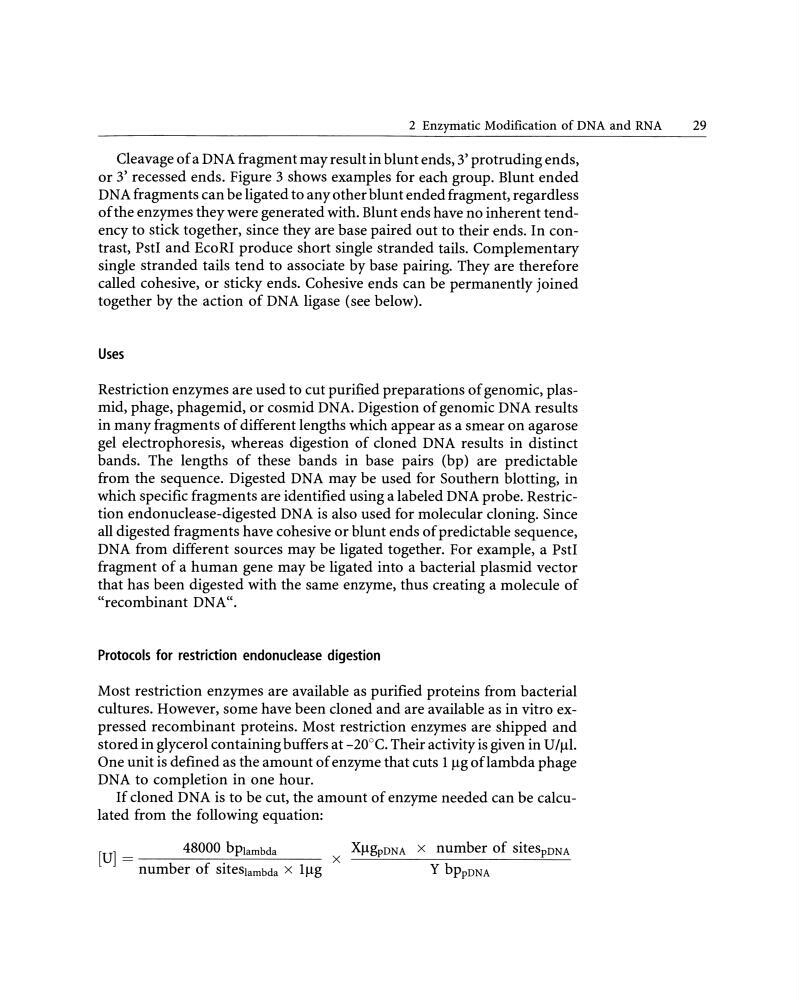
If cloned DNA is to be cut, the amount of enzyme needed can be calculated from the following equation:
[U] =
48000 bp1ambda
x X)lgpDNA x number of sitespDNA
number of siteslambda x l)lg
Y bppDNA
29
Cleavage of a DN A fragment may result in blunt ends, 3' protruding ends,
or 3' recessed ends. Figure 3 shows examples for each group. Blunt ended
DNA fragments can be ligated to any other blunt ended fragment, regardless
ofthe enzymes theywere generated with. Blunt ends have no inherent tendency tostick together, since they are base paired out to their ends. In contrast, Pstl and EcoRI produce short single stranded tails. Complementary
single stranded tails tend to associate by base pairing. They are therefore
called cohesive, or sticky ends. Cohesive ends can be permanently joined
together by the action of DNA ligase (see below).
Uses
Restrietion enzymes are used to cut purified preparations of genomic, plasmid, phage, phagemid, or cosmid DNA. Digestion of genomic DNA results
in many fragments of different lengths which appear as a smear on agarose
gel electrophoresis, whereas digestion of cloned DNA results in distinct
bands. The lengths of these bands in base pairs (bp) are predictable
from the sequence. Digested DNA may be used for Southern blotting, in
which specific fragments are identified using a labeled DNA probe. Restrietion endonuclease-digested DNA is also used for molecular cloning. Since
all digested fragments have cohesive or blunt ends of predictable sequence,
DNA from different sources may be ligated together. For example, a Pstl
fragment of a human gene may be ligated into a bacterial plasmid vector
that has been digested with the same enzyme, thus creating a molecule of
"recombinant DNA".
Protocols for restriction endonuclease digestion
Most restriction enzymes are available as purified proteins from bacterial
cultures. However, some have been cloned and are available as in vitro expressed recombinant proteins. Most restriction enzymes are shipped and
stored in glycerol containing buffers at -20°C. Their activity is given in U/).11.
One unit is defined as the amount of enzyme that cuts 1 )lg oflambda phage
DNA to completion in one hour.
If cloned DNA is to be cut, the amount of enzyme needed can be calculated from the following equation:
[U] =
48000 bp1ambda
x X)lgpDNA x number of sitespDNA
number of siteslambda x l)lg
Y bppDNA