

374
ROBERT F. REILLY
lmmunoprecipitation
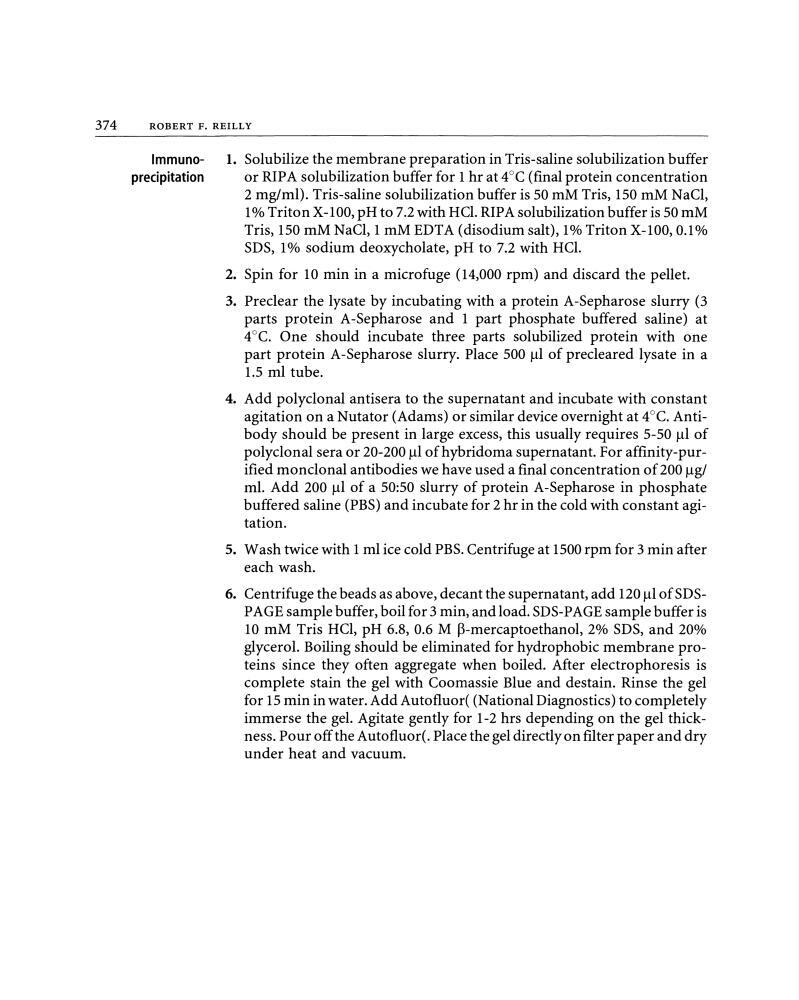
1. Solubilize the membrane preparation in Tris-saline solubilization buffer
or RIPA solubilization buffer for 1 hr at 4°C (final protein concentration
2 mg/ml). Tris-saline solubilization buffer is 50 mM Tris, 150 mM NaCl,
1% Triton X-100, pH to 7.2 with HCl. RIPA solubilization buffer is 50 mM
Tris, 150 mM NaCl, 1 mM EDTA (disodium salt), 1% Triton X-100, 0.1%
SDS, 1% sodium deoxycholate, pH to 7.2 with HCl.
2. Spin for 10 min in a microfuge (14,000 rpm) and discard the pellet.
3. Preclear the lysate by incubating with a protein A-Sepharose slurry (3
parts protein A-Sepharose and 1 part phosphate buffered saline) at
4 oc. One should incubate three parts solubilized protein with one
part protein A-Sepharose slurry. Place 500 Jll of precleared lysate in a
1.5 ml tube.
4. Add polyclonal antisera to the supernatant and incubate with constant
agitation on a Nutator (Adams) or similar device overnight at 4°C. Antibody should be present in large excess, this usually requires 5-50 Jll of
polyclonal sera or 20-200 Jll ofhybridoma supernatant. For affinity-purified mondanal antihoclies we have used a final concentration of200 Jlg/
ml. Add 200 Jll of a 50:50 slurry of protein A-Sepharose in phosphate
buffered saline (PBS) and incubate for 2 hr in the cold with constant agitation.
5. Wash twice with 1 ml ice cold PBS. Centrifuge at 1500 rpm for 3 min after
each wash.
6. Centrifuge the beads as above, decant the supernatant, add 120 Jll of SDSp AGE sample buffer, boil for 3 min, and load. SDS-PAGE sample buffer is
10 mM Tris HCl, pH 6.8, 0.6 M ß-mercaptoethanol, 2% SDS, and 20%
glycerol. Boiling should be eliminated for hydrophobic membrane proteins since they often aggregate when boiled. After electrophoresis is
complete stain the gel with Coomassie Blue and destain. Rinse the gel
for 15 min in water. Add Autofluor( (National Diagnostics) to completely
immerse the gel. Agitate gently for 1-2 hrs depending on the gel thickness. Po ur off the Autofluor(. Place the gel directly on filter paper and dry
under heat and vacuum.
ROBERT F. REILLY
lmmunoprecipitation
1. Solubilize the membrane preparation in Tris-saline solubilization buffer
or RIPA solubilization buffer for 1 hr at 4°C (final protein concentration
2 mg/ml). Tris-saline solubilization buffer is 50 mM Tris, 150 mM NaCl,
1% Triton X-100, pH to 7.2 with HCl. RIPA solubilization buffer is 50 mM
Tris, 150 mM NaCl, 1 mM EDTA (disodium salt), 1% Triton X-100, 0.1%
SDS, 1% sodium deoxycholate, pH to 7.2 with HCl.
2. Spin for 10 min in a microfuge (14,000 rpm) and discard the pellet.
3. Preclear the lysate by incubating with a protein A-Sepharose slurry (3
parts protein A-Sepharose and 1 part phosphate buffered saline) at
4 oc. One should incubate three parts solubilized protein with one
part protein A-Sepharose slurry. Place 500 Jll of precleared lysate in a
1.5 ml tube.
4. Add polyclonal antisera to the supernatant and incubate with constant
agitation on a Nutator (Adams) or similar device overnight at 4°C. Antibody should be present in large excess, this usually requires 5-50 Jll of
polyclonal sera or 20-200 Jll ofhybridoma supernatant. For affinity-purified mondanal antihoclies we have used a final concentration of200 Jlg/
ml. Add 200 Jll of a 50:50 slurry of protein A-Sepharose in phosphate
buffered saline (PBS) and incubate for 2 hr in the cold with constant agitation.
5. Wash twice with 1 ml ice cold PBS. Centrifuge at 1500 rpm for 3 min after
each wash.
6. Centrifuge the beads as above, decant the supernatant, add 120 Jll of SDSp AGE sample buffer, boil for 3 min, and load. SDS-PAGE sample buffer is
10 mM Tris HCl, pH 6.8, 0.6 M ß-mercaptoethanol, 2% SDS, and 20%
glycerol. Boiling should be eliminated for hydrophobic membrane proteins since they often aggregate when boiled. After electrophoresis is
complete stain the gel with Coomassie Blue and destain. Rinse the gel
for 15 min in water. Add Autofluor( (National Diagnostics) to completely
immerse the gel. Agitate gently for 1-2 hrs depending on the gel thickness. Po ur off the Autofluor(. Place the gel directly on filter paper and dry
under heat and vacuum.