

370
ROBERT F. REILLY
Other important points include:
• One can use a variety of templates for cell-free translation. Cellular RNA
requires 5-10 )lg; for poly (A)+ or transcribed RNA one needs only 0.251.0 )lg.
• Known inhibitors of translation include oxidized thiols, low concentrations of double stranded RNA (inhibits initiation by stimulating phosphorylation of eiF2), and acidic polysaccharides.
• The concentrations of magnesium (range 0.5-3.5 mM; concentration in
lysate 0.5 mM) and potassium (range 60-135 mM; concentration in lysate
79 mM) may need to be optimized for certain transcripts. One of the
moreextreme examples of this is poliovirus mRNA which requires a final
concentration of potassium of 60 mM and is translated very poorly at 125
mM. Different initiation sites may have different magnesium optima,
and termination may be suppressed by high concentrations of magnesmm.
• Spermidine (0.4 mM) has been noted to increase translation efficiencyin
some cases (7).
• Processing events such as signal peptide cleavage, membrane insertion,
translocation, and core glycosylation can also be examined by adding
canine microsomal membranes to the standard reaction (8). The microsomes are stripped of endogenaus membrane-bound ribosomes and
mRNA. Depending on the mRNA assayed the translation efficiency
may drop by 10-50% in the presence of microsomal membranes. The
following is a sample protocol for the use of microsomal membranes
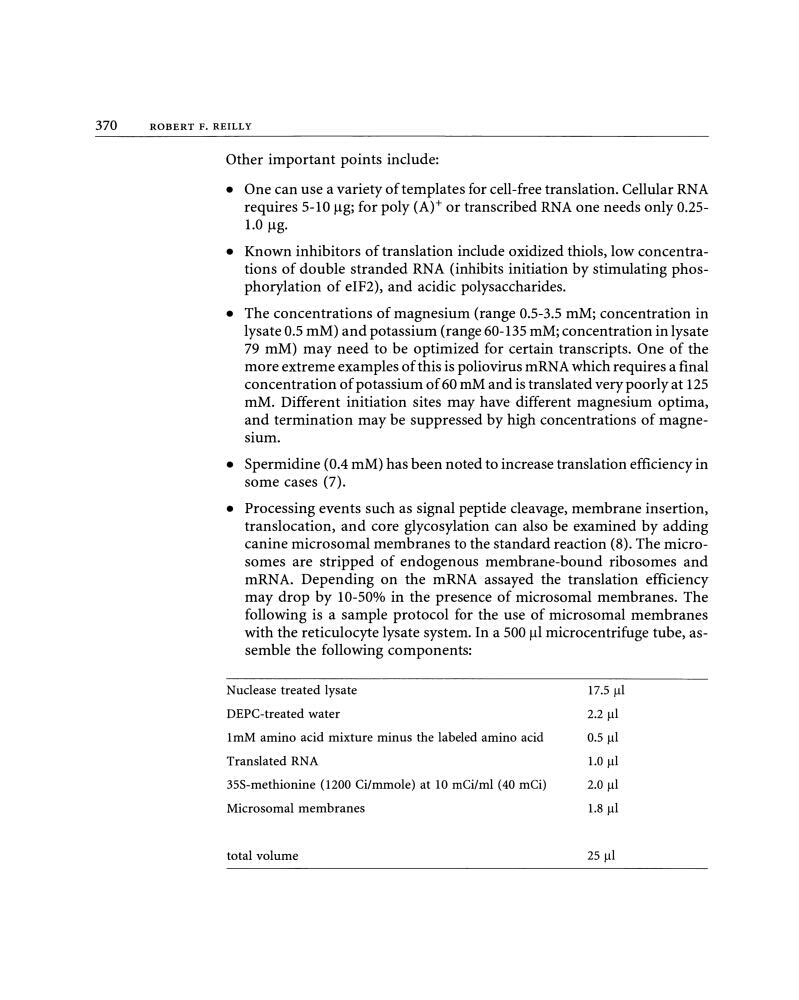
with the reticulocyte lysate system. In a 500 ).11 microcentrifuge tube, assemble the following components:
Nuclease treated lysate
DEPC-treated water
lmM amino acid mixtureminus the labeled amino acid
Translated RNA
35S-methionine (1200 Ci/mmole) at 10 mCi/ml (40 mCi)
Microsomal membranes
total volume
17.5 Jll
2.2 Jll
0.5 Jll
1.0 Jll
2.0 Jll
1.8 Jll
ROBERT F. REILLY
Other important points include:
• One can use a variety of templates for cell-free translation. Cellular RNA
requires 5-10 )lg; for poly (A)+ or transcribed RNA one needs only 0.251.0 )lg.
• Known inhibitors of translation include oxidized thiols, low concentrations of double stranded RNA (inhibits initiation by stimulating phosphorylation of eiF2), and acidic polysaccharides.
• The concentrations of magnesium (range 0.5-3.5 mM; concentration in
lysate 0.5 mM) and potassium (range 60-135 mM; concentration in lysate
79 mM) may need to be optimized for certain transcripts. One of the
moreextreme examples of this is poliovirus mRNA which requires a final
concentration of potassium of 60 mM and is translated very poorly at 125
mM. Different initiation sites may have different magnesium optima,
and termination may be suppressed by high concentrations of magnesmm.
• Spermidine (0.4 mM) has been noted to increase translation efficiencyin
some cases (7).
• Processing events such as signal peptide cleavage, membrane insertion,
translocation, and core glycosylation can also be examined by adding
canine microsomal membranes to the standard reaction (8). The microsomes are stripped of endogenaus membrane-bound ribosomes and
mRNA. Depending on the mRNA assayed the translation efficiency
may drop by 10-50% in the presence of microsomal membranes. The
following is a sample protocol for the use of microsomal membranes
with the reticulocyte lysate system. In a 500 ).11 microcentrifuge tube, assemble the following components:
Nuclease treated lysate
DEPC-treated water
lmM amino acid mixtureminus the labeled amino acid
Translated RNA
35S-methionine (1200 Ci/mmole) at 10 mCi/ml (40 mCi)
Microsomal membranes
total volume
17.5 Jll
2.2 Jll
0.5 Jll
1.0 Jll
2.0 Jll
1.8 Jll