

216
FRIEDHELM HILDEBRANDT AND IVA SINGH-SAWHNEY
• Reaction buffer
Gelatin and bovine serum albumin (100 )lg/ml) as well as nonionic detergents (e.g. Tween 20, 0.05%) can be used in the reaction buffer to help
stabilize the polymerase. DMSO may be helpful in multiplex PCR.
• Annealing temperatures
The optimal annealingtemperature fortheprimertemplate hybrid must be
determined empirically (7) and depends on the length of the primers, their
GC content, and the percentage of mismatch match between primer and
template sequence. As a rule one starts at 50°C, then increases the temperature by5"C increments in each subsequent experiment until a product
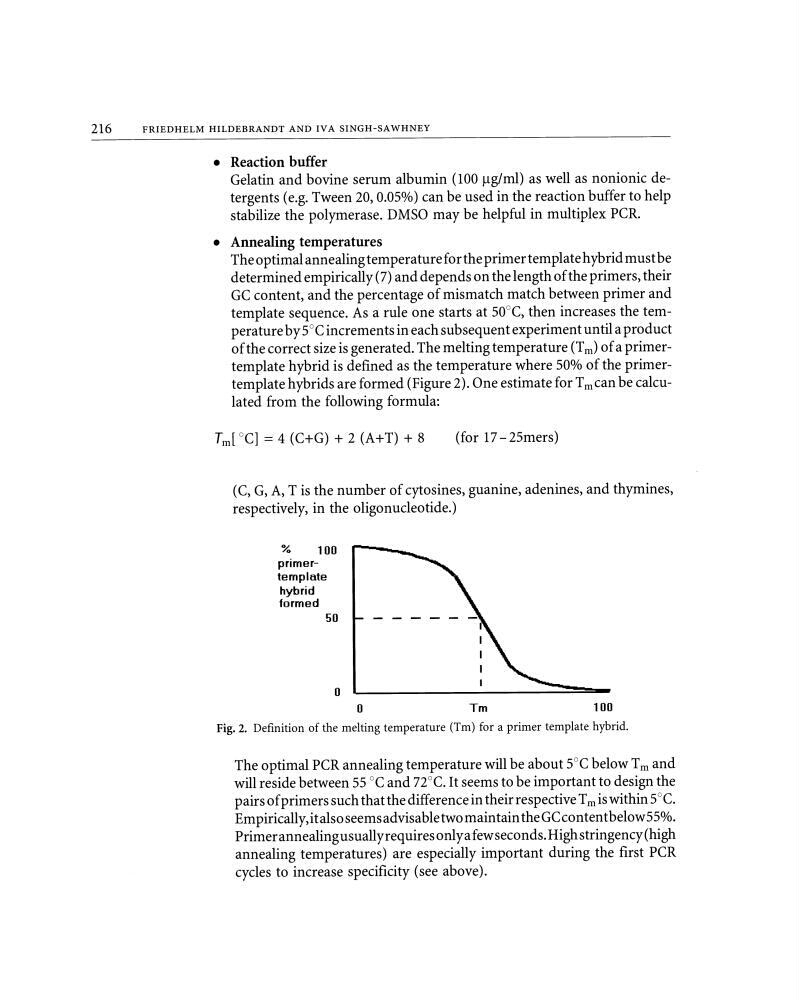
of the correct size is generated. The melting temperature (Tm) of a primertemplate hybrid is defined as the temperature where 50% of the primertemplate hybrids are formed (Figure 2). One estimate forT m can be calculated from the following formula:
(for 17-25mers)
(C, G, A, T is the number of cytosines, guanine, adenines, and thymines,
respectively, in the oligonucleotide.)
%
100
primertemplate
hybrid
formed
50
0
0
Tm
100
Fig. 2. Definition of the melting temperature (Tm) for a primer template hybrid.
The optimal PCR annealing temperature will be about 5°C below Tm and
will reside between 55 oc and 72°C. It seems tobe important to design the
pairs of primers suchthat the difference in their respective Tm is within 5 oc.
Empirically,italsoseemsadvisabletwom aintaintheGCcontentbelow55%.
Primerannealingusuallyrequires onlyafewseconds. High stringency(high
annealing temperatures) are especially important during the first PCR
cycles to increase specificity (see above).
FRIEDHELM HILDEBRANDT AND IVA SINGH-SAWHNEY
• Reaction buffer
Gelatin and bovine serum albumin (100 )lg/ml) as well as nonionic detergents (e.g. Tween 20, 0.05%) can be used in the reaction buffer to help
stabilize the polymerase. DMSO may be helpful in multiplex PCR.
• Annealing temperatures
The optimal annealingtemperature fortheprimertemplate hybrid must be
determined empirically (7) and depends on the length of the primers, their
GC content, and the percentage of mismatch match between primer and
template sequence. As a rule one starts at 50°C, then increases the temperature by5"C increments in each subsequent experiment until a product
of the correct size is generated. The melting temperature (Tm) of a primertemplate hybrid is defined as the temperature where 50% of the primertemplate hybrids are formed (Figure 2). One estimate forT m can be calculated from the following formula:
(for 17-25mers)
(C, G, A, T is the number of cytosines, guanine, adenines, and thymines,
respectively, in the oligonucleotide.)
%
100
primertemplate
hybrid
formed
50
0
0
Tm
100
Fig. 2. Definition of the melting temperature (Tm) for a primer template hybrid.
The optimal PCR annealing temperature will be about 5°C below Tm and
will reside between 55 oc and 72°C. It seems tobe important to design the
pairs of primers suchthat the difference in their respective Tm is within 5 oc.
Empirically,italsoseemsadvisabletwom aintaintheGCcontentbelow55%.
Primerannealingusuallyrequires onlyafewseconds. High stringency(high
annealing temperatures) are especially important during the first PCR
cycles to increase specificity (see above).