

212
FRIEDHELM HILDEBRANDT AND IVA SINGH-SAWHNEY
3. Aliquot 1 reaction volume of master mix into each PCR tube.
4. Add 5 1-Ll of DNA template to each PCR sample {10 5 -10 6 molecules, i.e.
approximately 1 fmol), mix.
5. Overlay with 50 1-Ll of mineral oil.
Note: For multiplex PCR (i.e. coamplification using multiple primer pairs)
adjust the volume by reducing the amount of water added.
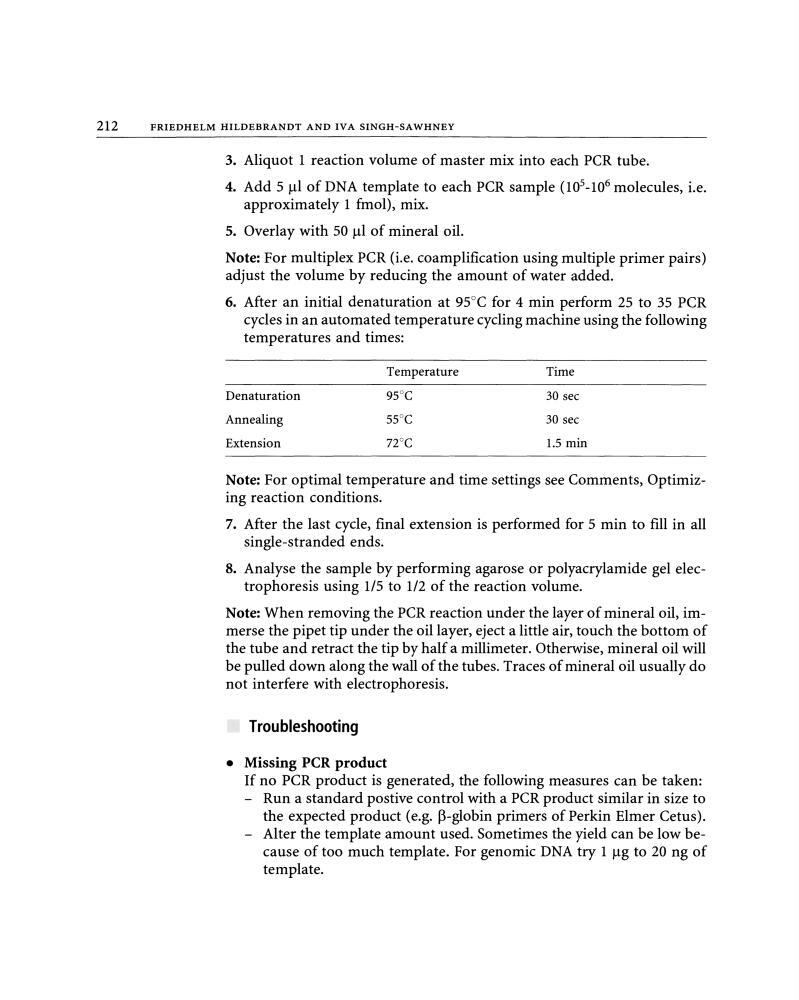
6. After an initial denaturation at 95°C for 4 min perform 25 to 35 PCR
cycles in an automated temperature cycling machine using the following
temperatures and times:
Denaturation
Annealing
Extension
Temperature
95°C
55°C
72°C
Time
30 sec
30 sec
1.5 min
Note: For optimal temperature and time settings see Comments, Optimizing reaction conditions.
7. After the last cycle, final extension is performed for 5 min to ftll in all
single-stranded ends.
8. Analyse the sample by performing agarose or polyacrylamide gel electrophoresis using 1/5 to 1/2 of the reaction volume.
Note: When removing the PCR reaction under the layer of mineral oil, immerse the pipet tip under the oillayer, eject a little air, touch the bottom of
the tube and retract the tip by half a millimeter. Otherwise, mineral oil will
be pulled down along the wall of the tubes. Traces of mineral oil usually do
not interfere with electrophoresis.
Troubleshooting
• Missing PCR product
If no PCR product is generated, the following measures can be taken:
- Run a standard postive control with a PCR product similar in size to
the expected product (e.g. ß-globin primers of Perkin Eimer Cetus).
- Alter the template amount used. Sometimes the yield can be low because of too much template. For genomic DNA try 1 !-Lg to 20 ng of
template.
FRIEDHELM HILDEBRANDT AND IVA SINGH-SAWHNEY
3. Aliquot 1 reaction volume of master mix into each PCR tube.
4. Add 5 1-Ll of DNA template to each PCR sample {10 5 -10 6 molecules, i.e.
approximately 1 fmol), mix.
5. Overlay with 50 1-Ll of mineral oil.
Note: For multiplex PCR (i.e. coamplification using multiple primer pairs)
adjust the volume by reducing the amount of water added.
6. After an initial denaturation at 95°C for 4 min perform 25 to 35 PCR
cycles in an automated temperature cycling machine using the following
temperatures and times:
Denaturation
Annealing
Extension
Temperature
95°C
55°C
72°C
Time
30 sec
30 sec
1.5 min
Note: For optimal temperature and time settings see Comments, Optimizing reaction conditions.
7. After the last cycle, final extension is performed for 5 min to ftll in all
single-stranded ends.
8. Analyse the sample by performing agarose or polyacrylamide gel electrophoresis using 1/5 to 1/2 of the reaction volume.
Note: When removing the PCR reaction under the layer of mineral oil, immerse the pipet tip under the oillayer, eject a little air, touch the bottom of
the tube and retract the tip by half a millimeter. Otherwise, mineral oil will
be pulled down along the wall of the tubes. Traces of mineral oil usually do
not interfere with electrophoresis.
Troubleshooting
• Missing PCR product
If no PCR product is generated, the following measures can be taken:
- Run a standard postive control with a PCR product similar in size to
the expected product (e.g. ß-globin primers of Perkin Eimer Cetus).
- Alter the template amount used. Sometimes the yield can be low because of too much template. For genomic DNA try 1 !-Lg to 20 ng of
template.