

13 Sequencing
187
plementary to the 3' -end of the known vector sequence adjacent to the insert, is synthesized. This primer anneals to the denatured template, thereby
initiating in vitro synthesis of a complementary DNA strand by the use of a
DNA polymerase. Sanger's method is based on the use of small amounts of
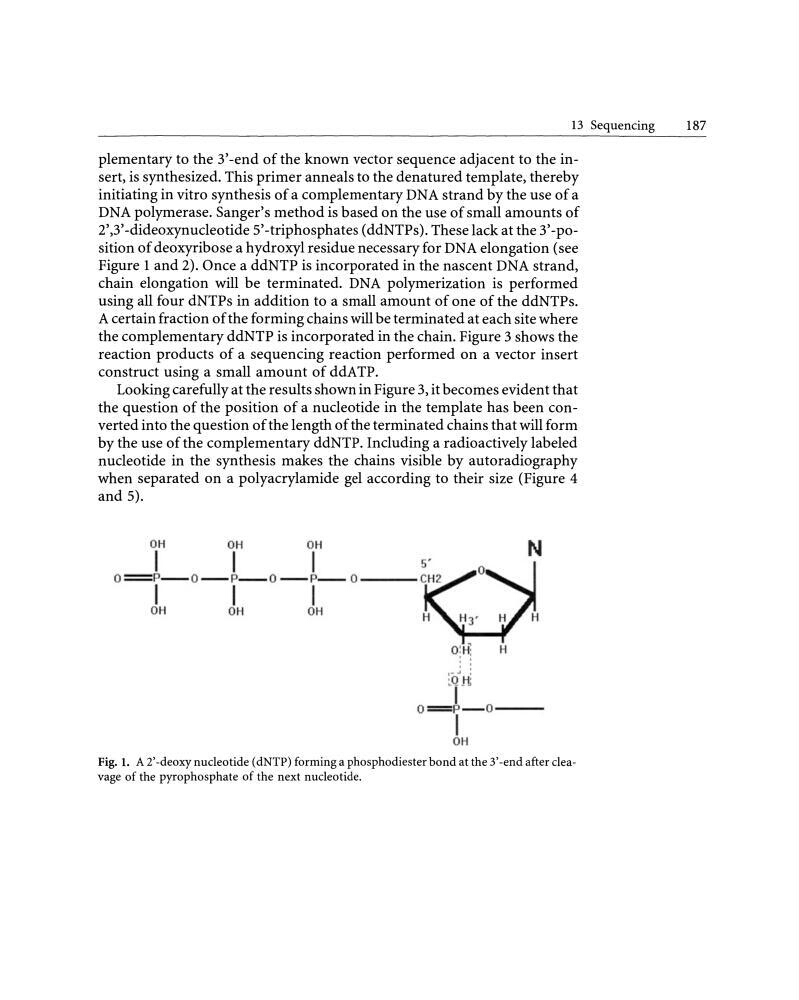
2',3' -dideoxynucleotide 5'-triphosphates (ddNTPs). Theselack atthe 3' -position of deoxyribose a hydroxyl residue necessary for DNA elongation (see
Figure 1 and 2). Once a ddNTP is incorporated in the nascent DNA strand,
chain elongation will be terminated. DNA polymerization is performed
using all four dNTPs in addition to a small amount of one of the ddNTPs.
A certain fraction of the forming chains will be terminated at each site where
the complementary ddNTP is incorporated in the chain. Figure 3 shows the
reaction products of a sequencing reaction performed on a vector insert
construct using a small amount of ddATP.
Looking carefully at the results shown in Figure 3, it becomes evident that
the question of the position of a nucleotide in the template has been converted into the question of the length of the terminated chains that will form
by the use of the complementary ddNTP. Including a radioactively labeled
nucleotide in the synthesis makes the chains visible by autoradiography
when separated on a polyacrylamide gel according to their size (Figure 4
and 5).
OH
OH
OH
I
I
I
N
5'
o =
P- - 0 - - P- - 0 - - P- - 0 - - -
1
I
I
OH
OH
OH
. .
:o"H:
·r·
O= P - 0 - - -
1
OH
Fig. 1. A 2' -deoxy nucleotide ( dNTP) forming a phosphodiester bond at the 3' -end after cleavage of the pyrophosphate of the next nucleotide.
187
plementary to the 3' -end of the known vector sequence adjacent to the insert, is synthesized. This primer anneals to the denatured template, thereby
initiating in vitro synthesis of a complementary DNA strand by the use of a
DNA polymerase. Sanger's method is based on the use of small amounts of
2',3' -dideoxynucleotide 5'-triphosphates (ddNTPs). Theselack atthe 3' -position of deoxyribose a hydroxyl residue necessary for DNA elongation (see
Figure 1 and 2). Once a ddNTP is incorporated in the nascent DNA strand,
chain elongation will be terminated. DNA polymerization is performed
using all four dNTPs in addition to a small amount of one of the ddNTPs.
A certain fraction of the forming chains will be terminated at each site where
the complementary ddNTP is incorporated in the chain. Figure 3 shows the
reaction products of a sequencing reaction performed on a vector insert
construct using a small amount of ddATP.
Looking carefully at the results shown in Figure 3, it becomes evident that
the question of the position of a nucleotide in the template has been converted into the question of the length of the terminated chains that will form
by the use of the complementary ddNTP. Including a radioactively labeled
nucleotide in the synthesis makes the chains visible by autoradiography
when separated on a polyacrylamide gel according to their size (Figure 4
and 5).
OH
OH
OH
I
I
I
N
5'
o =
P- - 0 - - P- - 0 - - P- - 0 - - -
1
I
I
OH
OH
OH
. .
:o"H:
·r·
O= P - 0 - - -
1
OH
Fig. 1. A 2' -deoxy nucleotide ( dNTP) forming a phosphodiester bond at the 3' -end after cleavage of the pyrophosphate of the next nucleotide.