

10 Hybridization Methods (Southern and Northern Blotting)
133
2. Add at least 4 gel volumes 0.25 M HCl to depurinate the DNA. Incubate
for 15 minutes at room temperature on a rocker. The bromophenol blue
from the gelloading buffer turns yellow during this procedure. If there is
still blue color after 15 minutes, incubate for additional 5 minutes.
Note: Depurination facilitates capillary transfer ofDNA bands of 10 kb and
more. Hence, it may be omitted if only DN A bands of less than 10 kb are of
interest.
3. Carefully drain the HCl from the plastic box. Rinse the gel once in distilled water.
4. Add at least 4 gel volumes of denaturing buffer ( caustic; wear gloves and
protective goggles!). Incubate for 20 minutes at room temperature on a
rocker.
5. Repeat step 4 with fresh buffer. Carefully drain the denaturing buffer.
Rinse the gel briefly with distilled water.
6. Add at least 4 gel volumes neutralization buffer. Incubate for 15 minutes
at room temperature on a rocker.
7. Repeat step 6 with fresh buffer.
8. While treating the gel, cut a piece of filter membrane (nitrocellulose or
nylon) to a size slightly larger than the gel. Prewet the filtermembranein
distilled water, then soak in 20x SSC for at least 15 minutes.
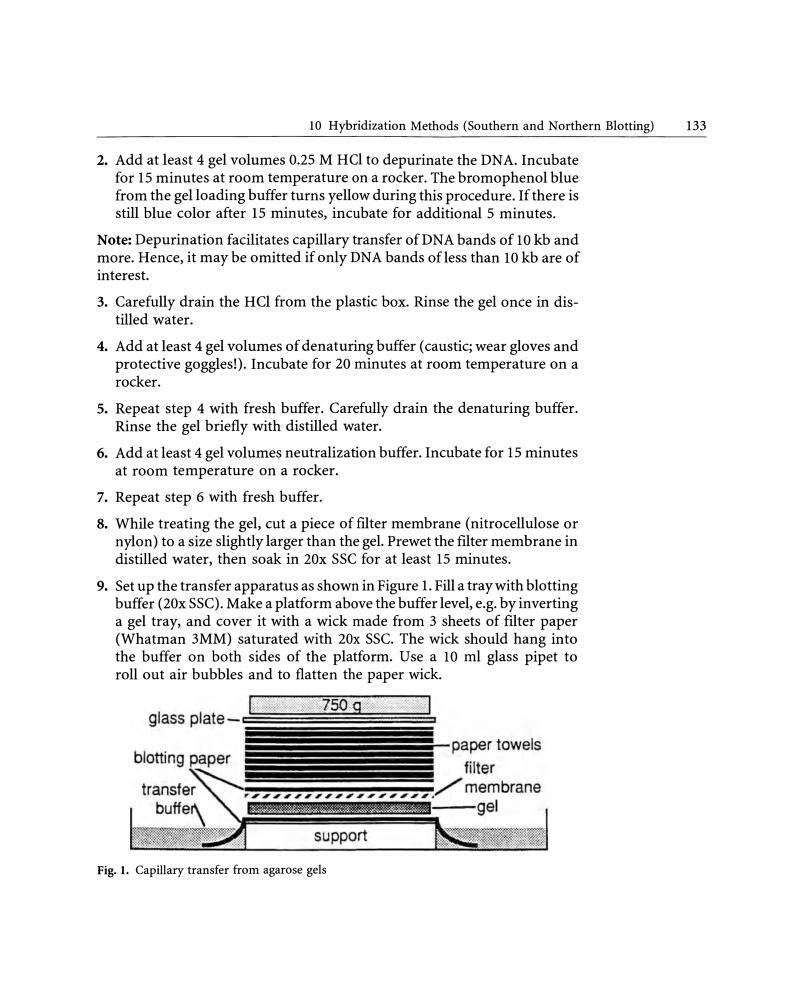
9. Set up the transfer apparatus as shown in Figure 1. Fill a traywith blotting
buffer (20x SSC). Make a platform above the buffer level, e.g. by inverting
a gel tray, and cover it with a wick made from 3 sheets of filter paper
(Whatman 3MM) saturated with 20x SSC. The wick should hang into
the buffer on both sides of the platform. Use a 10 ml glass pipet to
roll out air bubbles and to flatten the paper wick.
support
Fig. 1. Capillary transfer from agarose gels
133
2. Add at least 4 gel volumes 0.25 M HCl to depurinate the DNA. Incubate
for 15 minutes at room temperature on a rocker. The bromophenol blue
from the gelloading buffer turns yellow during this procedure. If there is
still blue color after 15 minutes, incubate for additional 5 minutes.
Note: Depurination facilitates capillary transfer ofDNA bands of 10 kb and
more. Hence, it may be omitted if only DN A bands of less than 10 kb are of
interest.
3. Carefully drain the HCl from the plastic box. Rinse the gel once in distilled water.
4. Add at least 4 gel volumes of denaturing buffer ( caustic; wear gloves and
protective goggles!). Incubate for 20 minutes at room temperature on a
rocker.
5. Repeat step 4 with fresh buffer. Carefully drain the denaturing buffer.
Rinse the gel briefly with distilled water.
6. Add at least 4 gel volumes neutralization buffer. Incubate for 15 minutes
at room temperature on a rocker.
7. Repeat step 6 with fresh buffer.
8. While treating the gel, cut a piece of filter membrane (nitrocellulose or
nylon) to a size slightly larger than the gel. Prewet the filtermembranein
distilled water, then soak in 20x SSC for at least 15 minutes.
9. Set up the transfer apparatus as shown in Figure 1. Fill a traywith blotting
buffer (20x SSC). Make a platform above the buffer level, e.g. by inverting
a gel tray, and cover it with a wick made from 3 sheets of filter paper
(Whatman 3MM) saturated with 20x SSC. The wick should hang into
the buffer on both sides of the platform. Use a 10 ml glass pipet to
roll out air bubbles and to flatten the paper wick.
support
Fig. 1. Capillary transfer from agarose gels