

10 Hybridization Methods (Southern and Northern Blotting)
127
At the molecular level, hybridization begins as soon as the ends of two complementary molecules come together. Once pairing ofbases is established at
one end, it proceeds in a zipper-like fashion throughout the length of the
molecule. The complexity, i.e. the sequence diversity, limits the speed of this
process. The more repetitive sequence elements there are (i.e. the lower the
complexity), the faster hybridization proceeds.
Factors influencing hybridization of nucleic acids
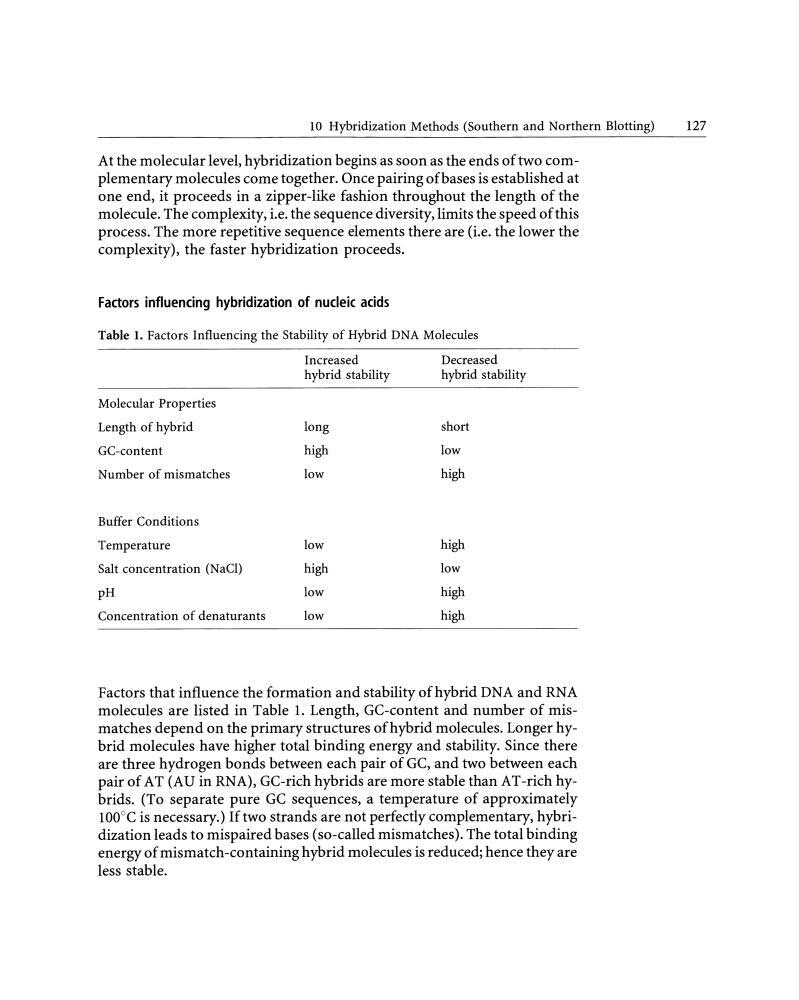
Table 1. Factars Influencing the Stability of Hybrid DNA Molecules
Molecular Properties
Length of hybrid
GC-content
Number of mismatches
Buffer Conditions
Temperature
Salt concentration (NaCl)
pH
Concentration of denaturants
Increased
hybrid stability
long
high
low
low
high
low
low
Decreased
hybrid stability
short
low
high
high
low
high
high
Factors that influence the formation and stability ofhybrid DNA and RNA
molecules are listed in Table 1. Length, GC-content and number of mismatches depend on the primary structures ofhybrid molecules. Longer hybrid molecules have higher total binding energy and stability. Since there
are three hydrogen bonds between each pair of GC, and two between each
pair of AT (AU in RNA), GC-rich hybrids are more stable than AT-rich hybrids. (To separate pure GC sequences, a temperature of approximately
100°C is necessary.) If two strandsarenot perfectly complementary, hybridization leads to mispaired bases (so-called mismatches). The total binding
energy of mismatch-containing hybrid molecules is reduced; hence they are
less stable.
127
At the molecular level, hybridization begins as soon as the ends of two complementary molecules come together. Once pairing ofbases is established at
one end, it proceeds in a zipper-like fashion throughout the length of the
molecule. The complexity, i.e. the sequence diversity, limits the speed of this
process. The more repetitive sequence elements there are (i.e. the lower the
complexity), the faster hybridization proceeds.
Factors influencing hybridization of nucleic acids
Table 1. Factars Influencing the Stability of Hybrid DNA Molecules
Molecular Properties
Length of hybrid
GC-content
Number of mismatches
Buffer Conditions
Temperature
Salt concentration (NaCl)
pH
Concentration of denaturants
Increased
hybrid stability
long
high
low
low
high
low
low
Decreased
hybrid stability
short
low
high
high
low
high
high
Factors that influence the formation and stability ofhybrid DNA and RNA
molecules are listed in Table 1. Length, GC-content and number of mismatches depend on the primary structures ofhybrid molecules. Longer hybrid molecules have higher total binding energy and stability. Since there
are three hydrogen bonds between each pair of GC, and two between each
pair of AT (AU in RNA), GC-rich hybrids are more stable than AT-rich hybrids. (To separate pure GC sequences, a temperature of approximately
100°C is necessary.) If two strandsarenot perfectly complementary, hybridization leads to mispaired bases (so-called mismatches). The total binding
energy of mismatch-containing hybrid molecules is reduced; hence they are
less stable.