

8 Pulsed-Field Gel Electrophoresis: Protocols
109
Procedure
1. Use sterile solutions and gloves to avoid degradation of DNA.
2. Rinse agarose blocks in 1 x TE for 3 x 20 min to remove EDTA (in Falcon
tubes).
3. Mix: Reaction buffer (high, medium or low salt buffer), 100 mM spermidine (for reactions using high salt buffer) and 10-20 units enzyme.
20 units of enzyme are plenty for a complete digestion of 10 )lg of
DNA overnight.
4. Include a control of a digest containing all ingredients except the enzyme
to check for unspecific DNA degradation.
5. Add agarose block to reaction mix; always manipulate blocks with sterile
scalpels or inoculating loops.
6. Digestion with two different enzymes can be done together if the buffers
are compatible, or sequentially (first use buffer with lower salt concentration; then adjust salt concentration). If the first enzyme requires 50°C,
then replace buffer for second enzyme.
7. If partial digests are needed, first try using 1:10 diluted enzyme at same
temperature and reaction time.
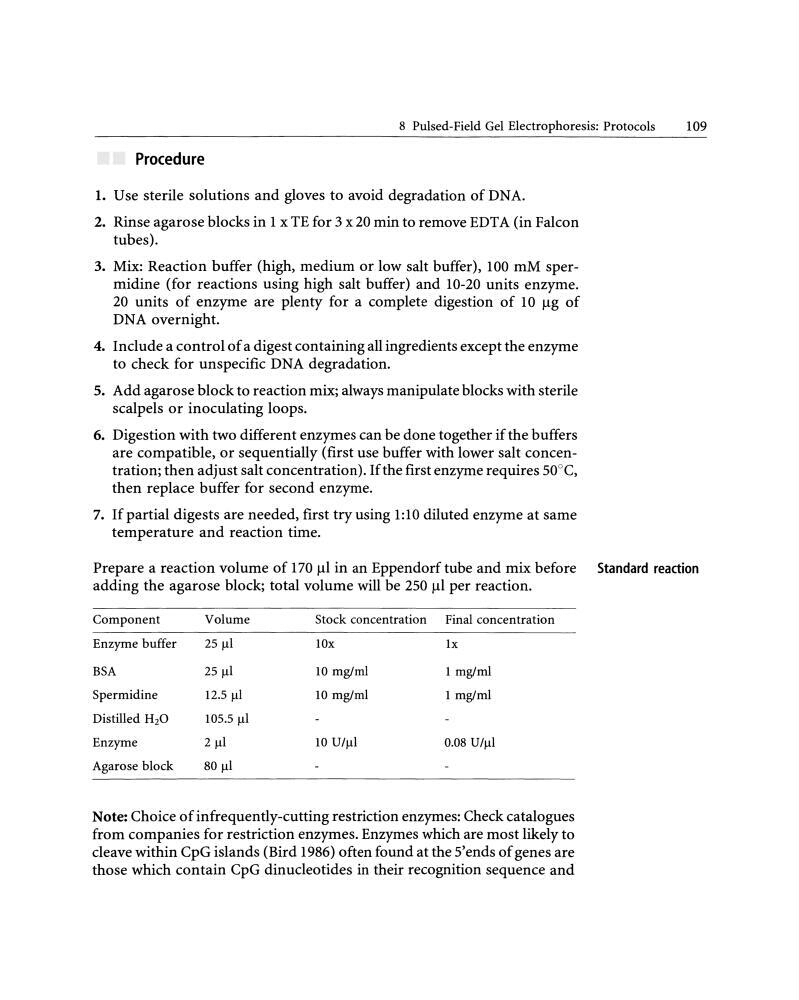
Prepare a reaction volume of 170 )ll in an Eppendorf tube and mix before Standard reaction
adding the agarose block; total volume will be 250 )ll per reaction.
Component
Volume
Stock concentration Final concentration
Enzyme buffer
25 JÜ
lOx
1x
BSA
25JÜ
10 mg/ml
1 mg/ml
Spermidine
12.5 J.!l
10 mg/ml
1 mg/ml
Distilled H20
105.5 J.!l
Enzyme
2 J.!l
10 U/J.!l
0.08 U/J.!l
Agarose block
80 J.!l
Note: Choice of infrequently-cutting restriction enzymes: Check catalogues
from companies for restriction enzymes. Enzymes which are most likely to
cleave within CpG islands (Bird 1986) often found at the S'ends of genes are
those which contain CpG dinucleotides in their recognition sequence and
109
Procedure
1. Use sterile solutions and gloves to avoid degradation of DNA.
2. Rinse agarose blocks in 1 x TE for 3 x 20 min to remove EDTA (in Falcon
tubes).
3. Mix: Reaction buffer (high, medium or low salt buffer), 100 mM spermidine (for reactions using high salt buffer) and 10-20 units enzyme.
20 units of enzyme are plenty for a complete digestion of 10 )lg of
DNA overnight.
4. Include a control of a digest containing all ingredients except the enzyme
to check for unspecific DNA degradation.
5. Add agarose block to reaction mix; always manipulate blocks with sterile
scalpels or inoculating loops.
6. Digestion with two different enzymes can be done together if the buffers
are compatible, or sequentially (first use buffer with lower salt concentration; then adjust salt concentration). If the first enzyme requires 50°C,
then replace buffer for second enzyme.
7. If partial digests are needed, first try using 1:10 diluted enzyme at same
temperature and reaction time.
Prepare a reaction volume of 170 )ll in an Eppendorf tube and mix before Standard reaction
adding the agarose block; total volume will be 250 )ll per reaction.
Component
Volume
Stock concentration Final concentration
Enzyme buffer
25 JÜ
lOx
1x
BSA
25JÜ
10 mg/ml
1 mg/ml
Spermidine
12.5 J.!l
10 mg/ml
1 mg/ml
Distilled H20
105.5 J.!l
Enzyme
2 J.!l
10 U/J.!l
0.08 U/J.!l
Agarose block
80 J.!l
Note: Choice of infrequently-cutting restriction enzymes: Check catalogues
from companies for restriction enzymes. Enzymes which are most likely to
cleave within CpG islands (Bird 1986) often found at the S'ends of genes are
those which contain CpG dinucleotides in their recognition sequence and