

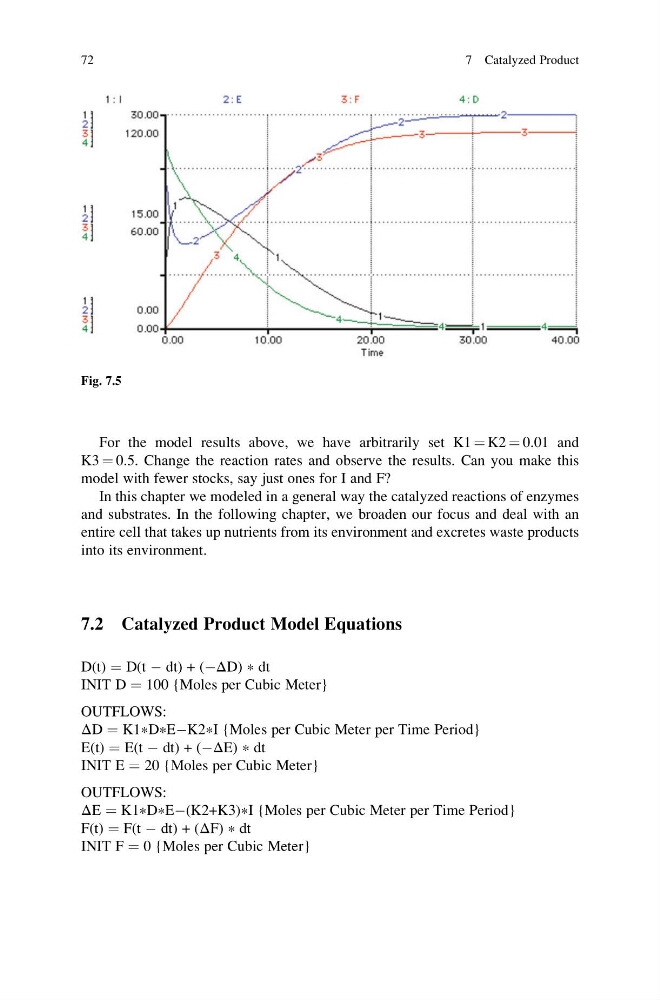
For the model results above, we have arbitrarily set K1 ¼ K2 ¼ 0.01 and
K3 ¼ 0.5. Change the reaction rates and observe the results. Can you make this
model with fewer stocks, say just ones for I and F?
In this chapter we modeled in a general way the catalyzed reactions of enzymes
and substrates. In the following chapter, we broaden our focus and deal with an
entire cell that takes up nutrients from its environment and excretes waste products
into its environment.
7.2 Catalyzed Product Model Equations
D(t) ¼ D(t À dt) + (ÀΔD) * dt
INIT D ¼ 100 {Moles per Cubic Meter}
OUTFLOWS:
ΔD ¼ K1 * D * EÀK2 * I {Moles per Cubic Meter per Time Period}
E(t) ¼ E(t À dt) + (ÀΔE) * dt
INIT E ¼ 20 {Moles per Cubic Meter}
OUTFLOWS:
ΔE ¼ K1 * D * EÀ(K2+K3) * I {Moles per Cubic Meter per Time Period}
F(t) ¼ F(t À dt) + (ΔF) * dt
INIT F ¼ 0 {Moles per Cubic Meter}
Fig. 7.5
72
7 Catalyzed Product
K3 ¼ 0.5. Change the reaction rates and observe the results. Can you make this
model with fewer stocks, say just ones for I and F?
In this chapter we modeled in a general way the catalyzed reactions of enzymes
and substrates. In the following chapter, we broaden our focus and deal with an
entire cell that takes up nutrients from its environment and excretes waste products
into its environment.
7.2 Catalyzed Product Model Equations
D(t) ¼ D(t À dt) + (ÀΔD) * dt
INIT D ¼ 100 {Moles per Cubic Meter}
OUTFLOWS:
ΔD ¼ K1 * D * EÀK2 * I {Moles per Cubic Meter per Time Period}
E(t) ¼ E(t À dt) + (ÀΔE) * dt
INIT E ¼ 20 {Moles per Cubic Meter}
OUTFLOWS:
ΔE ¼ K1 * D * EÀ(K2+K3) * I {Moles per Cubic Meter per Time Period}
F(t) ¼ F(t À dt) + (ΔF) * dt
INIT F ¼ 0 {Moles per Cubic Meter}
Fig. 7.5
72
7 Catalyzed Product