

order to maintain its fitness for that life. Thus, according to the Gaia hypothesis, life
and the environment evolve together as a single system. The species that leaves the
most progeny tend to inherit a particular environment, and in turn, the environment
that favors the most progeny is itself sustained.
There has been little success in finding the feedback mechanisms that regulate
Gaia, but these mechanisms are likely to be subtle and complex. Scientists have
questioned the validity of the Gaia hypothesis for this reason and others. One of the
most important criticisms has been that the active regulation of the environment
that is the central property of Gaia supposes natural selection for traits that will not
be beneficial for thousands of years. But the ecosystem has no capacity for
conscious forethought and planning, and it is clear that the biota would not evolve
altruistic planetary regulation systems in the pursuit of local self-interest. In other
words, if bacteria appear on the Earth’s surface, how can these bacteria regulate the
atmosphere to suit their own needs when they cannot possibly have a significant
effect on the atmosphere’s chemistry for thousands of years? Lovelock chose to
challenge this criticism with a paradigm and a numerical model: Daisyworld. Since
he first proposed the model, he also asserted that Daisyworld fully exhibits all of the
characteristics of a Gaian world.
In our simplified view, Daisyworld is a right cylindrical planet in Earth’s orbit
around a sun of Sol’s luminescence. This planet has a clear atmosphere and is
populated by two life forms: light and dark daisies. Here, albedo is specified as a
unitless measure of the reflectivity of a surface where 1 means perfectly reflective
and 0 means perfectly absorptive. Light daisies have an albedo greater than the
planet surface albedo and dark daisies have an albedo less than that of the planet’s
surface. If there is bare planet surface available, the daisies will grow and cover it,
and change its albedo.
The model of Daisyworld is based on Lovelock’s equations. The original
equations and parameters are listed in Tellus [2]. We briefly present them here.
There are only two stocks in this model, LIGHT DAISY AREA and DARK DAISY
AREA. These stocks represent the fraction of planet surface covered by each type
of daisy (Fig. 44.1).
Growth of the daisy populations is temperature dependent. For each daisy
species, there is a temperature “window” where growth can occur. That window
extends from 5 to 45
C. Within this window, growth is described by the parabola
defined with Eqs. (44.1) and (44.2).
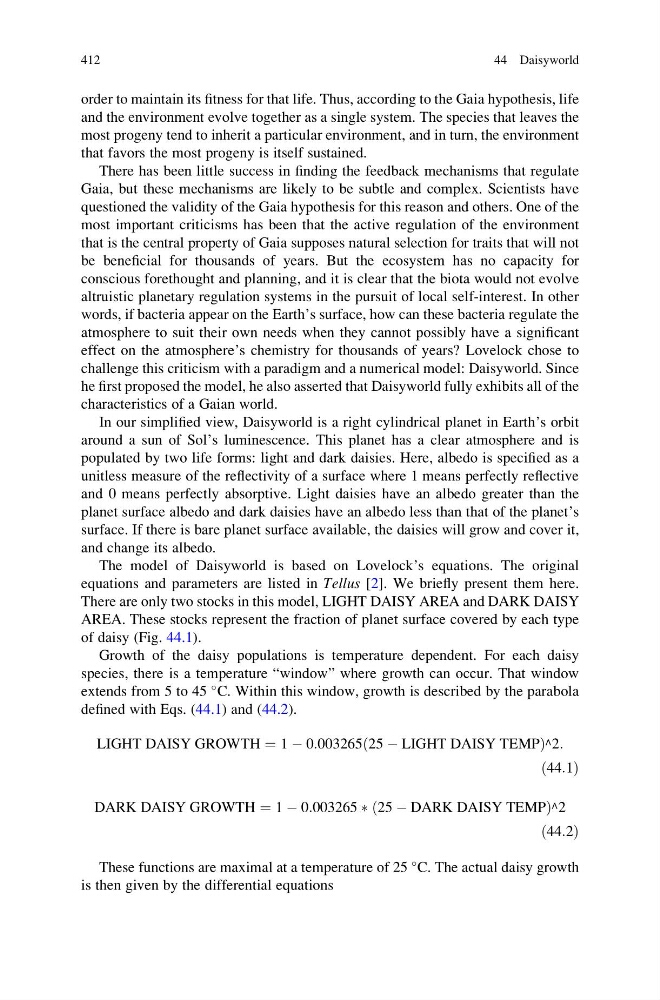
LIGHT DAISY GROWTH ¼ 1 À 0:003265 25 À LIGHT DAISY TEMP
ð
Þ ⋀ 2:
ð44:1Þ
DARK DAISY GROWTH ¼ 1 À 0:003265 Ã 25 À DARK DAISY TEMP
ð
Þ ⋀ 2
ð44:2Þ
These functions are maximal at a temperature of 25
C. The actual daisy growth
is then given by the differential equations
412
44 Daisyworld
and the environment evolve together as a single system. The species that leaves the
most progeny tend to inherit a particular environment, and in turn, the environment
that favors the most progeny is itself sustained.
There has been little success in finding the feedback mechanisms that regulate
Gaia, but these mechanisms are likely to be subtle and complex. Scientists have
questioned the validity of the Gaia hypothesis for this reason and others. One of the
most important criticisms has been that the active regulation of the environment
that is the central property of Gaia supposes natural selection for traits that will not
be beneficial for thousands of years. But the ecosystem has no capacity for
conscious forethought and planning, and it is clear that the biota would not evolve
altruistic planetary regulation systems in the pursuit of local self-interest. In other
words, if bacteria appear on the Earth’s surface, how can these bacteria regulate the
atmosphere to suit their own needs when they cannot possibly have a significant
effect on the atmosphere’s chemistry for thousands of years? Lovelock chose to
challenge this criticism with a paradigm and a numerical model: Daisyworld. Since
he first proposed the model, he also asserted that Daisyworld fully exhibits all of the
characteristics of a Gaian world.
In our simplified view, Daisyworld is a right cylindrical planet in Earth’s orbit
around a sun of Sol’s luminescence. This planet has a clear atmosphere and is
populated by two life forms: light and dark daisies. Here, albedo is specified as a
unitless measure of the reflectivity of a surface where 1 means perfectly reflective
and 0 means perfectly absorptive. Light daisies have an albedo greater than the
planet surface albedo and dark daisies have an albedo less than that of the planet’s
surface. If there is bare planet surface available, the daisies will grow and cover it,
and change its albedo.
The model of Daisyworld is based on Lovelock’s equations. The original
equations and parameters are listed in Tellus [2]. We briefly present them here.
There are only two stocks in this model, LIGHT DAISY AREA and DARK DAISY
AREA. These stocks represent the fraction of planet surface covered by each type
of daisy (Fig. 44.1).
Growth of the daisy populations is temperature dependent. For each daisy
species, there is a temperature “window” where growth can occur. That window
extends from 5 to 45
C. Within this window, growth is described by the parabola
defined with Eqs. (44.1) and (44.2).
LIGHT DAISY GROWTH ¼ 1 À 0:003265 25 À LIGHT DAISY TEMP
ð
Þ ⋀ 2:
ð44:1Þ
DARK DAISY GROWTH ¼ 1 À 0:003265 Ã 25 À DARK DAISY TEMP
ð
Þ ⋀ 2
ð44:2Þ
These functions are maximal at a temperature of 25
C. The actual daisy growth
is then given by the differential equations
412
44 Daisyworld