

Let us now experiment with this set-up and assume that the carrying capacity in
Pond 2 is 180 instead of the 27 assumed in the previous run. Although it is
preferable for the salamander to disperse through forest at a higher survival rate
of dispersal than dispersing through grass, the population of Pond 2 decreases
compared to Ponds 1 and 3 if the habitat is less suitable and has a lower carrying
capacity. This decrease demonstrates a lower cost-benefit ratio of choosing to
disperse through grass rather than forest—even though survival of dispersing
through grass may be lower, it is more beneficial for the overall population in the
long run if juveniles survive because the habitat is more suitable and can maintain a
larger population. These are the results captured in Fig. 38.4.
What would happen in the case of equal carrying capacities of 274 in each of the
three ponds, but Pond 1 suffering suddenly from local extinction? We model the
extinction with conditional statements so that the death rate for each life stage is
100 % for 5 years between time periods 10 and 15. In addition, during those 5 years,
the carrying capacity is set to 1 for the years between 10 and 15, but the usual
274 otherwise. These changes cause the population to crash starting at year 10 and
reaching an adult population low of five individuals and a juvenile population low
of two individuals at year 15 since the other populations are still dispersing to Pond
1 (Fig. 38.5). Once the extinction reaches a low, both the juvenile and adult
populations began increasing almost immediately, leading to a temporary population surge after the local extinction overshoots the carrying capacity. Juvenile and
adult populations then decline and finally stabilize, oscillating around the carrying
capacity much as before.
How would the model results change if all of the ponds have different carrying
capacities? How would the populations vary if each pond had different death rates
and hatching success based upon different environmental factors such as predation,
pH levels, hydrologic period of the ponds, food availability, and temperature?
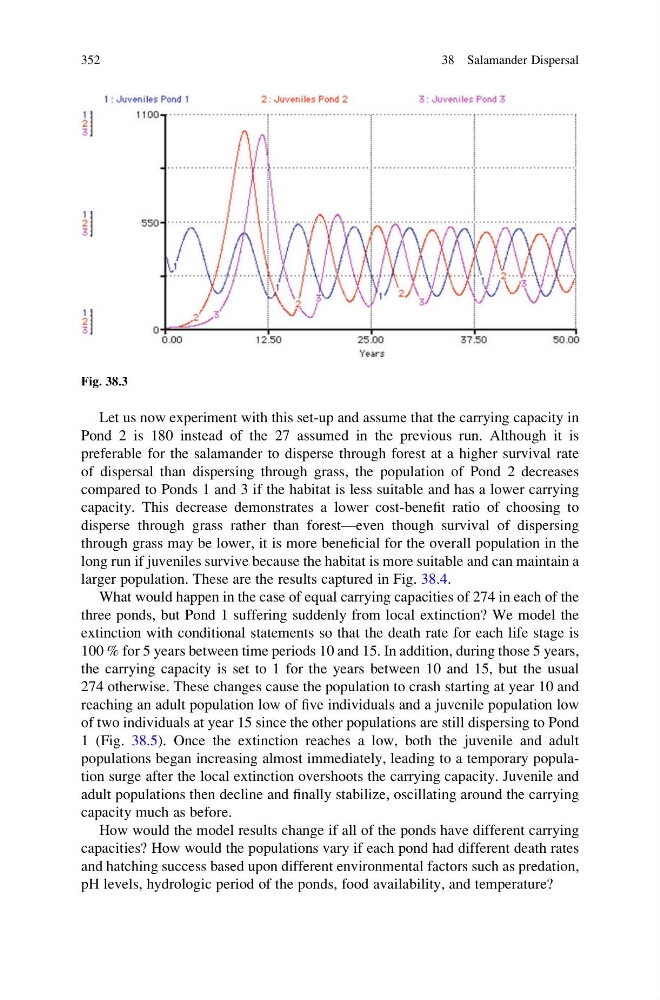
Fig. 38.3
352
38 Salamander Dispersal
Pond 2 is 180 instead of the 27 assumed in the previous run. Although it is
preferable for the salamander to disperse through forest at a higher survival rate
of dispersal than dispersing through grass, the population of Pond 2 decreases
compared to Ponds 1 and 3 if the habitat is less suitable and has a lower carrying
capacity. This decrease demonstrates a lower cost-benefit ratio of choosing to
disperse through grass rather than forest—even though survival of dispersing
through grass may be lower, it is more beneficial for the overall population in the
long run if juveniles survive because the habitat is more suitable and can maintain a
larger population. These are the results captured in Fig. 38.4.
What would happen in the case of equal carrying capacities of 274 in each of the
three ponds, but Pond 1 suffering suddenly from local extinction? We model the
extinction with conditional statements so that the death rate for each life stage is
100 % for 5 years between time periods 10 and 15. In addition, during those 5 years,
the carrying capacity is set to 1 for the years between 10 and 15, but the usual
274 otherwise. These changes cause the population to crash starting at year 10 and
reaching an adult population low of five individuals and a juvenile population low
of two individuals at year 15 since the other populations are still dispersing to Pond
1 (Fig. 38.5). Once the extinction reaches a low, both the juvenile and adult
populations began increasing almost immediately, leading to a temporary population surge after the local extinction overshoots the carrying capacity. Juvenile and
adult populations then decline and finally stabilize, oscillating around the carrying
capacity much as before.
How would the model results change if all of the ponds have different carrying
capacities? How would the populations vary if each pond had different death rates
and hatching success based upon different environmental factors such as predation,
pH levels, hydrologic period of the ponds, food availability, and temperature?
Fig. 38.3
352
38 Salamander Dispersal