

The herbivore growth rate is a product of the herbivore stock and the fractional
herbivore growth rate, FCN HERB GROW. To increase realism of the model, we
make FCN HERB GROW a function of the algae density in the previous time
period (Fig. 35.4). This is done by producing an additional stock called ALGAE
DELAY, shown in Fig. 35.5. In general, it makes sense to represent herbivore
behavior in this way. Herbivore gestation time reflects the origin of this lagged
behavior.
Figure 35.6 shows the wide swings in algal density and herbivore population
over time and Fig. 35.7 presents a plot of algal density against the herbivore
population, which shows the limit cycle resulting from this particular choice of
the variables.
Now it is your turn to try changing things. Can you make the herbivore crash and
not re-emerge? Try to maximize the herbivore population. Can you do this by
adjusting only the variable FCN HERB GROW, without changing the maximum
and minimum rates?
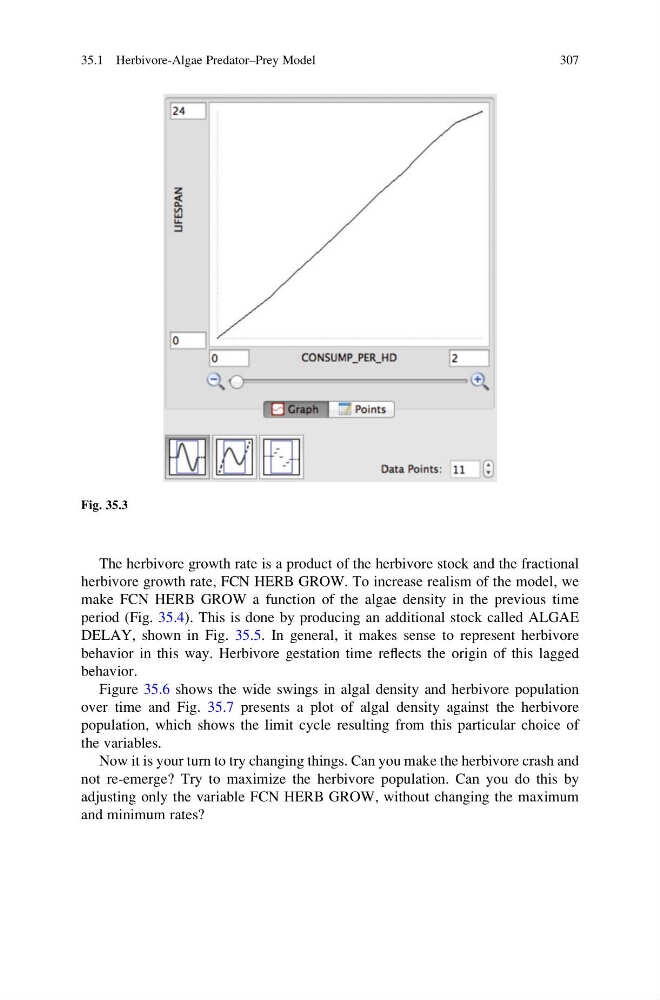
Fig. 35.3
35.1 Herbivore-Algae Predator–Prey Model
307
herbivore growth rate, FCN HERB GROW. To increase realism of the model, we
make FCN HERB GROW a function of the algae density in the previous time
period (Fig. 35.4). This is done by producing an additional stock called ALGAE
DELAY, shown in Fig. 35.5. In general, it makes sense to represent herbivore
behavior in this way. Herbivore gestation time reflects the origin of this lagged
behavior.
Figure 35.6 shows the wide swings in algal density and herbivore population
over time and Fig. 35.7 presents a plot of algal density against the herbivore
population, which shows the limit cycle resulting from this particular choice of
the variables.
Now it is your turn to try changing things. Can you make the herbivore crash and
not re-emerge? Try to maximize the herbivore population. Can you do this by
adjusting only the variable FCN HERB GROW, without changing the maximum
and minimum rates?
Fig. 35.3
35.1 Herbivore-Algae Predator–Prey Model
307