

may be even more evident if we allow each fire to destroy a whole patch, instead of
only a fraction of the patch. If this were the case, the disturbed patch would have to
rely solely on the species from adjacent patches to rebuild its population. It would be
interesting to see if the total landscape could maintain a somewhat steady population
over time, even when whole patches are being eliminated at various times. Set up the
model to investigate this case.
The realization that extreme variation of species presence at the patch (cell) level
results in their steady presence at the aggregate or landscape level seems to be a
unique principle for the science of ecology.
Modify the model of this section to allow the separate patches to have different
colonization rates. How will this affect the overall dynamics of the system? Is it
possible for the system as a whole to support inferior life in patches which would
not be able to support this species on their own?
In this chapter, we captured the competition for space. In the following four
chapters we will model a different type of species interaction as the one modeled
here. There, we will concentrate on predator–prey interactions. The first of these
models deals with algae and herbivore, using hypothetical data. The second is more
elaborate. It is built on real data for grass carp populations. The third predator–prey
model shown below concentrates on population management methods that are built
on predator–prey interactions. Finally, in Chap. 35 we will return to the issue of
spatial dynamics already discussed here in the context of spatial competition.
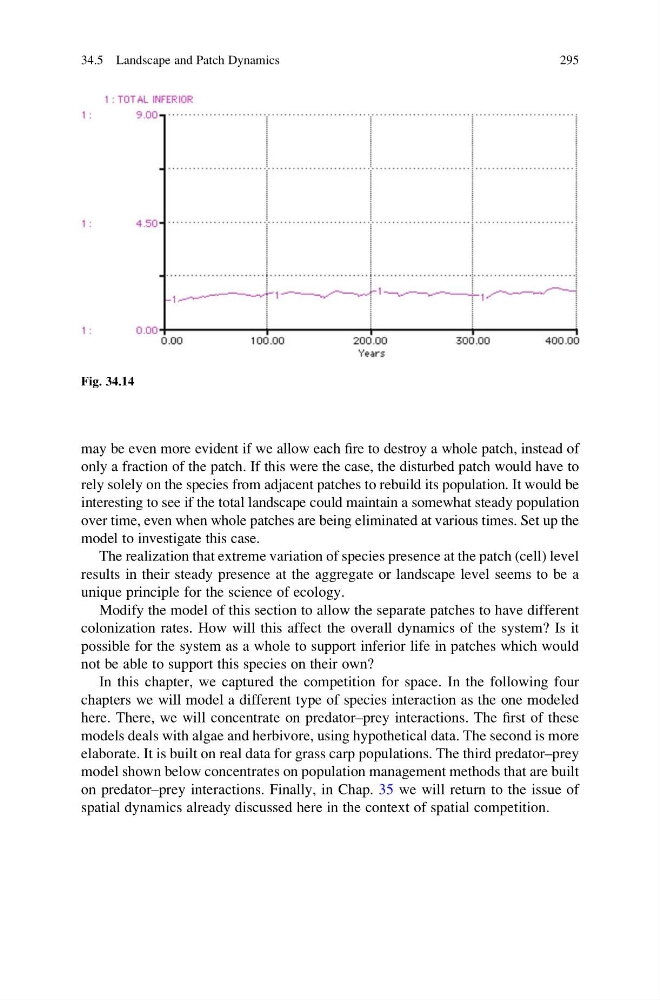
Fig. 34.14
34.5 Landscape and Patch Dynamics
295
only a fraction of the patch. If this were the case, the disturbed patch would have to
rely solely on the species from adjacent patches to rebuild its population. It would be
interesting to see if the total landscape could maintain a somewhat steady population
over time, even when whole patches are being eliminated at various times. Set up the
model to investigate this case.
The realization that extreme variation of species presence at the patch (cell) level
results in their steady presence at the aggregate or landscape level seems to be a
unique principle for the science of ecology.
Modify the model of this section to allow the separate patches to have different
colonization rates. How will this affect the overall dynamics of the system? Is it
possible for the system as a whole to support inferior life in patches which would
not be able to support this species on their own?
In this chapter, we captured the competition for space. In the following four
chapters we will model a different type of species interaction as the one modeled
here. There, we will concentrate on predator–prey interactions. The first of these
models deals with algae and herbivore, using hypothetical data. The second is more
elaborate. It is built on real data for grass carp populations. The third predator–prey
model shown below concentrates on population management methods that are built
on predator–prey interactions. Finally, in Chap. 35 we will return to the issue of
spatial dynamics already discussed here in the context of spatial competition.
Fig. 34.14
34.5 Landscape and Patch Dynamics
295