

disperse their seeds into that portion of the habitable area. Therefore, we need to
calculate I COLONIZES as a function of the presence of inferior species in those
two adjacent regions—INFERIOR 2 and INFERIOR 4.
With these rules, we can begin to model the effects of patch disturbances on the
overall landscape, and how the landscape as a whole responds to this single-patch
disturbance. This result is part of a body of theoretical ecosystem speculation (see,
e.g., [3–7]).
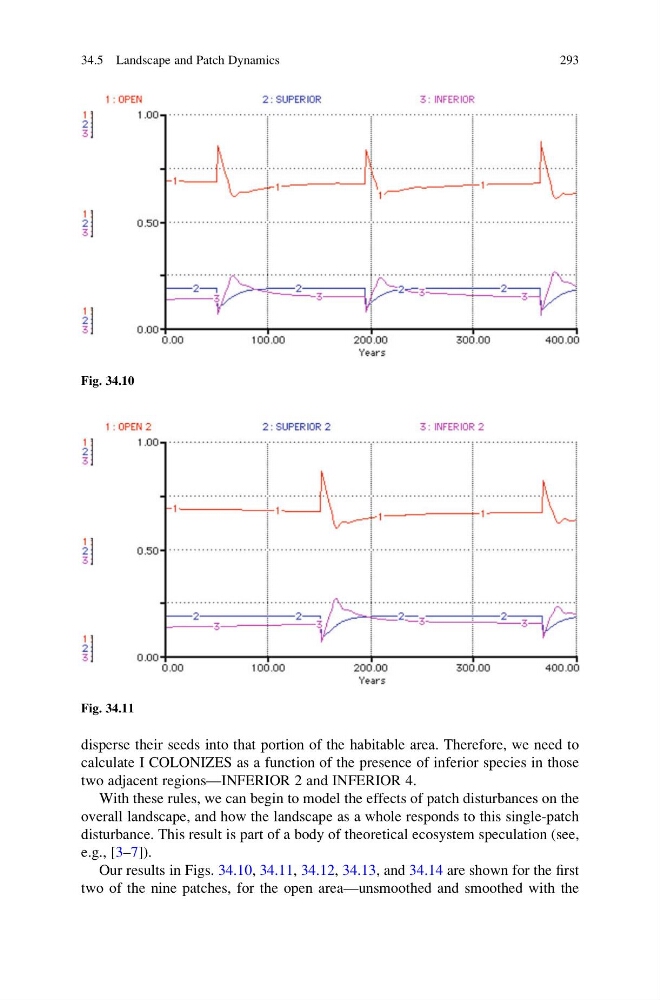
Our results in Figs. 34.10, 34.11, 34.12, 34.13, and 34.14 are shown for the first
two of the nine patches, for the open area—unsmoothed and smoothed with the
Fig. 34.10
Fig. 34.11
34.5 Landscape and Patch Dynamics
293
calculate I COLONIZES as a function of the presence of inferior species in those
two adjacent regions—INFERIOR 2 and INFERIOR 4.
With these rules, we can begin to model the effects of patch disturbances on the
overall landscape, and how the landscape as a whole responds to this single-patch
disturbance. This result is part of a body of theoretical ecosystem speculation (see,
e.g., [3–7]).
Our results in Figs. 34.10, 34.11, 34.12, 34.13, and 34.14 are shown for the first
two of the nine patches, for the open area—unsmoothed and smoothed with the
Fig. 34.10
Fig. 34.11
34.5 Landscape and Patch Dynamics
293