

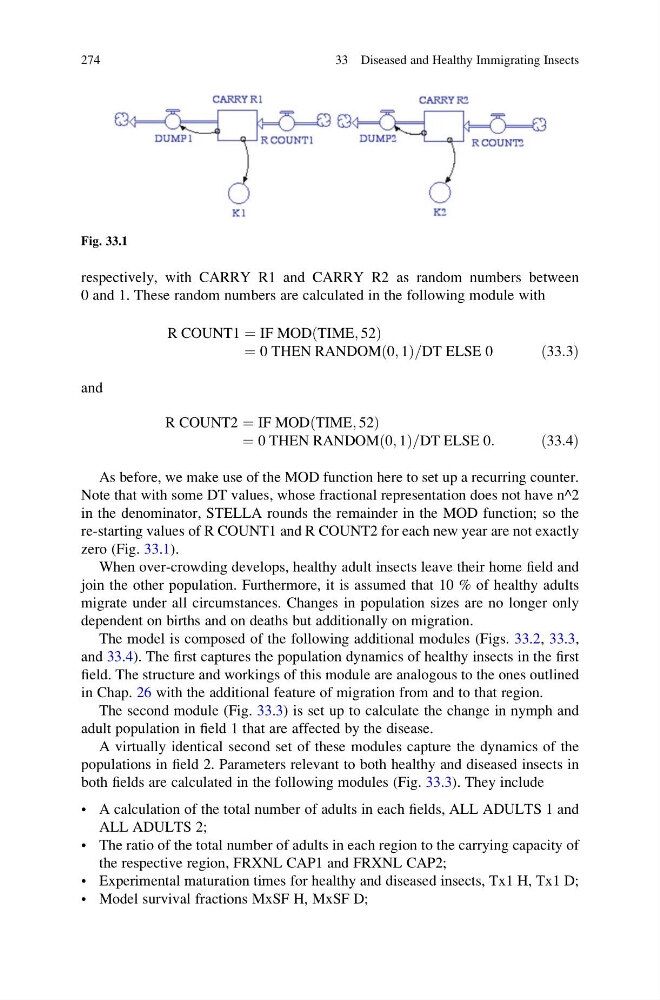
respectively, with CARRY R1 and CARRY R2 as random numbers between
0 and 1. These random numbers are calculated in the following module with
R COUNT1 ¼ IF MOD TIME; 52
ð
Þ
¼ 0 THEN RANDOM 0; 1
ð Þ=DT ELSE 0
ð33:3Þ
and
R COUNT2 ¼ IF MOD TIME; 52
ð
Þ
¼ 0 THEN RANDOM 0; 1
ð Þ=DT ELSE 0:
ð33:4Þ
As before, we make use of the MOD function here to set up a recurring counter.
Note that with some DT values, whose fractional representation does not have n^2
in the denominator, STELLA rounds the remainder in the MOD function; so the
re-starting values of R COUNT1 and R COUNT2 for each new year are not exactly
zero (Fig. 33.1).
When over-crowding develops, healthy adult insects leave their home field and
join the other population. Furthermore, it is assumed that 10 % of healthy adults
migrate under all circumstances. Changes in population sizes are no longer only
dependent on births and on deaths but additionally on migration.
The model is composed of the following additional modules (Figs. 33.2, 33.3,
and 33.4). The first captures the population dynamics of healthy insects in the first
field. The structure and workings of this module are analogous to the ones outlined
in Chap. 26 with the additional feature of migration from and to that region.
The second module (Fig. 33.3) is set up to calculate the change in nymph and
adult population in field 1 that are affected by the disease.
A virtually identical second set of these modules capture the dynamics of the
populations in field 2. Parameters relevant to both healthy and diseased insects in
both fields are calculated in the following modules (Fig. 33.3). They include
• A calculation of the total number of adults in each fields, ALL ADULTS 1 and
ALL ADULTS 2;
• The ratio of the total number of adults in each region to the carrying capacity of
the respective region, FRXNL CAP1 and FRXNL CAP2;
• Experimental maturation times for healthy and diseased insects, Tx1 H, Tx1 D;
• Model survival fractions MxSF H, MxSF D;
Fig. 33.1
274
33 Diseased and Healthy Immigrating Insects
0 and 1. These random numbers are calculated in the following module with
R COUNT1 ¼ IF MOD TIME; 52
ð
Þ
¼ 0 THEN RANDOM 0; 1
ð Þ=DT ELSE 0
ð33:3Þ
and
R COUNT2 ¼ IF MOD TIME; 52
ð
Þ
¼ 0 THEN RANDOM 0; 1
ð Þ=DT ELSE 0:
ð33:4Þ
As before, we make use of the MOD function here to set up a recurring counter.
Note that with some DT values, whose fractional representation does not have n^2
in the denominator, STELLA rounds the remainder in the MOD function; so the
re-starting values of R COUNT1 and R COUNT2 for each new year are not exactly
zero (Fig. 33.1).
When over-crowding develops, healthy adult insects leave their home field and
join the other population. Furthermore, it is assumed that 10 % of healthy adults
migrate under all circumstances. Changes in population sizes are no longer only
dependent on births and on deaths but additionally on migration.
The model is composed of the following additional modules (Figs. 33.2, 33.3,
and 33.4). The first captures the population dynamics of healthy insects in the first
field. The structure and workings of this module are analogous to the ones outlined
in Chap. 26 with the additional feature of migration from and to that region.
The second module (Fig. 33.3) is set up to calculate the change in nymph and
adult population in field 1 that are affected by the disease.
A virtually identical second set of these modules capture the dynamics of the
populations in field 2. Parameters relevant to both healthy and diseased insects in
both fields are calculated in the following modules (Fig. 33.3). They include
• A calculation of the total number of adults in each fields, ALL ADULTS 1 and
ALL ADULTS 2;
• The ratio of the total number of adults in each region to the carrying capacity of
the respective region, FRXNL CAP1 and FRXNL CAP2;
• Experimental maturation times for healthy and diseased insects, Tx1 H, Tx1 D;
• Model survival fractions MxSF H, MxSF D;
Fig. 33.1
274
33 Diseased and Healthy Immigrating Insects