

troop is located. For example, the X variable is initialized as a specific position,
such as the origin of the grid, and updated by ΔX.
The variables TREE X1, TREE Y1, and TREE X2 TREE Y2 draw the outline of
each of the trees present in the plane. VISIBILITY is the specified step distance and
it is used, after the trees are drawn, to calculate the total travel distance from the
starting point to the sighting point of the tree. The controller TARGET calculates
the relation of the troop to the tree circle of a visual influence of 17 m radius. When
this circle is reached, it is assumed that the troop can proceed by sight:
TARGET ¼ IF TIME > 16
ð
ÞAND R1 17
ð
ÞOR R2 17
ð
Þ
ð
Þ THEN 0 ELSE 1
ð28:1Þ
with R1 and R2 as the straight line distance from the troop to the center of tree 1 and
tree 2, respectively. R1 and R2 are defined by
R1 ¼ SQRT X À TREE X1
ð
Þ ^ 2 þ Y À TREE Y1
ð
Þ ^ 2
ð
Þ
ð 28:2Þ
R2 ¼ SQRT X À TREE X2
ð
Þ ^2 þ Y À TREE Y2
ð
Þ ^2
ð
Þ
ð 28:3Þ
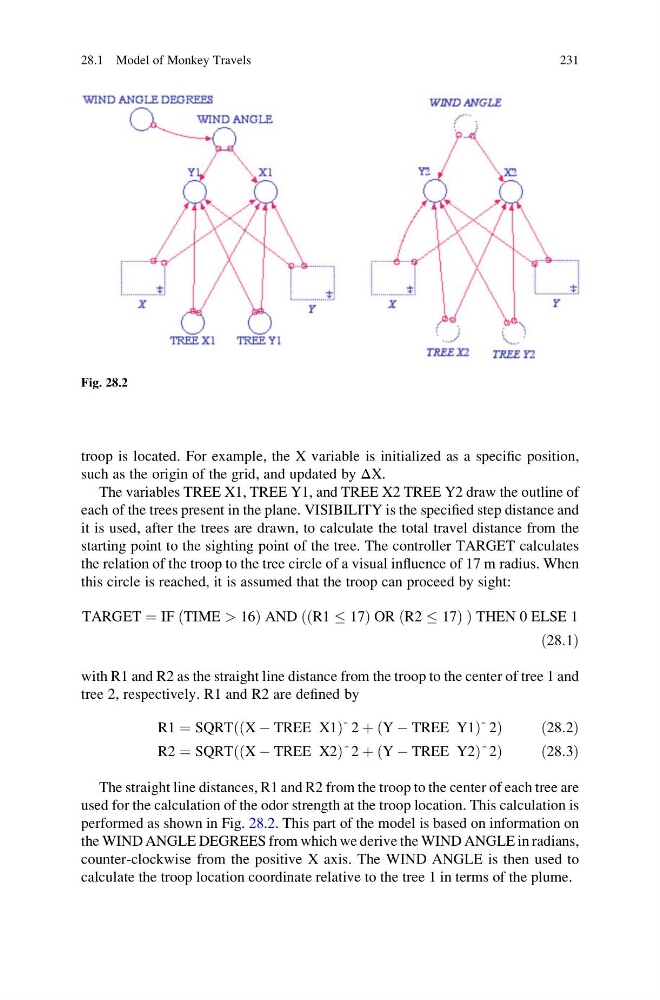
The straight line distances, R1 and R2 from the troop to the center of each tree are
used for the calculation of the odor strength at the troop location. This calculation is
performed as shown in Fig. 28.2. This part of the model is based on information on
the WIND ANGLE DEGREES from which we derive the WIND ANGLE in radians,
counter-clockwise from the positive X axis. The WIND ANGLE is then used to
calculate the troop location coordinate relative to the tree 1 in terms of the plume.
Fig. 28.2
28.1 Model of Monkey Travels
231
such as the origin of the grid, and updated by ΔX.
The variables TREE X1, TREE Y1, and TREE X2 TREE Y2 draw the outline of
each of the trees present in the plane. VISIBILITY is the specified step distance and
it is used, after the trees are drawn, to calculate the total travel distance from the
starting point to the sighting point of the tree. The controller TARGET calculates
the relation of the troop to the tree circle of a visual influence of 17 m radius. When
this circle is reached, it is assumed that the troop can proceed by sight:
TARGET ¼ IF TIME > 16
ð
ÞAND R1 17
ð
ÞOR R2 17
ð
Þ
ð
Þ THEN 0 ELSE 1
ð28:1Þ
with R1 and R2 as the straight line distance from the troop to the center of tree 1 and
tree 2, respectively. R1 and R2 are defined by
R1 ¼ SQRT X À TREE X1
ð
Þ ^ 2 þ Y À TREE Y1
ð
Þ ^ 2
ð
Þ
ð 28:2Þ
R2 ¼ SQRT X À TREE X2
ð
Þ ^2 þ Y À TREE Y2
ð
Þ ^2
ð
Þ
ð 28:3Þ
The straight line distances, R1 and R2 from the troop to the center of each tree are
used for the calculation of the odor strength at the troop location. This calculation is
performed as shown in Fig. 28.2. This part of the model is based on information on
the WIND ANGLE DEGREES from which we derive the WIND ANGLE in radians,
counter-clockwise from the positive X axis. The WIND ANGLE is then used to
calculate the troop location coordinate relative to the tree 1 in terms of the plume.
Fig. 28.2
28.1 Model of Monkey Travels
231