

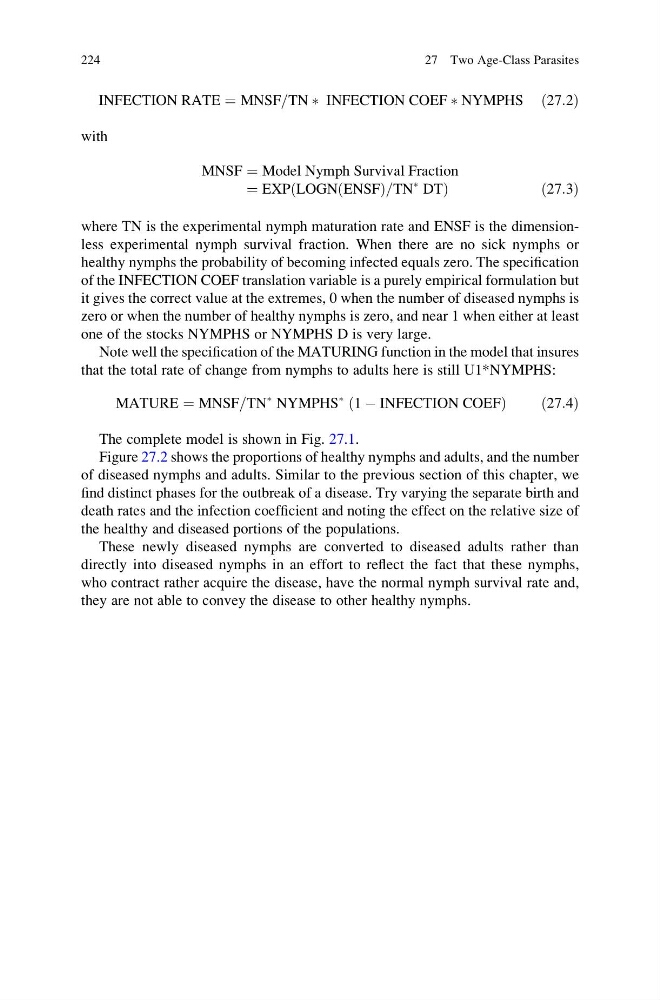
INFECTION RATE ¼ MNSF=TN Ã INFECTION COEF Ã NYMPHS ð27:2Þ
with
MNSF ¼ Model Nymph Survival Fraction
¼ EXP LOGN ENSF
ð
Þ=TN
à DT
ð
Þ
ð 27:3Þ
where TN is the experimental nymph maturation rate and ENSF is the dimensionless experimental nymph survival fraction. When there are no sick nymphs or
healthy nymphs the probability of becoming infected equals zero. The specification
of the INFECTION COEF translation variable is a purely empirical formulation but
it gives the correct value at the extremes, 0 when the number of diseased nymphs is
zero or when the number of healthy nymphs is zero, and near 1 when either at least
one of the stocks NYMPHS or NYMPHS D is very large.
Note well the specification of the MATURING function in the model that insures
that the total rate of change from nymphs to adults here is still U1*NYMPHS:
MATURE ¼ MNSF=TN
à NYMPHS
à 1 À INFECTION COEF
ð
Þ
ð 27:4Þ
The complete model is shown in Fig. 27.1.
Figure 27.2 shows the proportions of healthy nymphs and adults, and the number
of diseased nymphs and adults. Similar to the previous section of this chapter, we
find distinct phases for the outbreak of a disease. Try varying the separate birth and
death rates and the infection coefficient and noting the effect on the relative size of
the healthy and diseased portions of the populations.
These newly diseased nymphs are converted to diseased adults rather than
directly into diseased nymphs in an effort to reflect the fact that these nymphs,
who contract rather acquire the disease, have the normal nymph survival rate and,
they are not able to convey the disease to other healthy nymphs.
224
27 Two Age-Class Parasites
with
MNSF ¼ Model Nymph Survival Fraction
¼ EXP LOGN ENSF
ð
Þ=TN
à DT
ð
Þ
ð 27:3Þ
where TN is the experimental nymph maturation rate and ENSF is the dimensionless experimental nymph survival fraction. When there are no sick nymphs or
healthy nymphs the probability of becoming infected equals zero. The specification
of the INFECTION COEF translation variable is a purely empirical formulation but
it gives the correct value at the extremes, 0 when the number of diseased nymphs is
zero or when the number of healthy nymphs is zero, and near 1 when either at least
one of the stocks NYMPHS or NYMPHS D is very large.
Note well the specification of the MATURING function in the model that insures
that the total rate of change from nymphs to adults here is still U1*NYMPHS:
MATURE ¼ MNSF=TN
à NYMPHS
à 1 À INFECTION COEF
ð
Þ
ð 27:4Þ
The complete model is shown in Fig. 27.1.
Figure 27.2 shows the proportions of healthy nymphs and adults, and the number
of diseased nymphs and adults. Similar to the previous section of this chapter, we
find distinct phases for the outbreak of a disease. Try varying the separate birth and
death rates and the infection coefficient and noting the effect on the relative size of
the healthy and diseased portions of the populations.
These newly diseased nymphs are converted to diseased adults rather than
directly into diseased nymphs in an effort to reflect the fact that these nymphs,
who contract rather acquire the disease, have the normal nymph survival rate and,
they are not able to convey the disease to other healthy nymphs.
224
27 Two Age-Class Parasites